You are here

deep organizing

Understanding Sunrise, Part 1: Strategy

By William Lawrence - Convergence, March 14, 2022

Sunrise Movement made climate change a key political issue, but new conditions require new theory and strategy.

The state of Sunrise Movement, one of the more successful and visible U.S. Left organizations to emerge in the last five years, reflects trends in the broader Left. We hit a high-water mark with Sen. Bernie Sanders’ February 2020 victory in the Nevada caucus. Shortly after, the revenge of the Democratic establishment and the COVID pandemic halted all momentum and put Sunrise into a rear-guard attempt to salvage what could be won in a Biden administration. The underwhelming first year of that administration has left us floundering.

Today, a private and public reckoning is well underway. A new generation of leaders is taking account of Sunrise’s successes and failures, and working to design the next life of the movement. Early Sunrise leaders—of which I am one—are in the process of moving on, and handing over leadership of this youth organization to a more youthful cohort.

As a leader in Sunrise’s development from its founding in 2017 through early 2021, I feel obliged to offer an evaluation of our strategy and methods. My aim is to offer a detailed account of Sunrise’s aims and influences, in order that the next generation of strategist-organizers both inside and outside Sunrise may learn from what we did well, while overcoming our limitations.

You can consider just about every word of this essay as a self-critique and a practice of learning in public. As ever, I write with deep appreciation for all the climate justice fighters who find a place to place their hope amidst the looming dread of this crisis.

Part 1 of this essay, which you are reading now, focuses on Sunrise’s strategy, including our demands, rhetoric, and relation to the US party system. Part 2 will look at Sunrise’s methods of organizing.

I hope these essays not only illuminate our specific choices and why we made them, but demonstrate how the theoretical concepts on which we build our organizations actually shape their development. Sunrise’s successes owe much to the theories underpinning our strategy and methods, and our failures reveal much about where these theories fall short. I hope my reflections on these recent experiences may aid in developing better theory to face the challenges of the 21st century.

Green Union Organizing: Avoiding the "Jobs versus Environment" Trap

By That Green Union Guy - IWW Environmental Union Caucus, February 7, 2022

Note to readers: the intended audience for this piece includes environmental justice activists and/or workers sympathetic to them (and it should go without saying that there may be some overlap between the two):

As the climate and ecological crises deepen front line and working class communities are rising up to oppose the continued capitalist extractivism that continues to render their communities, homes, and sacred lands in to sacrifice zones.

Although this is not a new phenomena, it has been happening more and more. Typically, one of the favorite tricks in the capitalist playbook is to mobilize their employees--very often unionized employees, particularly those represented by conservative [2] business unions [1]--to parrot their corporate talking points, (at public hearings or in various forms of media) and usually these frame the issue as one of community and environment versus workers and jobs. Usually such spin is mostly false, but often the conservative business union officials and the rank file members buy into it. To make matters worse, the mainstream press, which inevitably serves capitalist interests, dutifly repeats and spreads the narrative. Such efforts are intended to isolate the community opposition, and either induce agencies, tasked with regulating the corporations in question, to take the corporate side, or--more likely--to provide cover for regulators already tacitly under industry capture to affirm their favorability towards the industry. The bosses know this trick often works, and they have been using it for over a half century. The trick isn't infallible, however, and this text is intended as a beginning guide on neutralizing its effects.

People's Utility Justice Playbook​

By Yesenia Rivera and Johanna Bozuwa - Energy Democracy Project, October 2021

Have you ever wondered who is in charge of your electricity? And why?

The People’s Utility Justice Playbook has two components:

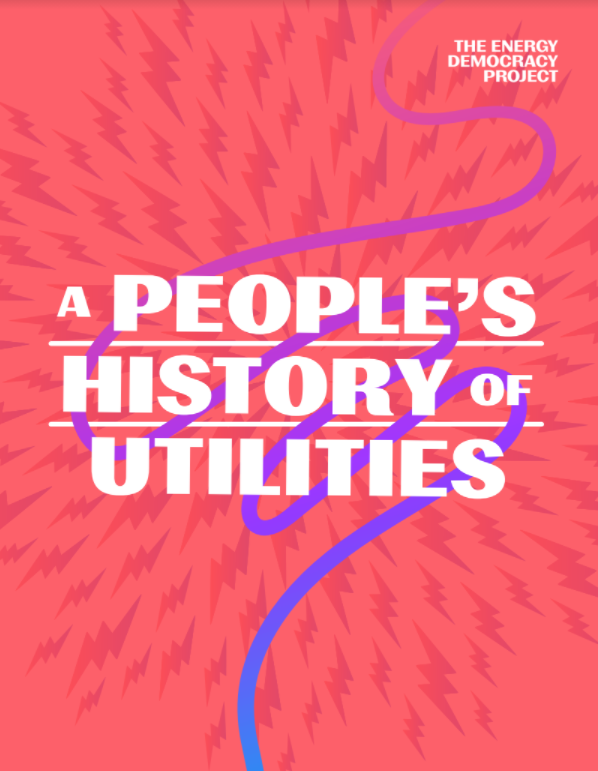
  1. a “History of Utilities” report to summarize the history of utilities for everyone to understand how our current energy system originated.
  2. a “People’s Utility Justice Playbook” to expose the tactics from electric utilities that are undermining community’s efforts, so we can build our organizing strength—to not only fight back but also to build the democratic energy system for climate justice.

This is the basic information we need to fight back against energy utilities attempting to slow or stop progress toward economic and climate justice.

History of Utilities​

Electric utilities have expanded into almost every aspect of our lives to become one of the most powerful and concentrated industries on Earth. To have a better understanding of what we’re fighting against, we first need to learn about the history of energy utilities! This PDF summarizes the entire timeline and how the rise of energy democracy came about.

People's Utility Justice Playbook

In order to fight the industry-owned utilities’ tactics, we need our own strategies for combat!

We have our very own playbook sourced from energy justice activists on the ground. They suggest strategies and tactics they employ when fighting against utilities that anyone fighting against utilities could use!

Read the History (PDF).

Read the Playbook (PDF).

Power, Workers, and the Fight for Climate Justice

By Tara Olivetree (Ehrcke) - Midnight Sun, July 12, 2021

Power

Who has more power than Shell Oil? This is one of the first questions a climate activist should ask themselves, because without finding an answer, we can’t win.

The power of the fossil fuel industry is massive. Fossil fuel companies are worth at least $18 trillion in stock equity, which represents about a quarter of total global stock markets. These vast resources and their outsized share of the world economy allow the industry to continually assert their interests, no matter the destruction this entails. They do so through any means available, of which there are many.

The notorious work of Exxon in first understanding, and then deeply misrepresenting, the science on climate change is one example. After generously funding its own climate research, and being told explicitly in 1977 that global warming due to the burning of fossil fuels was likely to lead to a two- to three-degree increase in global temperatures, Exxon embarked on an industry-wide quest to promote doubt in the science. This lengthy “fake news” campaign cost millions of dollars, and arguably set back the climate movement by decades.

However, the power of the fossil fuel industry goes well beyond the manipulation of global public thought. From the time of the industrial revolution in the 19th century, the history of modern capitalism has been replete with wars fought over fossil fuels. These have served to maintain strategic interests and, just as importantly, the profits of fossil fuel companies. A map of twentieth-century imperial conquest would show the disproportionate number of wars waged in the Middle East, where the world’s largest and cheapest oil deposits lie. As Alan Greenspan, a former chair of the US Federal Reserve, stated about one of these wars: “I am saddened that it is politically inconvenient to acknowledge what everyone knows: the Iraq war is largely about oil.”

How, then, do we go about exerting equivalent force, in order to dismantle the fossil fuel industry within the limited timeline outlined by scientists, while at the same time building an equitable, habitable, and just society?

There are a number of competing answers to this question. 

Bristol Earth Strike: Action for Earth Day

By Earth Strike UK - Bristol Earth Strike, April 21, 2021

What is Earth Day?

Earth Day was started on 22nd April 1970 and has continued annually since then. Each year, on 22nd April, a wide range of events take place globally with the aims of enacting transformative changes to tackle environmental crises and build a sustainable future.

Why is this important?

The International Panel on Climate Change (IPCC) has warned us that we must cut carbon emissions by 45% by 2030, and reach carbon neutrality by 2050, or we risk the planet heating beyond 1.5 degrees. If we fail to curb our carbon emissions and the average global temperature continues to increase, we risk triggering a climate breakdown that we will have no hope of stopping, causing global devastation.

Despite this stark warning by the scientific community, many governments and employers continue to act as if there were no crisis at all.

To bring about the change needed will require holding all sectors of the global economy accountable for their role in the environmental crisis and calling for bold, creative, and impactful solutions. This will require action at all levels, and we as workers have a part to play in ensuring a global just transition, the sustainability of our workplaces, and the compliance of our industries with scientific climate targets.

Regardless of how important you feel the Climate and Ecological emergency is, changes to the economy to address these issues are already happening. We feel it is important that Workers are fully involved in how these changes happen so that they can secure the rights and livelihoods of themselves and future generations.

The Decade of the Green New Deal

By Nikayla Jefferson - The Forge, March 4, 2021

“Are you one of those flat-Earthers?” The young man looked at the flaming Earth at my feet. 

“No,” I laughed. “I’m in the Sunrise Movement, a grassroots youth movement to stop the climate crisis. Can I tell you about our upcoming climate strike?”

It was September 2019. I had just joined Sunrise and was working to grow the San Diego hub through canvassing the local farmers market. The issue: I had no experience and no supplies. I struggled to articulate the what, where, and why as I tried to pin down strangers for their phone number and email. I think it had something to do with the tagline on the back of my shirt: Good Jobs and a Livable Future.

We were approaching the end of the hottest decade in recorded history. I had just graduated college, an experience scarred by the biggest wildfire in state history. I was stricken with climate anxiety and grief, and determined to do something about it. A friend told me about the Green New Deal, a national solution to avert the approaching apocalypse, and I decided to join the Sunrise movement to fight for my generation’s future. 

But when I talked to the man at the farmers market, I found myself explaining CO2 parts per million. I should have pitched my story instead because he said: “No, thanks.”

Eventually, I learned better recruitment tactics — both through trainings with the national organization and my own trial and error — and “No, thanks” began to turn into “Yes, tell me more.” I also expanded my reach beyond the local farmers market. I learned how to recruit online, table events, and give presentations to local schools and organizations. Our hub grew. Soon, we began planning actions, hosting our own trainings and events, and campaigning for local candidates. We became known as the new climate kids. 

My story is the story of so many organizers who have joined the Sunrise Movement over the past four years: young and inexperienced but driven to be the generation to solve the climate crisis. That shared story is why so many of us stay. In Sunrise, we have found a deep sense of understanding and community. 

A Worker's Green New Deal

By Paul Prescod, Lara Skinner, and Zakia Elliot - Science for the People, October 16, 2020

Science for the People's second teach-in on a Worker's Green New Deal. This is the seventh, and final, of our series of virtual teach-ins on A People's Green New Deal. For more information visit this page.

Related magazine article: "Dignity Over Dumping: The Fight for Climate Justice and a Just Transition for Sanitation Workers" by Zakia Elliott, Alison Kenner, and Morgan Sarao. This panel is focused on how to broadly conceptualize and implement a "Worker's Green New Deal." We would like to bring in topics of environmental justice that include workplace issues.

These could include workplace exposure to chemical, biological and other hazards, lack of public and worker education on these topics, inadequate PPEs to protect workers and other such issues. We would like the discussion to address questions like: What would a Green New Deal look like that is centered on workers' rights and is carried out in collaboration with unions and other workers' organizations? How does support for union jobs and the growth of unions, especially in the public sector, lay a strong foundation for protecting our environment and communities?

Living As If Another World Were Possible: Goodbye, David Graeber!

By Daniel Fischer - New Politics, September 9, 2020

Having grown up hearing his father recount experiences in Anarchist-run Barcelona as a Lincoln Brigade volunteer, David Graeber, a renowned anthropologist and organizer, lived according to a lifelong belief that a far fairer world was possible. His father and his mother, a garment worker who was briefly the lead singer in the union-produced Broadway musical Pins and Needles, were Jewish working-class bookworms who filled their shelves with books about radical possibilities. Graeber, born in 1961, recalled:

“There were a lot of books around the house when I was growing up, but almost no books of critique. I mean I’m sure my parents had Capital, at least volume one, but very few books about how awful the world was. They had lots of science fiction, lots of history, and lots of anthropology. I think their attitude was ‘I spent my nine to five working, experiencing how this system sucks for myself; I don’t need to read about that; I want to read about what other ways of existing might be like.’”

This is interesting, because as a public intellectual (who taught at Yale and London School of Economics), Graeber was probably most well known for his social critiques. Heavily influenced by the autonomist Marxist tradition, Graeber viewed neoliberalism as primarily a political project masquerading as an economic one, and he exposed the system’s convoluted methods of keeping people demoralized, resentful, and hopeless about building a better world. These instruments of hopelessness included debt (Debt: The First 5,000 Years), corporate bureaucracy (The Utopia of Rules) and pointless work (Bullshit Jobs: A Theory). Graeber aptly described that last book as “an arrow aimed at the heart of our civilization.” It argued that most of our working hours are not producing anything useful, and that the workweek could easily be reduced to fifteen or even twelve hours if it weren’t for capitalists’ drive to keep us perpetually busy. “The ruling class has figured out that a happy and productive population with free time on their hands is a mortal danger,” he wrote, “Think of what started to happen when this even began to be approximated in the sixties.”

To me, however, Graeber’s more inspiring works focused on discovering and building alternatives. He had a keen eye for spotting utopia in seemingly unlikely places. During field work in highland Madagascar in 1989 to 1991, he found that the IMF-weakened state performed only nominal functions, and communities actually governed themselves with consensus decision-making on most matters. His study of the Iroquois League’s Constitution challenged notions that democracy, feminism, and anarchism are of exclusively European origin. And in contrast to the mass media’s dismissal of “incoherent” U.S. protesters, Graeber’s Direct Action: An Ethnography and The Democracy Project explained how the horizontal structure of the alter-globalization and Occupy Wall Street movements prefigured the world they sought to build. Over the last few years, Graeber championed the direct democracy experiments in Northen Syria (Rojava). And, with co-author David Wengrow, he dismantled the widespread assumption that early civilizations were uniformly hierarchal. To the contrary, “Egalitarian cities, even regional confederacies, are historically quite commonplace.”

You can read in other obituaries how much of an intellectual giant he was. Within his field, Maurice Bloch called him “the best anthropologist of his generation” and his advisor Marshall Sahlins called him “the most creative student I ever had.” When Yale decided to end his contract in 2004, it was clearly due to his involvement in radical direct action, not the quality of his scholarship and teaching.

Going on the Offensive: Movements, Multisectorality, and Political Strategy

By Lusbert Garcia - Black Rose, September 1, 2020

By making a brief analysis of current social movements, we can see that they do not work together, that is, in a synchronous way between movements that operate in different areas of struggle. First off, this article is a complement to the translation of the article “A debate on the politics of alliances [Un debate sobre la política de alianzas]” where I talk in broad strokes about the numerous areas or sectors of struggle and think through how to build a multisectoral movement, that is, a broad movement made up of a network of social movements that work in coordination in different sectors and at the same time are articulated based on the common denominator of autonomy, feminism and anti-capitalism.

We know that the root of all problems lies in the capitalist system and the modern states that support it, and that this economic, political and social system supports a production model based on private ownership of the means of production and private benefit as a fundamental principle. All this constitutes what we know as the structural, and its manifestations in all areas of our lives, which is known as the conjunctural, of which we could mainly highlight: territory, labor, public services, accommodation and repression. When we analyze the political-social space, we must recognize the conjunctural problems that manifest as a consequence of the material structure:

  • The territorial issue would include within it the spheres in which the interests of the class which rules over the territory enter into conflict with those of the working class. It is the physical space in which all struggles will take place, so we can highlight the following areas: neighborhood or district if we talk about cities, rural and land struggles if we talk about undeveloped or non-industrialized areas, and we could even include the national liberation struggles for the self-determination of peoples against imperialism. Environmentalism and food sovereignty would also fall into this category.
  • Labor here would constitute one of the main axes of class conflict. It is the battlefield where capital and labor meet most directly. In this area we can mention the workers’ movement that is articulated around unionism. Although we have to differentiate between unionism that advocates social peace—that model that always leads to class conciliation, betraying the working class—and the revolutionary or class unionism that advocates the exacerbation of class conflict in the workplace.
  • The fight for housing is a movement that goes back a little over a century during the rural exodus caused by industrial development and the creation of working-class neighborhoods. Today, with capitalist restructuring underway again in advanced capitalist countries and those in development, access to housing is again a social problem that affects the working class as it finds itself with less economic capacity to face mortgages and rents, as well as access to decent housing. Faced with this problem, movements against evictions have sprung up in many countries, as did the squatter movement a little earlier.
  • As for state public services, in the face of this phase of capitalist restructuring, markets are increasingly interfering with these services through budget cuts, outsourcing and privatizations. Here we can mention: Education, Health, water and sanitation, public transport, and pensions, among others; and the respective social movements that arise in response to cuts and privatizations, such as the student movement, White Tide [1] and other movements against the privatization of water, the fight against increases in rates on public transport, etc.
  • Last but not least, all opposition movements receive state repression; therefore, it is important that we begin to see repression as an obstacle and a social problem that seeks to curb our social and political activities while serving the ruling class to perpetuate its dominance. In this regard, we must speak about the anti-repression issue and face repression collectively and outside of our own militant circles, as yet another social movement.

Every challenge can be overcome: 6 ideas for getting started

By staff - LibCom, December 13, 2019

There is no time for hopelessness. Here are some ideas for what we can do – now – to fight back against the attacks we know are coming.

The results are in and it 's a solid majority for the most viciously right-wing Tory party in a generation. The time for a proper post-mortem will come, but right now we need to think what we – as a movement and individuals within that movement – do next.

There’s no need to go into great detail about what’s coming because we know: “points-based” migration, seizing travellers’ possessions, and a hard Brexit with their bonfire of rights and regulations are all right there in the manifesto.

And their plans for the NHS and (not) dealing with climate change are clear as day, no matter what they’ve put in the manifesto.

It’s clear, then, that as a class we will have to mobilise. Labour activists have put hundreds of thousands of activist hours – even millions, probably – into campaigning for a Corbyn government: canvassing, phone banking, travelling to marginals; not to mention the past four years of CLP meetings, arguing over deselections and reselections.

Whatever our differences over this use of time, money and energy (we were skeptical), the fact of the matter is this: we cannot spend the next five years like we’ve spent the last four.

When Corbyn became leader of the Labour Party, he and his supporters promised to build a “social movement”. That has, quite plainly, not materialised. Aside from the lack of movement infrastructure (unions, community organisations, etc), the most worrying evidence of this is that 2017 saw the lowest number of workers taking strike action since records began.

We cannot spend the next five years on internal Labour Party politicking in the hopes of possibly winning an election in 2025. The stakes over the next few years are too high. No politician is coming to save us from disaster; the task, as it always has been, is ours alone.

Pages

The Fine Print I:

Disclaimer: The views expressed on this site are not the official position of the IWW (or even the IWW’s EUC) unless otherwise indicated and do not necessarily represent the views of anyone but the author’s, nor should it be assumed that any of these authors automatically support the IWW or endorse any of its positions.

Further: the inclusion of a link on our site (other than the link to the main IWW site) does not imply endorsement by or an alliance with the IWW. These sites have been chosen by our members due to their perceived relevance to the IWW EUC and are included here for informational purposes only. If you have any suggestions or comments on any of the links included (or not included) above, please contact us.

The Fine Print II:

Fair Use Notice: The material on this site is provided for educational and informational purposes. It may contain copyrighted material the use of which has not always been specifically authorized by the copyright owner. It is being made available in an effort to advance the understanding of scientific, environmental, economic, social justice and human rights issues etc.

It is believed that this constitutes a 'fair use' of any such copyrighted material as provided for in section 107 of the US Copyright Law. In accordance with Title 17 U.S.C. Section 107, the material on this site is distributed without profit to those who have an interest in using the included information for research and educational purposes. If you wish to use copyrighted material from this site for purposes of your own that go beyond 'fair use', you must obtain permission from the copyright owner. The information on this site does not constitute legal or technical advice.