You are here

cooperatives

Clean Power to the People

By Al Weinrub - Organizing Upgrade, October 27, 2021

As predicted, the climate has been screaming out with intensified ferocity at the assault on the earth by the global fossil fuel economy. Extreme weather conditions are wreaking havoc on communities across the world, leading many climate activists in the U.S. and elsewhere to declare a climate emergency, requiring an urgent, intensified transition from fossil fuels to renewable energy.

But thinking of this transition as mainly a shift in energy technology, as de-carbonizing the economy, is to misunderstand the deep roots of the climate crisis in an extractive economic system based on racialized social and economic inequality.

Emphasizing de-carbonization of energy without broad institutional transformation—an approach called carbon fundamentalism—leaves us still at the mercy of the corporate energy establishment. That approach, as we shall see, is actually amplifying the already devastating impacts of the climate crisis. “It ignores the specific needs of people of color, it promotes programs that force low-income people to pay unfairly for carbon reduction, it exposes our communities to increased risks, and it sacrifices justice in the urgent rush to reduce carbon,” says Jessica Tovar of the Local Clean Energy Alliance. “Time and again, it ends up throwing people of color under the bus.”

We need more than clean energy to address the climate crisis. We need to move from a large, centralized private utility model to a locally based, decentralized energy model. We need an energy system centered on democracy and justice.

People's Utility Justice Playbook​

By Yesenia Rivera and Johanna Bozuwa - Energy Democracy Project, October 2021

Have you ever wondered who is in charge of your electricity? And why?

The People’s Utility Justice Playbook has two components:

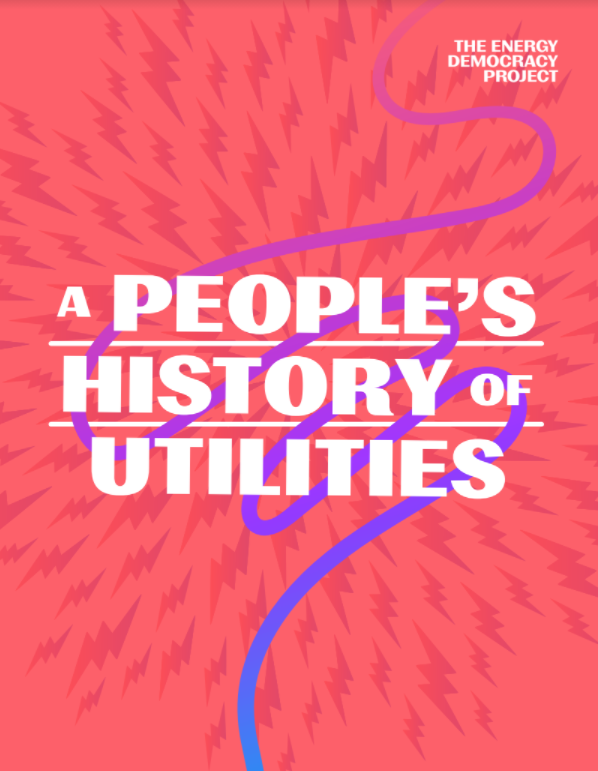
  1. a “History of Utilities” report to summarize the history of utilities for everyone to understand how our current energy system originated.
  2. a “People’s Utility Justice Playbook” to expose the tactics from electric utilities that are undermining community’s efforts, so we can build our organizing strength—to not only fight back but also to build the democratic energy system for climate justice.

This is the basic information we need to fight back against energy utilities attempting to slow or stop progress toward economic and climate justice.

History of Utilities​

Electric utilities have expanded into almost every aspect of our lives to become one of the most powerful and concentrated industries on Earth. To have a better understanding of what we’re fighting against, we first need to learn about the history of energy utilities! This PDF summarizes the entire timeline and how the rise of energy democracy came about.

People's Utility Justice Playbook

In order to fight the industry-owned utilities’ tactics, we need our own strategies for combat!

We have our very own playbook sourced from energy justice activists on the ground. They suggest strategies and tactics they employ when fighting against utilities that anyone fighting against utilities could use!

Read the History (PDF).

Read the Playbook (PDF).

Our Time To Thrive: A Town Hall

Transition from Crisis

By staff - Victorian Trades Hall Council, August 2020

With workers and unions leading the transformation of the economy, we will not only help to avoid the worst effects of climate change, it will lead to a more just society in which workers have a much greater share of the wealth they create. This is a moment in time in which we can reduce inequality, increase control over our own working lives, and have our economy work in the interests of everyday people. Without workers and unions playing this leading role, we risk either climate and economic breakdown or a transformation that is authoritarian, gives priority to the interests of capital over workers, and replicates the economic, social and political injustices that characterise the world today.

There are few more important issues facing workers in Victoria than how our economy is restructured and rebuilt in the wake of the COVID-19 crisis to reduce the risks of climate change and to manage the effects of the warming that is already locked in to the climate system.

Climate change affects all workers, but in different ways. Health professionals like nurses, and emergency services workers like fire fighters and paramedics, are on the frontlines of the response to extreme weather and disasters and at the same time managing the pressures of other crises, like COVID-19. Public sector workers must manage everything from fire reconstruction work to welfare support to coordinating pandemic responses, often after years of federal funding cuts. In drought-affected communities, local workers can be hurt by the economic decline caused by lack of water, which has also led to closures of businesses such as dairy farming. Construction workers and farm workers must deal with the increasing number of hot days, often resulting in a downturn in industry productivity.

COVID-19 and its economic fallout have demonstrated that in times of crisis it is far too often women who disproportionally bear the brunt, both in job losses and also as frontline workers acting in response. It has also shown us that crises – whether climate or health related - exacerbate existing inequities, meaning those in insecure work, the low-paid, the disabled, migrant workers and First Nations communities are disproportionately affected. For instance, the link between insecure employment and the spread of the virus is now acknowledged by health authorities and the Victorian Government: workers without paid sick leave are more likely to go to work while sick. This tells us that in preparing for the challenges and likely crises of the future, including those climate-related, the elimination of these inequities and inequalities must be given high priority.

All of us will have to learn how to cope with a changing climate. But managing the economic restructuring that will be necessary to avoid the worst impacts of climate change will be particularly important for workers and unions. Workers and their unions know only too well what happens when individual firms or industries are restructured without workers or unions having a proper say: it’s workers who pay the price.

Read the text (PDF).

Understanding and Responding to the Changing Nature of Work in the Bay Area

By various - ReWork the Bay, Working Partnerships USA, and Jobs with Justice San Francisco, May 2020

New technologies, accelerating climate change, shifting migration patterns, changes in economic and political norms, and a host of other trends are likely to impact—and indeed already are impacting—key features of work and employment, including management relationships, the types of jobs available, compensation patterns, and other issues that shape the day-to-day lives of working people.

This report presents a framework for understanding why and how work is changing in the San Francisco Bay Area. It provides a scan of strategies that Bay Area workers, communities, businesses, educators and elected leaders are deploying to address changes, and offers a suggested rubric for evaluating the potential effects of such strategies.

In the Bay Area and Silicon Valley, a global epicenter of innovation and extraordinary wealth, low-income communities and communities of color struggle with crises in housing and economic stability, and climate change makes itself felt through increasingly destructive wildfires. If Bay Area funders, advocates, policymakers, and worker organizations ever hope to realize quality, empowered jobs for all, we must be able to articulate how work is changing and identify the systemic interventions that will push change to benefit working people.

Read the text (PDF).

Blueprint for Europe's Just Transition: The Green New Deal for Europe (Edition II)

By various - The Green New Deal for Europe, December 2019

Europe today confronts three overlapping crises.

The first is an economic crisis, with rising levels of poverty, insecurity, and homelessness across the continent. The second is a climate and environmental crisis, with severe consequences for Europe’s front-line communities and even more perilous ones on the horizon. And the third is a crisis of democracy. Across the continent, people are disconnected from the locus of political decision-making not only in Brussels, but also in the communities where they reside.

These crises are products of Europe’s political decisions, and they are closely bound together. The promotion of extractive growth has driven environmental breakdown, and the devotion to budget austerity — over and above the democratic needs expressed in communities across Europe — has constrained our capacity to respond to it.

A radically new approach is necessary to reverse this destructive trend — and to deliver environmental justice in Europe and around the world. We call this approach the Green New Deal for Europe, and the following report is a comprehensive policy pack-age charting a course through Europe’s just transition.

Read the report (PDF).

Energy commons: from energy transition to climate justice

By Cécile Blanchet - ROARMag, June 19, 2019

In 2019, only oil lobbyists and shabby orange politicians persist in denying the influence of human activities on the Earth’s climate. Scientific evidence is piling up and we know that we must change our ways. The concept of energy transition has become mainstream.

However, governments have remained remarkably motionless. They are so inactive that kids have started school strikes and demand climate justice in front of the United Nations’ Conference of Parties. They are so immobile that citizen groups actually sue their governments for their lack of climate action. And when governments attempt to do something, it is so unjust that people take to the streets even during the coldest months of the year, screaming, filled with rage and frustration.

Our leaders have forgotten that the poorer half of our societies should not have to clean up the mess produced by the richest half. That it should not be our kids cleaning up our mess.

Doing It Ourselves

Facing a lack of political will, an interesting and vivid grassroots movement has taken shape to reclaim our energy systems. From households to city politics, and even at the European level, there has been an unprecedented involvement from the public into energy and electricity matters. For example, in the shape of energy cooperatives.

According to the European Federation of renewable energy cooperatives, RESCOOP, there are at present some 1,250 energy communities in which a million people throughout Europe are involved. Through the RESCOOP federation, these groups actively lobby at a European level to bend the legislation towards promoting and supporting energy cooperatives.

This model of energy cooperativism originated in Germany in the late 1990s and was enabled by a set of disruptive laws supporting the production of renewable energy. This bill kick-started the German energy transition (dubbed “Energiewende”), which has become a landmark and is being widely copied.

The two main pillars were defined in the Feed-In Act of 2000: the priority of renewable sources to the grid and feed-in tariffs (fixed prices paid for renewable energy).

The particularity of this framework is that it has enabled small players to enter the game. Citizen cooperatives and households have especially benefited, because a fixed price for each kilowatt hour (KWH) could be sold back to the grid, which gave them more space to invest in new technologies.

From the late 1990s onwards, the number of cooperatives in Germany has grown exponentially, reaching 900 in 2019, representing the majority of energy cooperatives in Europe. It is a model that comes with many advantages. Let’s virtually visit one of these cooperatives together.

Public Finance for the Future We Want (Lavinia Steinfort and Satoko Kishimoto)

By Lavinia Steinfort and Satoko Kishimoto (editors) - Transnational Institute, June 2019

Do you wish to see regenerative, equitable and democratic economies, built with collective power? We believe it is not only necessary but also very possible.Today’s economic system, fueled by an extractivist logic and prone to crises, has reignited and enflamed old monsters of racism, misogyny and other forms of fear and hate. Economic alternatives are needed now more than ever.

This book is about financial alternatives, drawn from real-world examples. It highlights the kinds of models that could become the new normal, building the basis for a democratically organized and life-sustaining future.Before the 2008 global financial crisis, the mantra was ‘there is no alter-native’ to the extractive economic model that has fostered excessive inequality and ecological destruction. Post-crisis, big banks were rescued and the blame misdirected to public spending.

This justified evermore harsh austerity measures, reinforcing the story that the public sector must rely on private finance to solve these ‘collaterals’.More than 10 years later, we know that private finance has not only failed to address these problems, it has intensified them. Civil society needs to unite behind systemic solutions before another financial bubble bursts.

Read the report (PDF).

Where unions and cooperatives meet: the example of Earthworker, Australia

Mark Tyler and Anna Boddenberg - Trade Unions for Energy Democracy, April 7, 2015

We are currently facing two interrelated crises; catastrophic climate change, and massive economic collapse. Those in power are not responding appropriately to this reality. Earthworker, a worker-controlled cooperative movement based in Australia, is one creative response to this situation. In the face of climate change, Earthworker is building sustainable industry. In the face of economic collapse, Earthworker is building secure, dignified jobs in worker-owned cooperatives. In the face of inaction (or unhelpful action) from government and business, Earthworker is building a strategy that can be controlled and enacted from below, by workers and local communities. While the vision is expansive, it is starting the only way it can: from where we are currently standing, and with one step at a time.

At the end of 2014, Earthworker saw the mutualisation of Eureka’s Future in Dandenong, Victoria, Australia. This means a private business was transformed into a worker-owned cooperative factory, manufacturing high-quality hot water tanks. The transition from a traditional, privately-owned enterprise was facilitated by Earthworker, and has taken many years of leg-work. This is the first of a network of worker-owned cooperatives in sustainable industries across Australia that Earthworker will support and build.

Earthworker does not emerge out of a vacuum. The project is a result of years of struggle and draws from the lessons of both the labour and environmental movements. These histories inform and guide Earthworker. Three principles that are key to the project are; 1) a direct action approach of “show me don’t tell me”; 2) an insistence that workers have control over how our labour is used; and 3) a memory that struggles for the emancipation of labour and struggles for environmental justice are sister movements.

A Brief History of Cooperatives in California

By John Curl - Grassroots Economic Organizing, June 11, 2018

COLLECTIVITY IN INDIAN TIMES

For thousands of years the San Francisco Bay Area supported a population of thousands of Ohlones, Miwoks, and Wintuns living in a stable life system based on peaceful collectivity.

The basic societal unit was a tribelet of typically about 250 people. There were about thirty permanent villages scattered around the Bay and into the delta, alongside rivers and creeks. The typical village had about fifteen houses arranged in a circle around a plaza, with a communal sweat lodge. Their houses were dome-shaped, framed with bent willow poles, between about six and twenty feet in diameter, each housing an extended family; the sweat lodges were usually twice as big as the family houses. Besides these main villages, there were other settlements used at different harvest seasons, and families and tribelets moved about throughout the cycle. The bay was also shared with tribelets having their primary villages inland, who made treks here in regular seasons for particular harvests.

Most tribelets spoke different dialects, but all lived in very similar life patterns. Food was readily available, so they lived entirely by hunting and gathering; hunger was entirely unknown. Annual intertwined harvests were connected with rituals and social celebrations oriented toward maintaining balance in the natural world and among people. Among the tribelets there was a complex network of trade, marriage, gift-giving, and ritual feasts. There were occasional conflicts between tribelets or villages, but differences were almost invariably settled with gifts as reparations to wronged parties.

Most hunting and gathering was done by extended families, but periodically they worked in larger communal groups. Communal hunts were invariably followed by great feasts and celebrations. Catches were divided in a ritual manner, with different parts of particular animals going to designated family members, relatives and neighbors.

Each tribelet had an elder man or woman in a chief-like position, but this position held mostly moral authority, and a chief's power varied with the respect commanded by deeds. A new chief was chosen by a consensus of elders, always however from the same family. The chief's main job was to maintain the traditional balances within the village, and tribelet, and with neighboring tribelets. This included seeing to the general welfare of the community. It was considered a great personal shame on the chief if anyone in the tribelet was needy. Cooperation and sharing were virtues, and competitiveness was not. People gained status in the community through generosity. Private property in land was unknown. Families and tribelets had "collecting rights" to particular areas to gather foods, but were expected to be generous to neighbors; should a harvest in one area fail, the unfortunate tribelet or family could traditionally share in the resources of adjoining areas. It was virtually unthinkable to let a neighbor go hungry. The elderly, crippled, sick, and children were well cared for by the village. A person's goods were not handed down in the family after death, but were dispersed or destroyed.

Pages

The Fine Print I:

Disclaimer: The views expressed on this site are not the official position of the IWW (or even the IWW’s EUC) unless otherwise indicated and do not necessarily represent the views of anyone but the author’s, nor should it be assumed that any of these authors automatically support the IWW or endorse any of its positions.

Further: the inclusion of a link on our site (other than the link to the main IWW site) does not imply endorsement by or an alliance with the IWW. These sites have been chosen by our members due to their perceived relevance to the IWW EUC and are included here for informational purposes only. If you have any suggestions or comments on any of the links included (or not included) above, please contact us.

The Fine Print II:

Fair Use Notice: The material on this site is provided for educational and informational purposes. It may contain copyrighted material the use of which has not always been specifically authorized by the copyright owner. It is being made available in an effort to advance the understanding of scientific, environmental, economic, social justice and human rights issues etc.

It is believed that this constitutes a 'fair use' of any such copyrighted material as provided for in section 107 of the US Copyright Law. In accordance with Title 17 U.S.C. Section 107, the material on this site is distributed without profit to those who have an interest in using the included information for research and educational purposes. If you wish to use copyrighted material from this site for purposes of your own that go beyond 'fair use', you must obtain permission from the copyright owner. The information on this site does not constitute legal or technical advice.