You are here

Canada

As coal dies, the US has no plan to help the communities left behind

By Emily Pontecorvo - Grist, March 3, 2021

Here are two tales of the energy transition unfolding in coal country, USA.

In late 2019, Pacificorp, an electric utility that operates in six Western states, told Wyoming regulators it wanted to shut down several of its coal-fired power plants early and replace them with wind and solar power and battery storage. It said this plan would save customers hundreds of millions of dollars on their electric bills and promised to work with local leaders on transition plans for workers and communities affected by the closures.

Wyoming, a state whose economy relies significantly on coal mining and coal power, went on the defensive. State lawmakers had already passed a law requiring coal plant owners to search for a buyer before being allowed to close a plant. Now, with support from the governor, regulators ordered an unprecedented investigation to scrutinize Pacificorp’s analysis and conclusions. Ultimately they determined the plan was deficient — that the company had not adequately considered allowing the coal plants to stay open or installing technology to capture the plants’ carbon emissions.

Climate Emergency: A 26-Week Transition Program for Canada

By Guy Dauncy - Canada 26 Weeks, March 2020

This is a work of imagination. But the urgency of the crisis is real, the need for the suggested programs is real, and the data included in these proposals is real.

What could the government of Canada do if its Ministers, MPs and civil servants really understood the severity of the climate emergency, and the urgency of the need? This paper shows how we could target a 65% reduction in emissions by 2030 and 100% by 2040. It proposes 164 new policies and programs, financed by $59 billion a year in new investments, without raising taxes or increasing public sector borrowing. The new programs and policies are announced every Monday morning between January and the end of June. To learn what they are, read on.

Read the text (PDF).

A Material Transition: Exploring supply and demand solutions for renewable energy minerals

By Andy Whitmore - War on Want, March 2021

There is an urgent need to deal with the potential widespread destruction and human rights abuses that could be unleashed by the extraction of transition minerals: the materials needed at high volumes for the production of renewable energy technologies. Although it is crucial to tackle the climate crisis, and rapidly transition away from fossil fuels, this transition cannot be achieved by expanding our reliance on other materials. The voices arguing for ‘digging our way out of the climate crisis’, particularly those that make up the global mining industry, are powerful but self-serving and must be rejected. We need carefully planned, lowcarbon and non-resource-intensive solutions for people and planet.

Academics, communities and organisations have labelled this new mining frontier, ‘green extractivism’: the idea that human rights and ecosystems can be sacrificed to mining in the name of “solving” climate change, while at the same time mining companies profit from an unjust, arbitrary and volatile transition. There are multiple environmental, social, governance and human rights concerns associated with this expansion, and threats to communities on the frontlines of conflicts arising from mining for transition minerals are set to increase in the future. However, these threats are happening now. From the deserts of Argentina to the forests of West Papua, impacted communities are resisting the rise of ‘green extractivism’ everywhere it is occurring. They embody the many ways we need to transform our energy-intense societies to ones based on democratic and fair access to the essential elements for a dignified life. We must act in solidarity with impacted communities across the globe.

This report includes in-depth studies written by frontline organisations in Indonesia and Philippines directly resisting nickel mining in both countries respectively. These exclusive case studies highlight the threats, potential impacts and worrying trends associated with nickel mining and illustrate, in detail, the landscape for mining expansion in the region.

Read the text (PDF).

How will electrification of vehicles impact auto workers?

By Elizabeth Perry - Work and Climate Change Report, February 23, 2021

Threats to traditional auto manufacturers are outlined in “The top trends killing the auto industry” in Corporate Knights (Feb. 3), including the climate crisis, the fall of fossil fuels, electrification and autonomous EV fleets, unfunded pension liabilities (US$14.4 billion for G.M., US$10.2 billion for Ford), as well as shifting government policies, and dampened demand in general. All the more reason to celebrate the good news about investment in EV production in Canada by GM, Ford and Fiat-Chrysler , as well as GM’s January 2021 announcement that it will sell only zero emissions vehicles by 2035. In February, Ford announced its target to sell EV’s only in Europe. But the good news is complicated, as described in “Auto industry peers into an electric future and sees bumps ahead” (Washington Post, Feb. 6) , and by “Canada and the U.S. auto sector’s abrupt pivot to electric vehicles” (National Observer, Feb. 15) . For Canada, the challenges include competition for the development of battery technology and the policy challenge of the new “Made in America” Executive Order by President Biden on January 25. Despite the brief and optimistic overview presented in “Jerry on the Job: How the president of Canada’s largest union, Jerry Dias, is driving the country’s electric vehicle push” (Corporate Knights, Feb. 4), our highly integrated North American auto industry has a complicated path forward. 

One of the most important issues ahead is how the conversion to electric vehicles will impact the jobs of current auto workers. In late 2020, Germany’s Fraunhofer Institute for Industrial Engineering conducted a detailed study of this issue on behalf of the Sustainability Council of the Volkswagen Group. Employment 2030 Effects Of Electric Mobility And Digitalisation on the Quality and Quantity of Employment at Volkswagen (Nov. 2020) is an English-language summary of the full, detailed study, which modelled the impacts of digitization and electrification in the industry. Although the study is specific to VW production in Germany, its findings are instructive, and include that job losses will be less than anticipated, ( a decrease of 12 percent in this decade, mainly due to planned output volumes and higher productivity). Digitization will result in a need for new skills, “will necessitate a profound change in corporate culture”, and will include higher employee expectations for job flexibility. A summary appearing in Clean Energy Wire states: “ …. there is no uniform employment trend in the ‘transformation corridor’ over the coming decade. Instead, there will be a complex, interconnected mixture of job creation, job upgrading and job cuts. It argues that it will be vital to ensure that small and medium-sized enterprises (SMEs) do not fall victim to this reorganisation, and warns that Germany’s automotive sector must establish new forms of cooperation so as not to “recklessly surrender the field of mobility to new market players.” The study is also summarized in a press release by VW (with links to the full study in German).

Canadian university pension funds unite for low carbon goals, and public sector pension funds across the country act on sustainability

By Elizabeth Perry - Work and Climate Change Report, February 22, 2021

With the goal to leverage their collective financial clout, Canadian university endowment funds and pension plans launched the University Network for Investor Engagement (UNIE) on February 18. Working through SHARE, Canada’s leading not-for-profit in responsible investment services, “The UNIE initiative will focus on key sectors where advocacy can make the biggest difference, including finance, transportation, energy and utilities, and manufacturing, focusing both on reducing greenhouse gas emissions and accelerating the transition to a low carbon economy.” Initial participants include Carleton University, Concordia University, McGill University, McMaster University, Mount Alison University, Université de Montreal, University of St. Michael’s College, University of Toronto Asset Management, University of Victoria, and York University.

This development follows on a number of statements and initiatives by Canadian pension administrators – most of which reflect this general strategy to prefer engagement as shareholders over divestment from fossil fuel holdings. Some examples:

In November 2020, the CEOs of Canada’s eight major pension administrators, with approximately $1.6 trillion in assets under management, issued a press release announcing their joint position statement, Companies and investors must put sustainability and inclusive growth at the centre of economic recovery. The text calls on companies to provide consistent and complete environmental, social, and governance (ESG) information, and continues: “For our part, we continue to strengthen our own ESG disclosure and integration practices, and allocate capital to investments best placed to deliver long-term sustainable value creation.” The signatories included: AIMCo, BCI, Caisse de dépôt et placement du Québec, CPP Investments, HOOPP, OMERS, Ontario Teachers’ Pension Plan, and PSP Investments.

Why are Ontario pensioners investing in future Alberta stranded assets?” (in Corporate Knights, December 16, 2020) describes investment by OP Trust (which holds the pension funds of Ontario civil servants, teachers and healthcare workers) in a natural gas electricity-generation plant in Alberta. The authors summarize the growing global realization that fossil fuel investments are financially risky and conclude, “The people at OPTrust have begun to recognize this. They’ve created multiple reports, with pretty graphs and rosy statements about supporting the Paris Agreement. But this statement rings out: “Emission reduction targets are not today’s objective.” Like many other organizations, they are unwilling to walk the talk.”

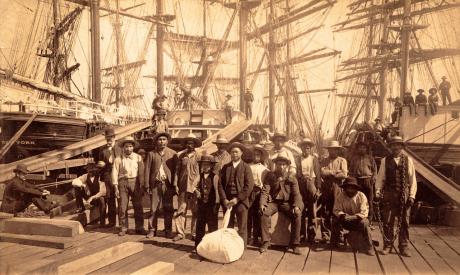
Bows and Arrows: Indigenous Workers, IWW Local 526, and Syndicalism on the Vancouver Docks

By Jeff Shantz - LibCom.Org, February 17, 2021

Few may be aware that the first union on the waterfront of Vancouver was organized by Indigenous workers, mostly Squamish and Tsleil-Waututh. And it was organized on an explicitly syndicalist basis as Local 526 of the Industrial Workers of the World (IWW). The IWW group would become known as the Bows and Arrows, a name that spoke to their active and more politically militant perspective and commitment to Indigenous solidarity. The Bows and Arrows organized on a multicultural/multiracial foundation of class solidarity.

While the lifespan of IWW Local 526 was brief (formally only a year while informally for about seven years) it had a lasting impact on working class organizing on the waterfront, anti-racism and racial solidarity on the docks, and on political organizing in Indigenous communities. It also showed the pivotal role of organizing within the logistical chains of global capitalism in sabotaging resource extractive industries, while providing a model of work organization that sustained community relevant work and work cycles rather than the single career monoculture of industrial capitalism at the time.

As historian Andrew Parnaby suggests, the Bows and Arrows:

"Join[ed] in the broader upsurge of support for the Wobblies that took place among loggers, miners, railroad workers, and seafarers prior to the Great War…Reformers, rebels, and revolutionaries: collectively, they were responsible for a level of militancy on the waterfront that was unmatched by most other occupations, provincially or nationally. Vancouver waterfront workers went on strike at least sixteen times between 1889 and 1923; the four largest and most dramatic strikes were in 1909, 1918, 1919, and 1923." (2008, 9)

While Local 526 would finally be broken through battles with waterfront employers that have been described as titanic, these workers provided important and lasting examples of working class militance, workplace organizing tactics, racial solidarity and anti-racism, and cultural defense. They offer a critical model of syndicalism in diverse workforces and changing economic conditions within a context of settler colonial capitalism.

Canadian steel, concrete, aluminum and wood: low carbon solutions for public infrastructure

By Elizabeth Perry - Work and Climate Change Report, February 2, 2021

In a February 1 press release, Ken Neumann, National Director for Canada of the United Steelworkers says, “We need our governments to support the creation and retention of good jobs by strengthening Canadian industrial and manufacturing capacities in ways that support the low-carbon transition of the economy”. To support that point, Blue Green Canada has released a new report, Buy Clean: How Public Construction Dollars can create jobs and cut pollution . Buy Clean calls for the use of Canadian-made building products in infrastructure in order to reap the dual benefit of reducing carbon emissions and supporting local industry and jobs. The USW press release continues: “Buy Clean makes sense for Canada because it leverages our carbon advantage. Whether its steel, aluminum, cement or wood, building materials sourced from within Canada are typically lower carbon than imported materials” – thanks largely to our low-emissions energy supply and reduced transportation costs. The report recommends that all levels of government continue and expand the use of Buy Clean policies for procurement. The report also calls for an Industrial Decarbonization Strategy to encourage technological innovation in the manufacture of steel, aluminum, concrete and wood , and for a “Clean Infrastructure Challenge Fund” , to act as a demonstration fund modelled on the Low Carbon Economy Challenge, but available only for public infrastructure projects, not to private industry.

Buy Clean: How Public Construction Dollars can create jobs and cut pollution is also available in a French-language version, Acheter Propre: Créer des emplois et réduire la pollution par une utilisation judicieuse des fonds publics en construction . The report includes appendices for each of the sectors, providing brief but specific summaries of how Canadian industry has already achieved lower carbon processes than their competitors – particularly in steel and aluminum, and what further decarbonization opportunities remain.

The Buy Clean message seems closely related to the Stand Up for Steel national campaign by the United Steelworkers, which also calls for the use of Canadian-made steel in infrastructure projects. After the disruptive tariffs levied by the previous U.S. administration, the Stand up for Steel Action Plan also calls for the right for unions to initiate trade cases; for expanding the definition of ‘material injury’ in trade cases; and for a carbon border adjustment on imported steel.

Overwhelming odds, unexpected alliances and tough losses: how defeating Keystone XL built a bolder, savvier climate movement

By Nick Engelfried - Waging Nonviolence, January 29, 2021

When President Biden rescinded a crucial permit for the Keystone XL pipeline last week, it marked the culmination of one of the longest, highest-profile campaigns in the North American climate movement. The opposition to Keystone XL included large environmental organizations, grassroots climate activist networks, Nebraska farmers, Texas landowners, Indigenous rights groups and tribal governments. Few environmental campaigns have touched so many people over such large swaths of the continent.

The Keystone XL resistance was part of the ongoing opposition to the Canadian tar sands, one of the most carbon-intensive industrial projects on the planet. Yet, it came to symbolize something even bigger. Many activists saw stopping Keystone XL as a measure of success for the climate movement itself.

“Keystone XL isn’t just any project,” said longtime activist Matt Leonard, who coordinated several major protests against the pipeline. “Its defeat is a testament to what movement building and direct action can accomplish.”

A stroke of President Biden’s pen finally killed Keystone XL. But paving the way for this victory were countless battles at the grassroots level, where activists tested new tactics and organizing strategies that built a bolder, savvier climate movement. Some of the groups involved took radically different approaches to politics, leading to unexpected alliances and occasional bitter feuds. And there were losses — other major oil pipelines, including the southern leg of Keystone XL itself, were completed even as the fight over the more famous northern half dragged on.

Yet, resistance to the Keystone XL’s northern leg succeeded against overwhelming odds. While there is always a possibility it could be resurrected someday, chances of that happening anytime soon seem slim. Understanding how this victory happened — and what it means for the climate movement — requires examining how 10-plus years of tar sands resistance played out in far-flung parts of North America.

How “clean” are clean energy and electric vehicles?

By Elizabeth Perry - Work and Climate Change Report, January 19, 2021

Several articles and reports published recently have re-visited the question: how “clean” is “clean energy”? Here is a selection, beginning in October 2020 with a multi-part series titled Recycling Clean Energy Technologies , from the Union of Concerned Scientists. It includes: “Wind Turbine blades don’t have to end up in landfill”; “Cracking the code on recycling energy storage batteries“; and “Solar Panel Recycling: Let’s Make It Happen” .

The glaring problem with Canada’s solar sector and how to fix it” (National Observer, Nov. 2020) states that “While solar is heralded as a clean, green source of renewable energy, this is only true if the panels are manufactured sustainably and can be recycled and kept out of landfills.” Yet right now, Canada has no capacity to recycle the 350 tonnes of solar pv waste produced in 2016 alone, let alone the 650,000 tonnes Canada is expected to produce by 2050. The author points the finger of responsibility at Canadian provinces and territories, which are responsible for waste management and extended producer responsibility (EPR) regulations. A description of solar recycling and waste management systems in Europe and the U.S. points to better practices.

No ‘green halo’ for renewables: First Solar, Veolia, others tackle wind and solar environmental impacts” appeared in Utility Drive (Dec. 14) as a “long read” discussion of progress to uphold environmental and health and safety standards in both the production and disposal of solar panels and wind turbine blades. The article points to examples of industry standards and third-party certification of consumer goods, such as The Green Electronics Council (GEC) and NSF International. The article also quotes experts such as University of California professor Dustin Mulvaney, author of Solar Power: Innovation, Sustainability, and Environmental Justice (2019) and numerous other articles which have tracked the environmental impact, and labour standards, of the solar energy industry.

Regarding the recycling of wind turbine blades: A press release on December 8 2020 describes a new agreement between GE Renewable Energy and Veolia, whereby Veolia will recycle blades removed from its U.S.-based onshore wind turbines by shredding them at a processing facility in Missouri, so that they can be used as a replacement for coal, sand and clay in cement manufacturing. A broader article appeared in Grist, “Today’s wind turbine blades could become tomorrow’s bridges” (Jan. 8 2021) which notes the GE- Veoli initiative and describes other emerging and creative ways to deal with blade waste, such as the Re-Wind project. Re-Wind is a partnership involving universities in the U.S., Ireland, and Northern Ireland who are engineering ways to repurpose the blades for electrical transmission towers, bridges, and more. The article also quotes a senior wind technology engineer at the National Renewable Energy Laboratory in the U.S. who is experimenting with production materials to find more recyclable materials from which to build wind turbine blades in the first place. He states: “Today, recyclability is something that is near the top of the list of concerns” for wind energy companies and blade manufacturers alike …. All of these companies are saying, ‘We need to change what we’re doing, number one because it’s the right thing to do, number two because regulations might be coming down the road. Number three, because we’re a green industry and we want to remain a green industry.’”

These are concerns also top of mind regarding the electric vehicle industry, where both production and recycling of batteries can be detrimental to the planet. The Battery Paradox: How the electric vehicle boom is draining communities and the planet is a December 2020 report by the Dutch Centre for Research on Multinational Corporations (SOMO). It reviews the social and environmental impacts of the whole battery value chain, (mining, production, and recycling) and the mining of key minerals used in Lithium-ion batteries (lithium, cobalt, nickel, graphite and manganese). The report concludes that standardization of battery cells, modules and packs would increase recycling rates and efficiency, but ultimately, “To relieve the pressure on the planet, …. any energy transition strategy should prioritize reducing demand for batteries and cars… Strategies proposed include ride-sharing, car-sharing and smaller vehicles.”

Principles and best practices for a Just Transition for Canada’s fossil fuel workers

By Elizabeth Perry - Work and Climate Change Report, January 19, 2021

Economist Jim Stanford has written a timely new report which should be required reading for politicians setting their hair on fire about Joe Biden’s stated intention to cancel the Keystone XL pipeline project on Day one of his presidency. Employment Transitions and the Phase-Out of Fossil Fuels, released on January 18, argues that “the actual number of fossil fuel jobs and the number of communities reliant on the industry is small enough that a just and equitable transition plan for workers is very feasible” – and the key is timing.

Stanford’s report begins by setting out the statistics regarding fossil fuel employment in Canada: “under 1% of total payroll employment in Canada (or about 160,000 jobs) is located in seven industrial sectors which together comprise most of the composite fossil fuel industry. “ Using 2016 Census data, the report discusses the distribution of fossil fuel jobs by province and community, showing that Alberta accounts for 75% of fossil-related jobs in 2016, but even there, only it accounts for 7% of all provincial employment. 18 fossil fuel-dependent communities are named, where fossil fuel jobs account for 9.5% of employment – including two well-known examples, Wood Buffalo/Fort McMurray in Alberta and Estevan in Saskatchewan. The report continues to compare employment in the fossil fuel industry and in the health care sector, Canada’s largest employer. The aim is not to diminish the importance of fossil fuel employment, but to illustrate that employment possibilities exist in other sectors, even within fossil fuel-reliant communities.

Stanford looks ahead and states: “given weakening global demand for fossil fuels, depressed prices, continued infrastructure constraints, and aggressive cost-cutting by fossil fuel employers (shedding labour to protect profits despite lower energy prices), fossil fuel industries will see continued downsizing of their employment footprint.” He summarizes the employment transitions of other sectors in Canada’s history, notably fisheries, auto manufacturing, manufacturing – as well as other sectors currently transitioning, including retail, transportation, and newspapers and media, and documents the overall dynamics which are always churning labour markets. All these arguments build to the report’s final section, which is to outline the principles and best practices for planning effective employment and community transitions for the inevitable decline of fossil fuels. 

Pages

The Fine Print I:

Disclaimer: The views expressed on this site are not the official position of the IWW (or even the IWW’s EUC) unless otherwise indicated and do not necessarily represent the views of anyone but the author’s, nor should it be assumed that any of these authors automatically support the IWW or endorse any of its positions.

Further: the inclusion of a link on our site (other than the link to the main IWW site) does not imply endorsement by or an alliance with the IWW. These sites have been chosen by our members due to their perceived relevance to the IWW EUC and are included here for informational purposes only. If you have any suggestions or comments on any of the links included (or not included) above, please contact us.

The Fine Print II:

Fair Use Notice: The material on this site is provided for educational and informational purposes. It may contain copyrighted material the use of which has not always been specifically authorized by the copyright owner. It is being made available in an effort to advance the understanding of scientific, environmental, economic, social justice and human rights issues etc.

It is believed that this constitutes a 'fair use' of any such copyrighted material as provided for in section 107 of the US Copyright Law. In accordance with Title 17 U.S.C. Section 107, the material on this site is distributed without profit to those who have an interest in using the included information for research and educational purposes. If you wish to use copyrighted material from this site for purposes of your own that go beyond 'fair use', you must obtain permission from the copyright owner. The information on this site does not constitute legal or technical advice.