You are here

climate change

Book Review: The Tragedy of the Worker

By Aragorn Eloff - New Frame, October 5, 2021

A radical collective committed to change in the face of climate collapse calls for global solidarity and a turn to the worker to revolutionise how we relate to the world.

The tone of The Tragedy of the Worker: Towards the Proletarocene is set in the opening paragraph with a sobering addendum to the Communist Manifesto’s most well-known sentences: “Workers of the world unite, you have nothing to lose but your chains. You have a world to win. What if the world is already lost?”

This important new book, written by the Salvage Collective – of which well-known science fiction author China Miéville is a member – is a manifesto-like cry to countenance the state of our social and ecological lifeworlds, and to grapple with the question of how “we imagine emancipation on an at best partially habitable planet”. Herein, for Salvage, lies the titular concern of the book, which unashamedly wears its politics on its sleeve: the tragedy of the worker is that “she was put to work for the accumulation of capital, from capitalism’s youth, amid means of production not of her choosing, and with a telos of ecological catastrophe”.

How do we think about progressive – even revolutionary – forms of politics when we live “at a point of history where the full horror of the methods of fossil capitalism is becoming clear”, and where, even if capitalism were overthrown tomorrow, we would “inherit productive forces inextricable from mass, trans-species death”?

As we are relentlessly reminded throughout the text, the situation is not good. The current confluence of accelerating ecological crises, most popularly termed the “Anthropocene” or the “sixth mass extinction crisis” is, as Salvage describes, “a megaphase change taking place in microphase time”.

Climate Jobs and Just Transition Summit: Strong Unions, Sustainable Transport

Do trade unions have energy for change?

By Bert Schouwenburg - MorningStar, October 2021

AGAINST a backdrop of floods and heatwaves of unprecedented magnitude and frequency all over the world, the latest report from the UN International Panel on Climate Change (IPCC) issues a stark warning that immediate action must be taken on emissions to prevent global warming exceeding 1.5°C above pre-industrial levels, if a global catastrophe is to be averted.

Its sobering assessment will set the scene at the forthcoming Cop26 climate change conference in Glasgow, scheduled to commence at the end of October after being postponed from last year because of the Covid pandemic, where representatives of the international trade union movement will be in attendance.

Many of those unions are affiliated to Trade Unions for Energy Democracy (TUED), established in 2012 and based in New York City.

TUED describes itself as a global multi-sector initiative to advance democratic direction and control of energy in a way that promotes solutions to the climate crisis, energy poverty, the degradation of land and people and responds to attacks on workers’ rights and protections.

It promotes an equitable energy system that can only occur if there is a decisive shift in power towards workers, communities and the public.

In order to achieve that goal, TUED advocates resistance to the agenda of the fossil fuel corporations, reclaiming privatised energy for the public ownership and restructuring it to a renewable, sustainable model.

Six of the 88 organisations belonging to TUED are the British trade unions — Unite, GMB, Unison, PCS, NEU and UCU. While they have all participated in TUED’s activities at one time or another and there is a general consensus on the call for public ownership, there are differences between them on matters of future energy policy in Britain and elsewhere.

Broadly speaking, the political debate about how best to avoid climate disaster has centred on whether the dominant neoliberal order can be adapted to provide market-based solutions to the crisis or whether a system based on perpetual growth and capital accumulation is completely at odds with the need to curb emissions.

It goes without saying that political elites in the richer countries of the global north, including Britain, subscribe to the former in their belief that some kind of green capitalism is both possible and desirable.

In this they are supported by the energy companies, whose principal concern is their bottom line.

TUED, on the other hand, is promoting the concept of a Just Transition from an economy based on fossil fuel consumption to one that largely relies on renewable energy.

Technological advances make that transition a realistic proposition but in order for it to be “just” it must take into consideration the livelihoods of energy workers who would see their jobs disappear.

This presents an enormous challenge to the governments of the day but were there to be a strategically planned conversion to a publicly owned green economy, there would undoubtedly be a huge demand in everything from retrofitting home insulation to the manufacturing of wind turbines that could more than absorb work lost in the transition.

The theory of a Just Transition within the framework of an oft-quoted Green New Deal is certainly plausible, but for British trade unions there is, justifiably, little faith in a right-wing Conservative regime doing the right thing by their members, many of whom currently enjoy relatively stable and well-paid employment in parts of the energy sector that would disappear.

People's Utility Justice Playbook​

By Yesenia Rivera and Johanna Bozuwa - Energy Democracy Project, October 2021

Have you ever wondered who is in charge of your electricity? And why?

The People’s Utility Justice Playbook has two components:

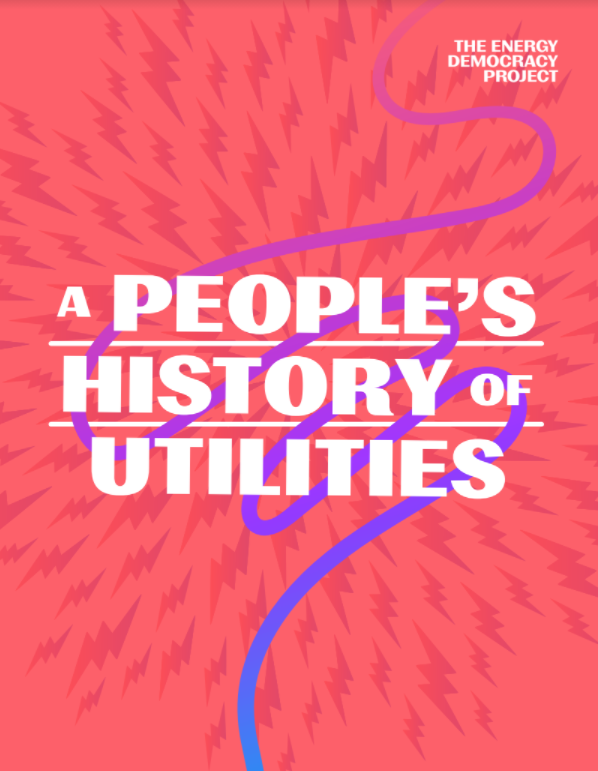
  1. a “History of Utilities” report to summarize the history of utilities for everyone to understand how our current energy system originated.
  2. a “People’s Utility Justice Playbook” to expose the tactics from electric utilities that are undermining community’s efforts, so we can build our organizing strength—to not only fight back but also to build the democratic energy system for climate justice.

This is the basic information we need to fight back against energy utilities attempting to slow or stop progress toward economic and climate justice.

History of Utilities​

Electric utilities have expanded into almost every aspect of our lives to become one of the most powerful and concentrated industries on Earth. To have a better understanding of what we’re fighting against, we first need to learn about the history of energy utilities! This PDF summarizes the entire timeline and how the rise of energy democracy came about.

People's Utility Justice Playbook

In order to fight the industry-owned utilities’ tactics, we need our own strategies for combat!

We have our very own playbook sourced from energy justice activists on the ground. They suggest strategies and tactics they employ when fighting against utilities that anyone fighting against utilities could use!

Read the History (PDF).

Read the Playbook (PDF).

A Vision for Scotland’s Railways

By staff - Unity Consulting, ASLEF, RMT, TSSA, and Unite the Union, October 29, 2021

Scotland cannot meet its environmental obligations without a world-class rail service that shifts people and goods from cars and lorries onto trains.

This requires a service that is fully staffed, with affordable fares, stations that are accessible and trains that are clean, green and attractive.

What is needed is an ambition for Scotland’s railways that is expansive, that encourages people to make rail their first travel choice and increases freight capacity.

Our long-term vision for Scotland's railways:

  • It should be a publicly operated and governed system run as public service and not for private profit
  • A system that helps Scotland meet its wider environmental and public policy ambitions
  • A railway that is supported by public subsidy
  • Is fully staffed
  • That reinvests in rail infrastructure, to help grow the economy.
  • Takes ScotRail (and the Serco operated Caledonian Sleeper) back under public ownership permanently
  • A railway that is part of a wider integrated public transport system with through ticketing
  • Is part of an industrial strategy that recognises rail services are a vital part of Scotland’s economy helping create jobs and growth
  • Has a democratic regulatory and governance structure
  • Has a cross representation of Scottish society and rail interests at the heart of decision making
  • Has representation from all four trade unions on the board of the new operator
  • Has local political representatives on the board
  • Has passenger representatives on the board

Read the text (PDF).

It’s time to act now! Just Transition must become a reality today! IndustriALL Global Union and industriAll European Trade Union on COP26

By staff - IndustriaALL, October 2021

On the occasion of the 26th Conference of the Parties to the UN Framework Convention on Climate Change (UNFCCC) taking place on 1-12 November 2021 in Glasgow, IndustriALL Global Union and industriAll European Trade Union - which collectively represent over 50 million workers in industry, energy and mining sectors globally - call on governments to finally act and make Just Transition a reality for everyone and for all generations!

For many years, the International Trade Union Movement has been vocal about the need to ensure a Just Transition that is on par with increased climate ambition. We cannot ignore the urgent need to step up our global efforts to reach climate neutrality as soon as possible. Climate change is affecting everyone, brought to our attention by recent extreme weather events around the globe, but it cannot be that the workforce and the poor will be the first to pay the price. The measures to mitigate and adapt to climate change will not affect everyone equally. Workers around the globe are at the centre of the transition and will be the actors to implement climate ambition through their daily work.

We campaigned for the inclusion of the Just Transition concept in the Paris Climate Agreement in 2015 and for the development of ILO Guidelines on how to implement it on the ground. The ILO Guidelines stress the need for tripartite dialogue, including governments, employers and trade unions, in each of the nine policy areas defined in the just transition framework1. In 2018, during COP24, 56 parties adopted the Solidarity and Just Transition Silesia Declaration, stressing “that Just Transition of the workforce and the creation of decent work and quality jobs are crucial to ensure an effective and inclusive transition to low greenhouse gas emissions and climate resilient development.” The Silesia Declaration invited all relevant stakeholders to implement it. Despite significant progress, in many places Just Transition is too often only nice words on paper.

Declarations and statements of good intentions must now be followed by concrete action. Especially during the COVID-crisis and in the aftermath, jobs were lost, social dialogue was not respected, and workers were driven into precarious conditions. Therefore, IndustriALL Global Union and industriAll European Trade Union call on governments that it is high time to move on from the narrative on paper to implementing a Just Transition through measures and resources on the ground. To achieve this, Just Transition plans must be systematically included as part of the UNFCCC reporting process, in every country.

Read the text (PDF).

The Green Jobs Advantage: How Climate Friendly Investments are Better Job Creators

By Joel Jager, et. al. - World Resources Institute, International Trade Union Confederation, and The Global Commission on the Economy and Climate, October 2021

As part of their COVID-19 recovery efforts, many governments continue to fund unsustainable infrastructure, even though this ignores the urgency of addressing climate change and will not secure longterm stability for workers.

Our analysis of studies from around the world finds that green investments generally create more jobs per US$1 million than unsustainable investments. We compare near-term job effects from clean energy versus fossil fuels, public transportation versus roads, electric vehicles versus internal combustion engine vehicles, and nature-based solutions versus fossil fuels.

Green investments can create quality jobs, but this is not guaranteed. In developing countries, green jobs can provide avenues out of poverty, but too many are informal and temporary, limiting access to work security, safety, or social protections. In developed countries, new green jobs may have wages and benefits that aren’t as high as those in traditional sectors where, in many cases, workers have been able to fight for job quality through decades of collective action.

Government investment should come with conditions that ensure fair wages and benefits, work security, safe working conditions, opportunities for training and advancement, the right to organize, and accessibility to all.

Read the text (PDF).

Are ‘Green’ Jobs Good Jobs? How lessons from the experience to-date can inform labour market transitions of the future

By Dr Anna Valero, et. al. - London School of Economics, October 2021

As governments worldwide are increasing their commitments to tackling climate change, efforts are growing to quantify and characterise the ‘green economy’, and to identify opportunities to be seized and challenges to be overcome in the transition to the net-zero economy of the future. The aim of this report and accompanying policy brief is to shed light on the quantity and quality of current green labour markets, to inform policy action and future research for the net-zero transition.

Main messages

  • Research on green jobs often uses a narrow definition of the green economy that does not cover all the jobs that will be important for driving forward the net-zero transition.
  • In contrast, the authors apply a broad approach to the UK and European economies.
  • They find that around 20% of jobs in the UK and 14 European economies can be considered directly and indirectly green, taking a broad, occupation-level definition of the ‘greenness’ of jobs.
  • They find some evidence that greener jobs tend to be ‘better’ jobs.
  • Workers in some types of green jobs, particularly those that are new occupations related to greening the economy, are likely to be educated to a higher level and be on permanent contracts, though there are differences in these relationships across countries, sectors and regions.
  • For the UK, the authors also find that greener jobs tend to pay higher wages, and are more resilient to automation.
  • Greener jobs tend to be occupied by older workers and men. Policymakers will need to ensure equitable access to green, future-fit jobs. Educational and training requirements of ‘green’ jobs will need to be met with new education and skills policies, including improved incentives for firms and individuals to train.

Read the text (link).

How capitalism Drives the Climate Crisis

Social Justice and Trade Union statements at the PreCOP in Milano

By Gina Cortes Valderrama - Women Gender Climate, September 30, 2021

Thank you, my name is Gina Cortes Valderrama and I speak on behalf of five diverse rights-based constituencies- Women and Gender, Trade unions, Indigenous Peoples, Youth, the Climate Action Network, and Demand Climate Justice. We are speaking collectively to demand ambition, justice, and people-powered solutions. Together, we represent over 3000 organizations in more than 160 countries.

Let’s start with reality:

  • In 2020, five years after Paris promised to uphold human rights in all climate actions, a record number of activists were murdered as they worked to protect the environment
    and land rights.
  • The recent UNFCCC NDC synthesis report warns emissions will be 16 percent above the 2010 level by 2030 - even after the latest mitigation pledges -, while science tells us we need to halve emissions until then.
  • In addition, according to the OECD figures, 2019 climate finance remained $20bn below the target for 2020. And it is virtually certain that the $100bn will not be met in 2021.
  • In all circumstances, the connection between climate impacts and inequality are abundantly clear. These inequities are further exacerbated when a few rich nations have yet refused a TRIPS waiver and ensured vaccine equity with adequate support...

Read the entire text (PDF).

Pages

The Fine Print I:

Disclaimer: The views expressed on this site are not the official position of the IWW (or even the IWW’s EUC) unless otherwise indicated and do not necessarily represent the views of anyone but the author’s, nor should it be assumed that any of these authors automatically support the IWW or endorse any of its positions.

Further: the inclusion of a link on our site (other than the link to the main IWW site) does not imply endorsement by or an alliance with the IWW. These sites have been chosen by our members due to their perceived relevance to the IWW EUC and are included here for informational purposes only. If you have any suggestions or comments on any of the links included (or not included) above, please contact us.

The Fine Print II:

Fair Use Notice: The material on this site is provided for educational and informational purposes. It may contain copyrighted material the use of which has not always been specifically authorized by the copyright owner. It is being made available in an effort to advance the understanding of scientific, environmental, economic, social justice and human rights issues etc.

It is believed that this constitutes a 'fair use' of any such copyrighted material as provided for in section 107 of the US Copyright Law. In accordance with Title 17 U.S.C. Section 107, the material on this site is distributed without profit to those who have an interest in using the included information for research and educational purposes. If you wish to use copyrighted material from this site for purposes of your own that go beyond 'fair use', you must obtain permission from the copyright owner. The information on this site does not constitute legal or technical advice.