You are here

Joe Biden

The Real Crisis Threatening Ukraine isn’t a Russian Invasion or US backed NATO Imperialism. It’s Capitalism

By Javier Sethness - The Commoner, January 27, 2022

published on The Commoner, 27 January 2022

This exclusive interview with Assembly, a magazine based in Ukraine, provides a fresh, on-the-ground perspective on the Russo-Ukrainian conflict. Writers from Assembly have published articles with The Commoner before, which you can find here. You may otherwise find their website here.

Comrades, thank you for agreeing to this interview. We very much enjoyed your recent article in The Commoner, ‘The Time Has Come?’, about ongoing socio-economic resistance in Ukraine.

Today, the world looks on in horror as Russian President Vladimir Putin’s military is amassing over a hundred-thousand troops on Ukraine’s eastern border. These forces are reportedly composed of sixty battalion tactical groups (BTG’s), including Spetznatz special forces, hundreds of tanks, and dozens of ballistic-missile units—not to mention either the Black Sea Fleet or aerial forces. Although Ukraine gained formal independence from the collapsing Soviet Union in 1991, Putin has repeatedly expressed nostalgia for Tsarist and Soviet imperialism, while Maria Zakharova, spokesperson for the Russian Ministry for Foreign Affairs, has long belittled the idea of Ukrainian sovereignty.

Currently, the UK is selling light anti-tank weapons to Ukraine, while the US has supplied billions of dollars in military aid to the country since 2014, when the Russian military occupied and annexed Crimea. Some media sources suggest that Putin has not yet decided whether to order the invasion, which could spark the most destructive conflict in Europe since World War II, even if Ukraine is not a part of the North Atlantic Treaty Organisation (NATO). Now, following a breakdown in negotiations, President Joe Biden is reportedly considering sending thousands of NATO troops to the Baltic countries.

Beyond the Green New Deal: A Discussion with Monica Atkins of the Climate Justice Alliance

Coal Miners Weren’t Happy When Joe Manchin Derailed Build Back Better

By Austyn Gaffney - Sierra, January 19, 2022

The United Mine Workers of America issued a statement criticizing the senator for withdrawing his support from the legislation:

When West Virginia senator Joe Manchin III, a well-known coal baron, withdrew support from the Build Back Better agenda, the Biden administration’s landmark climate and social safety net bill, an influential coal-mining union was quick to respond.

The United Mine Workers of America (UMWA), a labor union formed in 1890 to organize coal miners seeking safe working conditions and fair pay, released a statement by international president Cecil E. Roberts on December 20 characterizing the union’s relationship with Manchin as “long and friendly” but expressing disappointment that the bill didn’t pass. (On the same day, the AFL-CIO, the largest federation of American labor unions, released a similar statement.)

“We urge Senator Manchin to revisit his opposition to the legislation and work with his colleagues to pass something that will help keep coal miners working,” Roberts wrote, “and have a meaningful impact on our members, their families, and their communities.”

Given the UMWA’s history with Manchin—he has been an honorary member since 2020—it was a notable reminder of just how much is at stake for miners and their communities as the president’s signature measure hangs in the balance. The Build Back Better legislation includes important items for the UMWA, like incentives to build manufacturing facilities in post-coal communities, financial penalties for employers who deny workers their rights to unionize, and an extension of the black lung trust fund, a levy paid by coal companies that provides a small monthly payment to miners with pneumoconiosis, a disease caused by coal dust and silica inhalation. 

As the Biden Administration Eyes Wind Leases Off California’s Coast, the Port of Humboldt Sees Opportunity

By Emma Foehringer Merchant - Inside Climate News, January 5, 2022

The administration wants to sell its first lease in 2022, and a new bill in California requires a plan. Some in Humboldt have been waiting years for this moment to arrive.

In the early 20th century, the U.S. Census Bureau declared Humboldt County, California—now famous for its redwoods—the “principal center” of the state’s lumber industry. In 1900, the product accounted for nearly 60 percent of the region’s exports. 

But now, though lumber yards and wood suppliers still line Humboldt Bay, the industry is a shadow of its former self. 

“You look at old photographs of Humboldt Bay from back then and there’s mills everywhere, pulp mills and ships and docks,” said Matthew Marshall, executive director of the Redwood Coast Energy Authority. “As that retracted there’s a lot of available land and waterfront …. So, there’s a big opportunity.”

The Redwood Coast Energy Authority (RCEA)—a power organization formed by the County of Humboldt and Northern Californian cities such as Trinidad and Eureka—has been working for years to prepare for that opportunity. In 2018, RCEA submitted an unsolicited application to the U.S. Department of the Interior in hopes of building wind energy in waters just west of Humboldt Bay. 

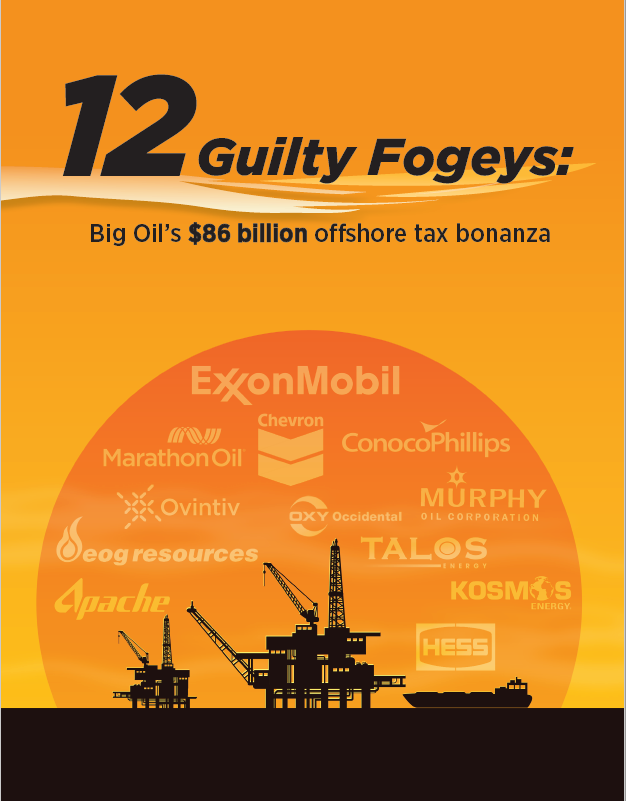
12 Guilty Fogeys: Big Oil’s $86 billion offshore tax bonanza

By staff - Friends of the Earth, Bailout Watch, and Oxfam, September 2021

Few letter-soup acronyms in Washington bureaucratese are so aptly pronounced as GILTI and FOGEI, two esoteric provisions in the tax code worth tens of billions of dollars to Big Oil’s multinational majors.

Under the Trump Administration’s radical 2017 tax law, companies that extract oil and gas overseas enjoy special exemptions within the Global Intangible Low-Tax (GILTI) regime covering Foreign Oil and Gas Extraction Income (FOGEI).

It is a fitting accident of nomenclature: FOGEI’s GILTI carveout helps prop up the fossil firms most culpable for the climate crisis — to the tune of $84 billion. An additional international tax loophole enjoyed by Big Oil is worth at least another $1.4 billion, for a grand total of over $86 billion in offshore tax giveaways.

Read the text (PDF).

Chomsky and Pollin: Protests Outside of COP26 Offered More Hope Than the Summit

By C.J. Polychroniou, Noam Chomsky, and Robert Pollin - Truthout, November 22, 2021

The legacy of the 2021 United Nations Climate Change Conference (COP26) this fall was perhaps best encapsulated by its president, who bowed his head and — close to tears — actually apologized for the process, which ended with a last-minute watering-down of participants’ pledges on coal.

“May I just say to all delegates I apologize for the way this process has unfolded and I am deeply sorry,” said Alok Sharma, the British politician who served as president for COP26. The conference ended on November 13 with a disheartening “compromise” deal on the climate after two weeks of negotiations with diplomats from more than 190 nations.

In the interview that follows, leading public intellectuals Noam Chomsky and Robert Pollin offer their assessments of what transpired at COP26 and share their views about ways to go forward with the fight against the climate crisis. Chomsky — one of the most cited scholars in history and long considered one of the U.S.’s voices of conscience — is Institute Professor Emeritus at the Massachusetts Institute of Technology and currently Laureate Professor of Linguistics and Agnese Nelms Haury Chair in the Agnese Nelms Haury Program in Environment and Social Justice at the University of Arizona. He is joined by one of the world’s leading economists of the left, Robert Pollin, who is Distinguished Professor and co-director of the Political Economy Research Institute at the University of Massachusetts at Amherst. Chomsky and Pollin are co-authors of the recently published book, Climate Crisis and the Global Green New Deal: The Political Economy to Save the Planet.

C.J. Polychroniou: COP26, touted as our “last best hope” to avert a climatic catastrophe, has produced an outcome that was a “compromise,” according to United Nations Secretary General António Guterres, while activists conducted a funeral ceremony at the Glasgow Necropolis to symbolize the failure of the summit. Noam, can you give us your analysis of the COP26 climate agreement?

Noam Chomsky: There were two events at Glasgow: within the stately halls, and in the streets. They may have not been quite at war, but the conflict was sharp. Within, the dominant voice mostly echoed the concerns of the largest contingent, corporate lobbyists; rather like the U.S. Congress, where the impact of lobbyists, always significant, has exploded since the 1970s as the corporate-run neoliberal assault against the general population gained force. The voice within had some nice words but little substance. In the streets, tens of thousands of protesters, mostly young, were desperately calling for real steps to save the world from looming catastrophe.

Noam Chomsky: Ending Climate Change “Has to Come From Mass Popular Action,” Not Politicians

By Poyâ Pâkzâd, Benjamin Magnussen, and Noam Chomsky - Jacobin, November 19, 2021

Benjamin Magnussen: To change subjects: What do you see as the greatest obstacle in solving the climate crisis?

Noam Chomsky: There are two major obstacles. One is, of course, the fossil fuel companies. Second is the governments of the world, including Europe and the United States. We have just seen that very dramatically over the summer. On August 9, 2021, the IPCC [Intergovernmental Panel on Climate Change] issued its last analysis of the climate situation. It was a very dire warning — much more than before.

The message basically was, “We have two choices.” We can either start right now cutting back on fossil fuel use, [and] do it systematically every year, until we phase them out by mid-century. That’s one choice. The other choice is cataclysm. The end of organized human life on earth. Not immediately — we’ll just reach irreversible tipping points, and it goes on to disaster. Those are the options.

How did the great powers react? The day after the IPCC report, Joe Biden issued an appeal to the OPEC cartel [Organization of the Petroleum Exporting Countries] to increase production. Europe chimed in by calling on all producers, including Russia, to increase production. Increase production. This is a response to the IPPC warning that we have to start reducing right now.

That’s for political reasons, for profit for the oil companies. [The] political reason is that they want the price reduced. It’s better for them. [For] Joe Biden, if the gas prices are high, it harms his electoral prospects. [If] you read the major business press right now, [there’s] a big discussion going on: What’s the best way to increase production? Is it through the American shale oil — the fracking industry — or is it through OPEC? But how do we increase production best? That’s the business press. Turn to the petroleum journals. [They are] euphoric: “We just found new fields to exploit. Demand is going up. It’s great.”

Let’s go to the US Congress. The Biden program — under pressure from young activists, the Bernie Sanders movements, and so on — is actually a big improvement on any previous ones, on paper. It’s not wonderful, but it’s much better than anything else. Well, the [previous] negotiations in Congress over the “reconciliation bill,” initiated by Bernie Sanders, cut back very sharply from Sanders’s proposals. It’s a very valuable bill. It somewhat reverses the huge assault on the population during the neoliberal era.

The Republicans are 100 percent opposed. Nothing. [They] won’t accept anything. The Democrats do have a swing vote. The so-called moderate Democrats, who should be called “ultra-reactionaries,” are the swing vote. One of them is the chair of the Senate Energy Committee, [who] also happens to be the champion in Congress of receiving funding from the fossil fuel industry — which is quite an achievement, because they pay off everyone — but he’s the champion. His name is Joe Manchin. He has a policy — he’s made it explicit — that’s taken from the playbook of the oil companies. He made it very clear; he said: “No elimination, only innovation.” So, no cutbacks on the use of fossil fuel. If you can make up something new, it’s okay. So, he’s blocking it. There are climate change provisions in it. They’re already out. Blocked.

In Europe, it varies. There are some countries, like Denmark, for example, that are moving toward renewable energy pretty significantly. Others vary. But when it comes to the crunch, telling the oil companies and the producers right now what to do, Europe is, as far as I know, unified in saying, “Increase production” — right after the warning that we have to decrease production. That’s the world we live in.

The Green New Deal–From Below

By Jeremy Brecher - Labor Network for Sustainability, October 30, 2021

This is the first in a series of commentaries on “The Green New Deal–From Below.” This commentary explains the idea of a Green New Deal from Below and provides an overview of the series. Subsequent commentaries in this series will address dimensions of the Green New Deal from below ranging from energy production to the role of unions to microgrids, coops, anchor institutions, and many others.

The Green New Deal is a visionary program to protect the earth’s climate while creating good jobs, reducing injustice, and eliminating poverty. Its core principle is to use the necessity for climate protection as a basis for realizing full employment and social justice.

The Green New Deal first emerged as a proposal for national legislation, and the struggle to embody it in national legislation is ongoing. But there has also emerged a little-noticed wave of initiatives from community groups, unions, city and state governments, tribes, and other non-federal institutions designed to contribute to the climate protection and social justice goals of the Green New Deal. We will call these the Green New Deal from Below (GNDfB).

The purpose of this commentary is to provide an overview of Green New Deal from Below initiatives in many different arenas and locations. It provides an introduction to a series of commentaries that will delve more deeply into each aspect of the GNDfB. The purpose of the series is to reveal the rich diversity of GNDfB programs already underway and in development. The projects of Green New Dealers recounted here should provide inspiration for thousands more that can create the foundation for national mobilization–and reconstruction.

The original 2018 Green New Deal resolution submitted by Rep. Alexandria Ocasio-Cortez called for a national 10-year mobilization to achieve 100% of national power generation from renewable sources; a national “smart grid”; energy efficiency upgrades for every residential and industrial building; decarbonizing manufacturing, agriculture, transportation, and other infrastructure; and helping other countries achieve carbon neutral economies and a global Green New Deal. It proposed a job guarantee to assure a living wage job to every person who wants one; mitigation of income and wealth inequality; basic income programs; and universal health care. It advocated innovative financial structures including cooperative and public ownership and public banks. Since that time a wide-ranging discussion has extended and fleshed out the vision of the Green New Deal to include an even wider range of proposals to address climate, jobs, and justice.

The Green New Deal first emerged as a proposal for national mobilization, and national legislation has remained an essential element. But whether legislation embodying the Green New Deal will be passed, and how adequate it will be, continues to hang in the balance. Current “Build Back Better” legislation has already been downsized to less than half its original scale, and many of the crucial elements of the Green New Deal have been cut along the way. How much of the Green New Deal program will actually be passed now or in the future cannot currently be known.

But meanwhile, there are thousands of efforts to realize the goals of the Green New Deal at community, municipal, county, state, tribal, industry, and sectoral levels. While these cannot substitute for a national program, they can contribute enormously to the Green New Deal’s goals of climate protection and economic justice. Indeed, they may well turn out to be the tip of the Green New Deal spear, developing in the vacuum left by the limitations of national programs.

Plagued by Daily Blackouts, Puerto Ricans Are Calling for an Energy Revolution. Will the Biden Administration Listen?

By Kristoffer Tigue - Inside Climate Newses, October 25, 2021

Many residents say a record amount of incoming federal aid provides a once-in-a-generation opportunity to transition the island to clean energy. So far, the funds are mostly going to natural gas.

Eddie Ramirez has never understood why his government doesn’t more aggressively pursue renewable energy.

When Hurricane Maria swept across Puerto Rico in September 2017, shredding the energy grid and knocking out power for nearly all the island’s 3.4 million residents for months on end, Casa Sol—Ramirez’s five-bedroom bed and breakfast—was one of the only buildings in San Juan with working electricity, with 30 solar panels bolted to its roof.

When a large fire this June at an electrical substation in San Juan plunged more than 800,000 Puerto Rican homes into darkness and knocked out power to another 330,000 the following week, Casa Sol’s lights stayed on, even as its neighbors lost power.

And when a series of equipment failures and poor maintenance led to cascading power outages across the island in August, September and October, leaving hundreds of thousands of Puerto Ricans without electricity for days at a time and prompting calls for Puerto Rico Gov. Pedro Pierluisi to resign, Ramirez and his solar-powered hotel carried on, business as usual.

“We don’t even know when it happens,” Ramirez said of the blackouts, which have become a daily part of life for many Puerto Ricans since June, when the private company LUMA Energy took over the island’s electricity transmission system.

With Puerto Rico’s grid still in shambles four years after Maria’s landfall, and $12.4 billion in federal aid earmarked to help repair the territory’s electrical systems and jumpstart its economy, many Puerto Ricans, like Ramirez, see a once-in-a-generation opportunity to reimagine the island’s tattered power system as a modern grid powered by clean energy and far better at withstanding the worsening threats of the climate crisis.

But many Puerto Ricans worry their political leaders are squandering that opportunity by planning to rebuild the electricity grid with natural gas power plants that continue to emit greenhouse gases and feed lengthy transmission lines that are vulnerable to natural disasters.

Indigenous Resistance Against Carbon

By Dallas Goldtooth, Alberto Saldamando, and Kyle Gracey, et. al. - Indigenous Environmental Network and Oil Change International, September 1, 2021

This report shows that Indigenous communities resisting the more than 20 fossil fuel projects analyzed have stopped or delayed greenhouse gas pollution equivalent to at least 25 percent of annual U.S. and Canadian emissions. Given the current climate crisis, Indigenous peoples are demonstrating that the assertion of Indigenous Rights not only upholds a higher moral standard, but provides a crucial path to confronting climate change head-on and reducing emissions. 

The recently released United Nations climate change report by the Intergovernmental Panel on Climate Change (IPCC) states that in order to properly mitigate the worst of the climate crisis, rapid and large-scale action must be taken, with a focus on immediate reduction of fossil fuel emissions. As the United Nations prepares for its upcoming COP 26 climate change conference in Glasgow, Scotland, countries are being asked to update their pledges to cut emissions — but as the IPCC report states, current pledges fall short of the changes needed to mitigate the climate chaos already millions of people around the world. 

While United Nations member countries continue to ignore the IPCC’s scientists and push false solutions and dangerous distractions like the carbon markets in Article 6 of the Paris Agreement, Indigenous peoples continue to put their bodies on the line for Mother Earth. False solutions do not address the climate emergency at its root, and instead have damaging impacts like continued land grabs from Indigenous Peoples in the Global South. Indigenous social movements across Turtle Island have been pivotal in the fight for climate justice.

Read the text (PDF).

Pages

The Fine Print I:

Disclaimer: The views expressed on this site are not the official position of the IWW (or even the IWW’s EUC) unless otherwise indicated and do not necessarily represent the views of anyone but the author’s, nor should it be assumed that any of these authors automatically support the IWW or endorse any of its positions.

Further: the inclusion of a link on our site (other than the link to the main IWW site) does not imply endorsement by or an alliance with the IWW. These sites have been chosen by our members due to their perceived relevance to the IWW EUC and are included here for informational purposes only. If you have any suggestions or comments on any of the links included (or not included) above, please contact us.

The Fine Print II:

Fair Use Notice: The material on this site is provided for educational and informational purposes. It may contain copyrighted material the use of which has not always been specifically authorized by the copyright owner. It is being made available in an effort to advance the understanding of scientific, environmental, economic, social justice and human rights issues etc.

It is believed that this constitutes a 'fair use' of any such copyrighted material as provided for in section 107 of the US Copyright Law. In accordance with Title 17 U.S.C. Section 107, the material on this site is distributed without profit to those who have an interest in using the included information for research and educational purposes. If you wish to use copyrighted material from this site for purposes of your own that go beyond 'fair use', you must obtain permission from the copyright owner. The information on this site does not constitute legal or technical advice.