

You are here

Inflation Reduction Act (IRA)
Why unions are excited about these provisions hidden deep in the Inflation Reduction Act

By Kristin Toussaint - Fast Company, January 27, 2023

The Inflation Reduction Act, which was signed into law last summer, is the U.S.’s largest-ever investment in clean and renewable energy. But it’s also a landmark policy for labor, tying $270 billion in tax incentives (of the bill’s $369 billion clean energy investment) to labor standards that will boost working conditions for those in clean energy jobs.

Those standards are set to go into effect on January 29, and labor advocates say it’s a historic opportunity to create a tremendous number of union jobs in the clean energy economy.

The IRA has tax credits that create financial incentives not only for developers to embark on more clean energy projects but also for those projects to meet high labor standards. Companies can get a 30% tax credit on their qualifying projects—from offshore wind to solar construction to energy storage—but only if they meet certain standards. That includes paying workers a prevailing wage (the federal government sets this rate for work on public projects; states can set theirs higher) and having a certain amount of work done by those in registered apprenticeship programs. (To start, 12.5% of total labor hours must be done by apprentices; that increases to 15% in 2024.)

If clean energy developers don’t meet those standards—say, paying only minimum wage and choosing not to hire any apprentices—they get a tax credit of just 6%. “The IRA provides a substantial and impactful financial benefit for developers to pay good wages, hire apprentices, and really create a pipeline to good careers in the clean energy economy,” says Dave Hancock, director of strategic campaigns at the Climate Jobs National Resource Center, which helps unions develop labor-led climate job coalitions and works toward a “worker-centered renewable economy.”

An EV in Every Driveway Is an Environmental Disaster

By Alissa Walker - Curbed, January 25, 2023

“There is always a huge climate benefit — and, I would argue, a safety benefit — to ensuring people have access to excellent public transit,” Transportation Secretary Pete Buttigieg said earlier this month at the Transportation Research Board’s annual meeting. “Even if we weren’t aggressively working to decarbonize existing modes of transportation, that alone is one of the biggest and the best things we can do from a climate perspective.” This is the closest thing to a mic drop that exists at such an event, so the assembled transportation academics, urban planners, and civil engineers erupted into applause. Buttigieg had to pause, letting the hoots fade out before he could finish his remarks. He was onstage with Energy Secretary Jennifer Granholm to announce the first blueprint to decarbonize U.S. transportation by 2050, an unprecedented collaboration between the Departments of Transportation, Energy, and Housing and Urban Development and the Environmental Protection Agency to move the country away from using fossil fuels when, well, moving around.

Despite its many strengths, the blueprint is largely built around two things that have very little to do with what got Buttigieg the most applause from transit professionals: It’s heavily reliant on developing technologies that don’t exist yet and the Biden administration’s goal to have half of the new vehicles sold in 2030 to be electric (a figure closely negotiated with automakers). The latter point is perhaps why the slow but steadily growing number of electric vehicles, or EVs, sold in this country each year has become its own kind of shorthand for the decarbonization revolution. (“Electric Vehicles Keep Defying Almost Everyone’s Predictions,” “Electric Vehicle Sales Hit a Tipping Point in 2022,” “Electric Vehicles = 10% Of New Vehicle Sales Globally!”) A green future, the story goes, looks a lot like today — it’s just that the cars on the road make pit stops at charging stations instead of gas stations. But a one-for-one swap like that — an EV to take the place of your gas guzzler — is a disaster of its own making: a resource-intensive, slow crawl toward a future of sustained high traffic deaths, fractured neighborhoods, and infrastructural choices that prioritize roads over virtually everything else. And considering what it would take to produce that many cars, the vision being sold by the Biden administration about an EV in every driveway is more than just a fantasy — it’s an environmental nightmare.

A zero emissions future without the mining boom: A new report finds that the U.S. can reduce lithium demand by up to 90 percent

By Blanca Begert and Lylla Younes - Grist, January 24, 2023

The effort to shift the U.S. economy off fossil fuels and avoid the most disastrous impacts of climate change hinges on the third element of the periodic table. Lithium, the soft, silvery-white metal used in electric car batteries, was endowed by nature with miraculous properties. At around half a gram per cubic centimeter, it’s the lightest metal on Earth and is extremely energy-dense, making it ideal for manufacturing batteries with a long life. 

The problem is, lithium comes with its own set of troubles: Mining the metal is often devastating for the environment and the people who live nearby, since it’s water intensive and risks permanently damaging the land. The industry also has an outsized impact on Native Americans, with three-quarters of all known U.S. deposits located near tribal land. 

Demand for lithium is expected to skyrocket in the coming decades (up to 4,000 percent according to one estimate), which will require many new mines to meet it (more than 70 by 2025). These estimates assume the number of cars on the road will remain constant, so lithium demand will rise as gas guzzlers get replaced by electric vehicles. But what if the United States could design a policy that eliminates carbon emissions from the transportation sector without as much mining? 

A new report from the Climate and Community Project, a progressive climate policy think tank, offers a fix. In a paper out on Tuesday, the researchers estimated that the U.S. could decrease lithium demand up to 90 percent by 2050 by expanding public transportation infrastructure, shrinking the size of electric vehicle batteries and maximizing lithium recycling. They claim that this report is the first to consider multiple pathways for getting the country’s cars and buses running on electricity and suppressing U.S. lithium demand at the same time. 

We need a lot more electricians if we’re going to electrify everything

By Emily Pontecorvo - Canary Media, January 11, 2023

The U.S. has a shortage of electricians to install clean equipment like EV chargers, heat pumps and induction stoves. Those who get into the field can earn big.

Chanpory Rith, a 42-year-old product designer at the software company Airtable, bought a house in Berkeley, California with his partner at the end of 2020. The couple wasn’t planning to buy, but when Covid hit and they began working from their one-bedroom San Francisco apartment, they developed a new hobby: browsing listings on Zillow and Redfin — ​“real estate porn,” as Rith put it.

Their pandemic fantasizing soon became a pandemic fairy tale: They fell for a five-bedroom midcentury home in the Berkeley hills with views of San Francisco Bay and put down an offer. ​“And then came the joys and tribulations of homeownership,” Rith said.

One of those tribulations began with a plan to install solar panels. Rith didn’t consider himself a diehard environmentalist, but he was concerned about climate change and wanted to do his part to help. He didn’t have a car but planned on eventually getting an electric vehicle and also wanted to swap out the house’s natural-gas appliances for electric versions. Getting solar panels would be a smart first step, he figured, because it might trim his utility bills. But Rith soon found out that the house’s aging electrical panel would need to be upgraded to support rooftop solar. And he had no idea how hard it would be to find someone to do it.

Many of the electricians Rith reached out to didn’t respond. Those who did were booked out for weeks, if not months. He said they were so busy that the conversations felt like interviews — as if he were being evaluated, to suss out whether his house was worth their time. 

“It felt like trying to get your kid into a nice kindergarten, where you have to be interviewed and do a lot of things just to get on the radar of these electricians,” Rith told Grist.

'Groundbreaking' Report Shows Promise of Greener Jobs for Former Fossil Fuel Workers

By Julia Conley - Common Dreams, January 3, 2023

New analysis shows how California "can achieve a just and equitable transition away from fossil fuels for oil and gas workers."

A new analysis out Tuesday shows how a just transition towards a green economy in California—one in which workers in the state's fossil fuel industry would be able to find new employment and receive assistance if they're displaced from their jobs—will be "both affordable and achievable," contrary to claims from oil and gas giants and anti-climate lawmakers.

The study published by the Gender Equity Policy Institute (GEPI) notes that a majority of workers in the oil and gas sectors will have numerous new job opportunities as California pushes to become carbon neutral by 2045 with a vow to construct a 100% clean electricity grid and massively reduce oil consumption and production.

"The state will need to modernize its electrical grid and build storage capacity to meet increased demand for electricity," reads the report. "Carbon management techniques, plugging orphan wells, and the development of new energy sources such as geothermal will all come into play, providing economic opportunities to workers and businesses alike."

GEPI analyzed the most recent public labor data, showing that the oil and gas industries in California employed approximately 59,200 people as of 2021 across jobs in production, sales, transportation, legal, and executive departments, among others.

The group examined potential job opportunities for fossil fuel workers "in all growing occupations, not solely in clean energy or green jobs," and found that about two-thirds of employees are likely to find promising opportunities outside of fossil fuel-related work.

"Our findings show that a sizable majority (56%) of current oil and gas workers are highly likely to find jobs in California in another industry in their current occupation, given demand in the broader California economy for workers with their existing skills," the report says.

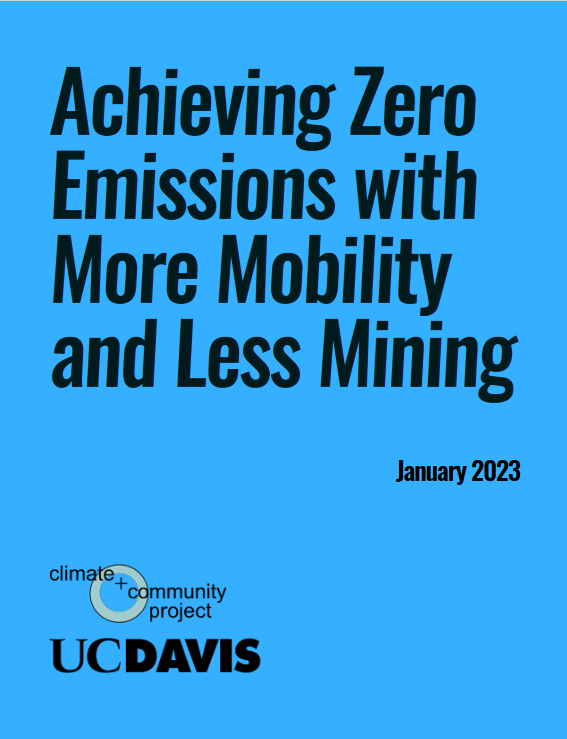
Achieving Zero Emissions with More Mobility and Less Mining

By Thea Riofrancos, Alissa Kendall, Kristi K. Dayemo, Matthew Haugen, Kira McDonald, Batul Hassan, and Margaret Slattery in partnership with the University of California, Davis - Climate and Community Project, January 2023

Transportation is the number one source of carbon emissions in the United States– making the sector crucial to decarbonize quickly to limit the climate crisis. States like New York and California banned the sale of gas cars by 2035 and the 2022 Inflation Reduction Act made major federal investments in electrifying transportation. As a result, US consumers are embracing electric vehicles (EVs), with over half of the nation’s car sales predicted to be electric by 2030. This is a critical juncture. Decisions made now will affect the speed of decarbonization and the mobility of millions. Zero emissions transportation will also see the transformation of global supply chains, with implications for climate, environmental, and Indigenous justice beyond US borders.

A crucial aspect of electrified transportation is new demand for metals, and specifically the most non-replaceable metal for EV batteries– lithium. If today's demand for EVs is projected to 2050, the lithium requirements of the US EV market alone in 2050 would require triple the amount of lithium currently produced for the entire global market. This boom in demand would be met by the expansion of mining. 

Large-scale mining entails social and environmental harm, in many cases irreversibly damaging landscapes without the consent of affected communities. As societies undertake the urgent and transformative task of building new, zero-emissions energy systems, some level of mining is necessary. But the volume of extraction is not a given. Neither is where mining takes place, who bears the social and environmental burdens, or how mining is governed. 

This report finds that the United States can achieve zero emissions transportation while limiting the amount of lithium mining necessary by reducing the car dependence of the transportation system, decreasing the size of electric vehicle batteries, and maximizing lithium recycling. Reordering the US transportation system through policy and spending shifts to prioritize public and active transit while reducing car dependency can also ensure transit equity, protect ecosystems, respect Indigenous rights, and meet the demands of global justice. 

Read the rest of the summary here.

Read the report (Link).

Powering Toward 100 Percent Clean Power by 2035

By: Charles Harper, Sam Krasnow, Leah Stokes, Lissa Lynch, Sam Ricketts, Amanda Levin, Daniela Schulman, Jeff Slyfield, and Christy Walsh - Evergreen Collaborative and NRDC, January 2023

President Joe Biden entered office with a commitment to the American people: that the United States would achieve 100 percent clean, carbon-free electricity by 2035. Clean electricity is essential to America’s response to the climate crisis. And reaching 80 percent clean power by 2030 is key to achieving the U.S. economy-wide goal of at least halving carbon pollution this decade.

Decarbonizing the power sector is a major task requiring both federal legislative and executive action. Accordingly, the Biden Administration has promised a whole-of-government response that includes robust performance standards, significant investment, and a commitment to justice. The U.S. took an important step on clean energy investment in 2022, when Congress and President Biden enacted the Inflation Reduction Act (IRA). This historic climate legislation contains over $370 billion in investments towards building America’s clean energy economy.

However, according to new modeling in this report, the U.S. must take further action to meet its clean energy goals this decade. The IRA’s investments are projected to increase carbon-free electricity in the U.S. from approximately 40 percent in 2022 to 66 percent clean power by 2030. This falls short of the 80 percent target that’s consistent with the path to 100 percent clean electricity by 2035. The bill is also estimated to help cut economy-wide greenhouse gas (GHG) pollution to 40 percent below 2005 levels by 2030—an important step, but short of America’s 50–52 percent commitment under the Paris Agreement.

To close the gaps between our climate and clean power targets and our current trajectory, and to further advance President Biden’s critical climate and environmental justice commitments, the Biden Administration must take decisive executive action to cut pollution and advance clean electricity in the power sector over the next two years. More states must also continue to step up and lead on 100 percent clean energy.

Read the entire statement (PDF).

Green Unionism and Human Rights: Imaginings Beyond the Green New Deal

By Chaumtoli Huq - Pace Environmental Law Review, January 2023

Web Editor's Note: This publication contains an error, identifying the International Woodworkers of America (IWA), a CIO union, as an IWW affiliate. This is inaccurate. The IWA was cofounded by many radical workers, including (but not limited to) members of the IWW, but it was never an IWW union itself.

The Green New Deal harkens us back to the nostalgia of the New Deal era when a diverse and comprehensive set of federal legislation, agencies, programs, public work projects and financial reforms were implemented between 1933 and 1939 by President Franklin D. Roosevelt to promote economic recovery. Among them, relevant to this essay’s focus on labor, was the passage of the National Labor Relations Act (NLRA) which provided legal protection to organizing, and supporting unionization and collective bargaining. However, due to political compromises, categories of workers including domestic workers and agricultural workers, who were mostly Black and immigrants were excluded from the NLRA’s coverage. Despite these exclusions, it was a time when the New Deal state seemed to be a strong ally of workers and the labor movement. Industrial peace and security were dominant narratives fueling much of the New Deal legislation. This industrial peace and security rhetoric suppressed the radicalization and rising militancy of the labor movement of the time such as the Industrial Workers of the World (IWW). Moreover, the law was actively used to prosecute criminally radical unionists and through other extra-judicial means.

New Deal policies solidified one form of unionism, referred to as business or contract unionism which is based on the idea that the union or labor movement brokers wages, benefits from its members, through collective bargaining agreements, and unions become servicers or administrators of those benefits. Such an approach heavily defers to law, state and legislative spaces as the protector of labor rights; thereby, ceding power away from worker or community control. In contrast, social unionism espoused the view that the role of the labor movement was to build worker power which gives them greater control over their livelihood, workplaces and environment. This view encompassed a wide spectrum of political ideologies and strategies. Social unionism broadly advanced that unions should address the economic interests of its members, encourage them to be active on broader issues of social justice and engage with the state to pass protective worker legislation.18 Under the social unionism view, syndicalists like IWW were skeptical or at most contemptuous of the legal system and emphasized the direct role of the union as agents of social change and governance.

Read the report (PDF).

2022 Oil Change International Supporter Briefing

Victory against Manchin’s “Dirty Deal”!

By Larry Williams, Jr. - Labor Network for Sustainability, October 30, 2022

Dear friends,

We’re celebrating the recent defeat of US Senator Joe Manchin’s “Dirty Deal.” This was a proposal to undermine environmental reviews and fast-track fossil fuel projects like the Mountain Valley Pipeline.

Today, we’d like to lift up the board members of the Labor Network for Sustainability who fought tooth and nail to oppose this Dirty Deal. LNS Board Members Jennifer Krill and Edgar Franks recently joined an action in the Hart Senate Building in Washington DC, in which Jennifer was arrested in an act of civil disobedience to oppose the deal.

Jennifer Krill stated: “Prioritizing the climate crisis means prioritizing environmental justice. Legislation that leads to more drilling and mining is precisely the kind of political side-dealing that has set us back from meeting our urgent climate goals. We’re grateful that members of Congress have taken action to stop the exploitation of frontline communities and stand up to the fossil fuel and mining industries. Congress has sacrificed people for corporate profits for far too long.”

Edgar Franks stated: “We as a farmworker union want to stand on the side of environmental justice. We are one of the communities that are bearing the brunt of climate change and also some of the most disenfranchised politically. The Dirty Deal was filled with mechanisms that further widen the divide where we will continue to be sacrificed for profits to the fossil fuel industry. We look for the time where we will not have to pit environment over jobs. As unions we need to be present and demand real solutions that are led by affected communities.”

But of course, this victory does not belong to us. It belongs to the many environmental justice leaders from across the country who’ve taken a stand against the Dirty Deal. It belongs to the communities in the Gulf of Mexico and coastal Alaska and everywhere in between. And it belongs to you.

To every member of the Labor Network for Sustainability—thank you. Whether you signed a petition, emailed or called your Senator, marched in a rally, risked arrest, or donated to support the cause, this is your victory.

We know the fight’s not over. Manchin will stop at nothing to cater to the fossil fuel industry, and we expect him to try to force through a similar deal later this year. But in the meantime, we can celebrate this moment and take stock of all we hold dear.

Thanks for being part of this movement.

Pages

The Fine Print I:

Disclaimer: The views expressed on this site are not the official position of the IWW (or even the IWW’s EUC) unless otherwise indicated and do not necessarily represent the views of anyone but the author’s, nor should it be assumed that any of these authors automatically support the IWW or endorse any of its positions.

Further: the inclusion of a link on our site (other than the link to the main IWW site) does not imply endorsement by or an alliance with the IWW. These sites have been chosen by our members due to their perceived relevance to the IWW EUC and are included here for informational purposes only. If you have any suggestions or comments on any of the links included (or not included) above, please contact us.

The Fine Print II:

Fair Use Notice: The material on this site is provided for educational and informational purposes. It may contain copyrighted material the use of which has not always been specifically authorized by the copyright owner. It is being made available in an effort to advance the understanding of scientific, environmental, economic, social justice and human rights issues etc.

It is believed that this constitutes a 'fair use' of any such copyrighted material as provided for in section 107 of the US Copyright Law. In accordance with Title 17 U.S.C. Section 107, the material on this site is distributed without profit to those who have an interest in using the included information for research and educational purposes. If you wish to use copyrighted material from this site for purposes of your own that go beyond 'fair use', you must obtain permission from the copyright owner. The information on this site does not constitute legal or technical advice.
