

You are here

jobs

The Inflation Reduction Act and the Labor-Climate Movement

By staff - Labor Network for Sustainability, September 2022

Passage of the Inflation Reduction Act reveals the power that can arise when the movements for worker protection, climate protection, and justice protection join forces.

The fossil fuel industry, the Republican Party, conservative fossil-fuel Democrats, and right-wing ideologues combined to block the climate, labor, and social justice programs of the Green New Deal and Build Back Better. They almost succeeded. But at the last minute, the combined power of climate protectors, worker advocates, and justice fighters was enough to force passage of the Inflation Reduction Act, the most significant climate legislation in U.S. history.[1]

That power was enough to include important positive elements in the Inflation Reduction Act. It will provide the largest climate protection investment ever made. It will create an estimated 1 to 1.5 million jobs annually for a ten-year period.[2] It includes modest but significant funding to address pollution in frontline communities.[3]

But the power of the fossil fuel industry and its allies was still enough to gut important parts of a program for climate, jobs, and justice – and to add provisions that promote injustice and climate change. The legislation includes only one-quarter of the investment necessary to meet the Paris climate goals and prevent the worst consequences of global warming. It allows much of its funding to be squandered on unproven technologies that claim to reduce greenhouse gas emissions but whose primary effect may simply be to permit the continued burning of fossil fuels – and enrich their promoters. It allows increased extraction of fossil fuels, especially on federal lands. It allows massive drilling and pipeline construction that will turn areas like the Gulf Coast and Appalachia into de facto “sacrifice zones” where expanded fossil fuel infrastructure will devastate the environment – and the people. It does not guarantee that the jobs it creates will be good jobs. It makes few “just transition” provisions for workers and communities whose livelihoods may be threatened by the changes it will fund.

Sweden: Activists and locals take action against limestone mining

By Take Concrete Action - Freedom, August 31, 2022

Right now in Sweden, activists are fighting to stop the state from throwing open the doors to corporate impunity. When the company Cementa was barred from continuing to mine limestone on the island of Gotland on the basis of environmental protections in the Swedish constitution, the government decided the constitution was the problem. They granted an exception to the company, despite the fact that thousands of people were facing water shortages due to the mine draining Gotland’s groundwater. Not only that, but Cementa is also Sweden’s second-largest emitter of carbon dioxide. Now, locals and climate activists teamed up under the name Take Concrete Action to shut Cementa down by sending hundreds of people to occupy the mine.

At the end of August, they travelled to the remote island in the middle of the Baltic sea, donned their best hazmat suits and walked into a limestone mine to stay there as long as possible. Below, they explain why.

Because Sweden is at a political crossroads that could have grave implications for its people and environment – and we see this as our best chance of stopping it.

To hit 82% renewables in 8 years, we need skilled workers – and labour markets are already overstretched

By Chris Briggs and Rusty Langdon - The Conversation, August 17, 2022

In just eight years time, the Labor government wants Australia to be 82% powered by renewable energy. That means a rapid, historic shift, given only 24% of our power was supplied by renewables as of last year.

To make this happen, we must rapidly scale up our renewable energy construction workforce. Last week’s energy ministers’ meeting calls for assessment of the “workforce, supply chain and community needs” for the energy transition. The government’s jobs and skills summit in early September will tackle the issue too. While it’s positive the government is focused on these challenges, the reality is we’re playing catch-up.

Why? Because Australia is already stretched for workers, and it takes time to give new ones the skills they will need. Our research estimates the renewable energy transition will need up to 30,000 workers in coming years to build enough solar farms, wind farms, batteries, transmission lines and pumped hydro storage to transform our energy system. Most of these jobs will be in regional areas.

In coming decades, Australia will invest around A$66 billion in large-scale renewables and $27 billion in rooftop solar and battery storage. This creates openings for industry development like the $7.4 billion market opportunity for an integrated battery supply chain and manufacturing which builds on our strengths, such as wind towers.

If we get this right, we can create new manufacturing and supply chain jobs and reverse the long drift of these jobs overseas. But if we get it wrong, skill shortages could derail the vision of a new energy system by 2030.

The transition to electrified vehicles: Evaluating the labor demand of manufacturing conventional versus battery electric vehicle powertrains

By Turner Cotterman, Erica R.H. Fuchs, and Kate Whitefoot - Carnegie Mellon University, July 22, 2022

The ongoing shift from traditional internal combustion engine vehicles (ICEVs) to electric vehicles (EVs) has raised questions about whether this transition will be economically as well as environmentally sustainable. In particular, one concern is the impact on manufacturing labor. Prior studies of the anticipated impacts of vehicle electrification on manufacturing labor requirements are mixed, with some suggesting that producing EVs may require fewer labor hours and jobs than conventional gasoline vehicles and some suggesting that there will be limited impacts on labor outcomes. Moreover, analysis of labor implications has been hindered by a lack of shop floor-level data on the labor hours required for ICEV and EV manufacturing. We collect detailed data on the production process steps required to build key ICEV and battery electric vehicle (BEV) powertrain components and the labor required for each process step.

The data include information for 252 process steps, which we collected from the shop floors of leading automotive manufacturers and combine with information on a further 78 process steps found in the existing literature. We then use this data to build a production process model that determines the labor hours required to produce ICEV and BEV powertrain components in a variety of scenarios of different production volumes and labor efficiency levels. We find that, in all scenarios we explore, the labor intensity required for the manufacturing of BEV powertrain components is larger than for ICEV powertrain components. Our results imply that vehicle electrification may lead to more jobs in powertrain manufacturing, at least in the short- to medium-term. These results emphasize the importance of using information about manufacturing process tasks and labor requirements to estimate the labor impacts of EVs, rather than recent approaches concentrating on part counts.

Stop EACOP Trade Union briefing July 2022

The Case for Not Flying

By Fabrizio Menardo - Green European Journal, July 7, 2022

Although aviation accounts for 2.8 per cent of global CO2 emissions, its harmful impact rarely rises on the climate action agenda. In a globalised economy with businesses and lifestyles built around air travel, flying can be a hard habit to shake. To Fabrizio Menardo, individuals must make behavioural changes and policymakers must address the socio-economic challenges in the sector to bring travel in line with climate goals.

In 2015, under the famed Paris Agreement, almost every country on Earth pledged to limit the global temperature rise to well below 2 degrees Celsius compared to pre-industrial levels and “pursue efforts” to keep warming to 1.5 degrees Celsius. The latest report of the Intergovernmental Panel on Climate Change (IPCC) shows that greenhouse gas emissions from human activities have already caused around 1.1 degrees of warming, leading to an increase in extreme weather and climate events such as heatwaves, heavy precipitation, and droughts. Many of these impacts will last for centuries, and their magnitude will grow in line with cumulative future emissions. The IPCC estimates that, in order to achieve a 67 per cent probability of staying below 1.5 degrees Celsius, our cumulative CO2 emissions from the beginning of 2020 must remain below 400 billion tonnes. Current annual CO2 emissions stand at around 35 billion tonnes

Achieving a Net-Zero Canadian Electricity Grid by 2035

The UK Government's Nuclear Scam

170+ Organizations Sign Letter Opposing Subsidies to Delay Closure of Diablo Canyon Power Plant

By staff - Nuclear Information and Resource Service, June 21, 2022

Over 170 organizations, including Beyond Nuclear, North American Water Office, Food & Water Watch, Institute for Policy Studies Climate Policy Program, Nuclear Energy Information Service (NEIS), Center for Biological Diversity, International Marine Mammal Project of Earth Island Institute, Nuclear Information and Resource Service (NIRS) and more sent a letter to Secretary of Energy Jennifer Granholm opposing the misuse of the Department of Energy’s Civil Nuclear Credit program (CNC) to dismantle the fossil-free phaseout and just transition plan for the Diablo Canyon Nuclear Power Plant. 

The CNC was created by the bipartisan Infrastructure Investment and Jobs Act (IIJA) to mitigate potential greenhouse gas emissions (GHG) increases due to the closure of unprofitable nuclear reactors that operate in competitive electricity markets. The letter explains how applying the CNC program to Diablo Canyon would violate the letter and intent of the law. The nuclear power plant is not eligible for funds under the CNC program because it does not meet the basic requirements of the IIJA, nor those of the CNC program guidance DOE published to implement the program. 

The letter highlights climate, economic, environmental justice, and power supply concerns with abandonment of the just transition agreement dictating the planned closure of Diablo Canyon’s nuclear reactors in 2024 and 2025. 

Over 50 organizations from the State of California signed onto the letter, including San Luis Obispo Mothers for Peace, Physicians for Social Responsibility-Los Angeles, SoCal 350 Climate Action, Tri-Valley CAREs, Physicians for Social Responsibility/Sacramento, San Francisco Bay Physicians for Social Responsibility, Oceanic Preservation Society, Electric Vehicle Association of CA Central Coast, Californians for Energy Choice, Parents Against Santa Susana Field Lab and more. 

Tim Judson, NIRS executive director said, “Diablo Canyon’s planned phaseout and just transition accelerates California’s climate and renewable energy goals, supports Diablo workers and local communities, and promotes economic and environmental justice. Misusing the CNC program to unravel that progress would betray President Biden’s commitments to climate and environmental justice.” He added, “The Diablo Canyon phaseout plan which California is implementing is a just transition model DOE should promote instead of seeking to preempt it. The basis for the plan shows how phasing out nuclear power plants along with fossil fuel generation can help accelerate emissions reductions, the growth of the renewable energy economy, and a just and equitable transition for workers and communities. Is DOE afraid to let that happen while it is spending billions of dollars to promote the idea that we need to invest in overly expensive, failure-prone nuclear power plants?”

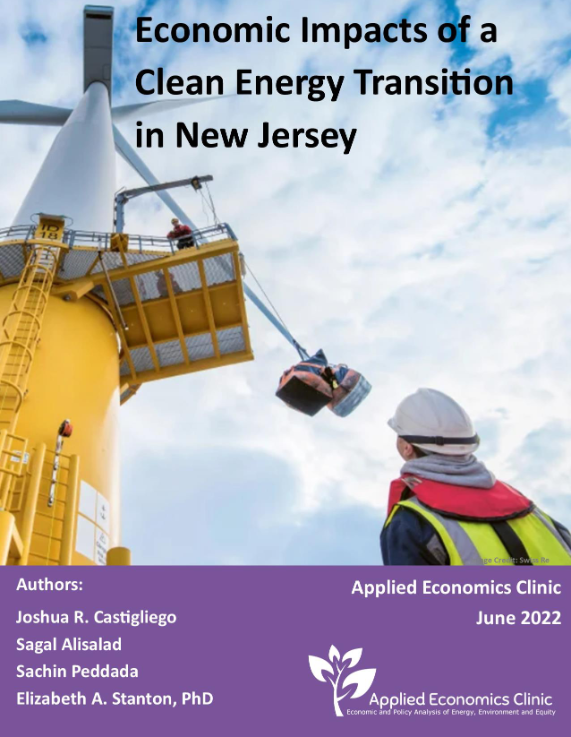
Economic Impacts of a Clean Energy Transition in New Jersey

By Joshua R. Castigliego, Sagal Alisalad, Sachin Peddada, and Liz Stanton, PhD - Applied Economics Clinic, June 7, 2022

Researcher Joshua Castigliego, Assistant Researchers Sagal Alisalad and Sachin Peddada, and Senior Economist Liz Stanton, PhD prepared a report on the economic impacts associated with a clean energy transition in New Jersey that aims to achieve the State’s climate and energy goals in the coming decades. AEC staff find that adding in-state renewables and storage, and electrifying transportation and buildings creates additional job opportunities, while also bolstering the state’s economy. From 2025 to 2050, AEC estimates that New Jersey’s clean energy transition will result in almost 300,000 more “job-years” (an average of about 11,000 jobs per year) than would be created without it. AEC also identifies a variety of additional benefits of a clean energy transition, including several benefits that are conditional on the design and implementation of the transition.

In a companion publication to this report—Barriers and Opportunities for Green Jobs in New Jersey—AEC discusses equity, diversity and inclusion in New Jersey’s clean energy sector along with barriers that impede equitable representation in New Jersey’s green jobs.

Download a copy of this publication here (PDF).

Pages

The Fine Print I:

Disclaimer: The views expressed on this site are not the official position of the IWW (or even the IWW’s EUC) unless otherwise indicated and do not necessarily represent the views of anyone but the author’s, nor should it be assumed that any of these authors automatically support the IWW or endorse any of its positions.

Further: the inclusion of a link on our site (other than the link to the main IWW site) does not imply endorsement by or an alliance with the IWW. These sites have been chosen by our members due to their perceived relevance to the IWW EUC and are included here for informational purposes only. If you have any suggestions or comments on any of the links included (or not included) above, please contact us.

The Fine Print II:

Fair Use Notice: The material on this site is provided for educational and informational purposes. It may contain copyrighted material the use of which has not always been specifically authorized by the copyright owner. It is being made available in an effort to advance the understanding of scientific, environmental, economic, social justice and human rights issues etc.

It is believed that this constitutes a 'fair use' of any such copyrighted material as provided for in section 107 of the US Copyright Law. In accordance with Title 17 U.S.C. Section 107, the material on this site is distributed without profit to those who have an interest in using the included information for research and educational purposes. If you wish to use copyrighted material from this site for purposes of your own that go beyond 'fair use', you must obtain permission from the copyright owner. The information on this site does not constitute legal or technical advice.
