

You are here

jobs

Transit Equity Day: Livestream 2022

Workers Can’t Wait: Just Transition Now – Building Global Labour Power For Climate Justice

What Germany’s Effort to Leave Coal Behind Can Teach the U.S.

By Alec MacGillis - ProPublica, January 31, 2022

In late September, just before the German parliamentary elections, the Alternative für Deutschland held a large campaign rally in Görlitz, a picturesque city of about 56,000 people across the Neisse River from Poland. I was making my way down a narrow street toward the rally when I entered a square that had been dressed up as Berlin circa 1930, complete with wooden carts, street urchins and a large poster of Hitler.

Görlitz, which was barely damaged in the Second World War, often stands in for prewar Europe in movies and TV shows. (“Babylon Berlin,” “Inglourious Basterds” and other productions have filmed scenes there.) It was a startling sight nonetheless, especially since, a few hundred yards away, a crowd was gathering for the AfD, the far-right party whose incendiary rhetoric about foreign migrants invading Germany has raised alarms in a country vigilant about the resurgence of the radical right.

In fact, at the rally, the rhetoric about foreigners from the AfD’s top national candidate, Tino Chrupalla, was relatively mild. Germany’s general success with handling the wave of more than a million refugees and migrants who arrived in the country starting in 2015 has helped undermine the party’s central platform. Chrupalla moved on from migrants to other topics: the threat of coronavirus-vaccination mandates for schoolchildren, the plight of small businesses and the country’s desire to stop burning coal, which provides more than a quarter of its electricity, a greater share even than in the United States.

Coal has particular resonance in the area around Görlitz, one of the country’s two large remaining mining regions. Germany’s coal-exit plan, which was passed in 2020, includes billions of euros in compensation for the coal regions, to help transform their economies, but there are reports that some of the money has been allocated to frivolous-sounding projects far from the towns most dependent on mining. Chrupalla, who is from the area, listed some of these in a mocking tone and told the crowd that the region was being betrayed by the government, just as it had been after German reuni­fication, when millions in the former East Germany lost their jobs, leading many to abandon home for the West. “We are being deceived again, like after 1990,” he said.

Such language was eerily familiar. For years, I had been reporting on American coal country, where the industry’s decadeslong decline has spurred economic hardship and political resentment. In West Virginia, fewer than 15,000 people now work in coal mining, down from more than a 100,000 in the 1950s. The state is the only one that has fewer residents than it did 70 years ago, when the U.S. had a population less than half its current size — a statistic that is unlikely to surprise anyone who has visited half-abandoned towns such as Logan, Oceana and Pine­ville. Accompanying the decline has been a dramatic political shift: A longtime Democratic stronghold, West Virginia was one of only 10 states to vote for Michael Dukakis in 1988; in 2020, it provided Donald Trump with his second-­largest margin of victory, after Wyoming, which also happens to be the country’s largest coal producer, ahead of West Virginia.

Report: The Fossil Fuel Industry’s Job Claims are “Wildly Inaccurate”

By Dan Bacher - CounterPunch, January 28, 2022

The Western States Petroleum Association (WSPA), the most powerful corporate lobbying group in Sacramento, claims that there are 368,000 jobs in the oil and gas industry in California.

“The oil and gas industry is a vital part of California’s energy mix,” WSPA stated on their website. “As a leading economic force and major employer, we proudly contribute to communities across the state, providing more than 368,000 jobs in CA.” www.wspa.org/…

But a just-released Food & Water Watch analysis counts just 22,000 jobs in the industry in California, based on Department of Labor statistics — and says this total has dropped 40 percent over the past decade.

“Overall, oil and gas production account for barely one-tenth of 1 percent of all employment in California,” the analysis revealed.

WSPA spent a total of $4,267,181 on lobbying California legislators and officials in 2020 and $8.8 million in 2019 as thousands of oil and gas drilling permits were approved by CalGEM, the state’s oil and gas regulatory agency: www.citywatchla.com/…

The research from the environmental organization Food & Water Watch debunks fossil fuel industry claims about job creation throughout the U.S. showing that “overall employment has suffered even as production has increased.”

“When Gov. Gavin Newsom announced modest plans to phase out permitting for new oil production in California, industry advocates freaked out,” according to the analysis. “The Western States Petroleum Association claimed that the oil industry supports close to 368,000 jobs in the state. That is surprising since, according to the Bureau of Labor Statistics, only 22,000 Californians were involved in oil production in 2020, down 40 percent from the industry’s peak in 2012. In the Golden State, oil and gas production accounts for barely one-tenth of 1 percent of all employment.”

The analysis notes that one of the most misleading aspects of industry jobs analysis is the conflation of direct jobs with indirect and induced jobs.

“Direct jobs are positions directly within a given industry. Indirect jobs are those within the supply chain that supports that industry, while induced jobs are positions supported by wages from both direct and indirect jobs. Indirect and induced jobs account for nearly 75 percent of the top-line numbers that some oil and gas companies are referencing. Misattributing these jobs to the oil and gas industry itself distorts the size and scope of the industry’s payroll,” the analysis noted.

As the state continues to suffer from devastating fires and drought and salmon, Delta smelt and other fish species continue on the path to extinction, both the state and federal governments continue to approve oil and gas well permits in California.

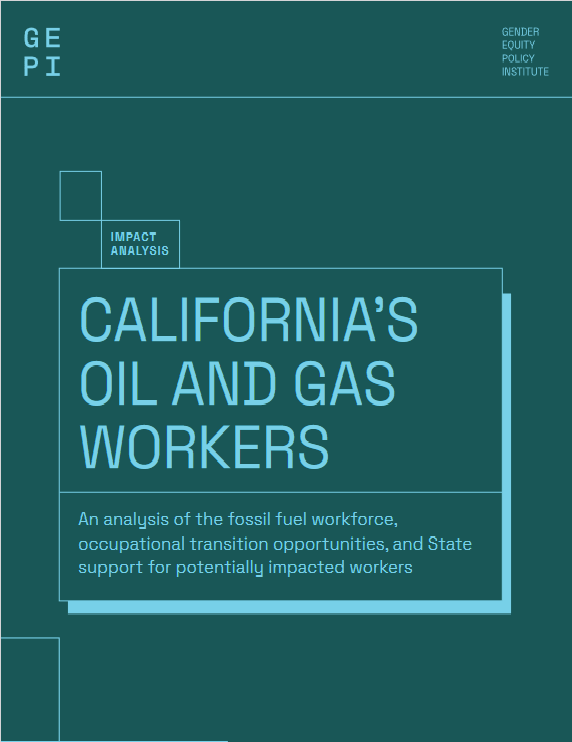
Impact Analysis: California’s Oil and Gas Workers

By Staff - Gender Equity Policy Institute, January 23, 2023

California’s ambitious climate goals, supported by state and federal investment, will create enormous economic opportunity over the coming decades. To meet the 2045 target of carbon neutrality, a 100% clean electric grid, and a 90% reduction in oil consumption and refinery production, the state will need to modernize its electrical grid and build storage capacity to meet increased demand for electricity. Carbon management techniques, plugging orphan wells, and the development of new energy sources such as geothermal will all come into play, providing economic opportunities to workers and businesses alike. Reducing use of polluting fossil fuels will likewise result in significant health benefits to Californians, especially to communities disproportionately burdened by polluting enterprises and proximity to freeways.

Supported by state investment and federal funding through the Infrastructure Investment and Jobs Act and the Inflation Reduction Act, the actions necessary to tackle the challenges of climate change are projected to create 4 million new jobs in the state. California is investing in developing the clean energy workforce, with an equity commitment to recruit and train historically disadvantaged and under- represented communities.

Decarbonizing the economy and accelerating the adoption of clean energy is necessary if we are to preserve a habitable planet. Progress to a carbon neutral future is already well underway in the state. Wind and solar power are less expensive than natural gas or coal powered electricity. A large majority of Californians are concerned about climate change and support action to address its impacts.

However, as with all sectoral economic change, some industries will grow and thrive, while others will shrink, leaving some of their workers behind. Labor unions and trades groups are rightly concerned that workers are not forced to abandon skills developed over their careers and thrown into an inhospitable labor market with no support.

Thus, a key challenge in meeting California’s climate action goals is to devise a fair, equitable, and empirically-based policy to provide support for workers at risk of unemployment and income loss as many factors combine to reduce demand in state for oil and gas products.

Coal Miners Weren’t Happy When Joe Manchin Derailed Build Back Better

By Austyn Gaffney - Sierra, January 19, 2022

The United Mine Workers of America issued a statement criticizing the senator for withdrawing his support from the legislation:

When West Virginia senator Joe Manchin III, a well-known coal baron, withdrew support from the Build Back Better agenda, the Biden administration’s landmark climate and social safety net bill, an influential coal-mining union was quick to respond.

The United Mine Workers of America (UMWA), a labor union formed in 1890 to organize coal miners seeking safe working conditions and fair pay, released a statement by international president Cecil E. Roberts on December 20 characterizing the union’s relationship with Manchin as “long and friendly” but expressing disappointment that the bill didn’t pass. (On the same day, the AFL-CIO, the largest federation of American labor unions, released a similar statement.)

“We urge Senator Manchin to revisit his opposition to the legislation and work with his colleagues to pass something that will help keep coal miners working,” Roberts wrote, “and have a meaningful impact on our members, their families, and their communities.”

Given the UMWA’s history with Manchin—he has been an honorary member since 2020—it was a notable reminder of just how much is at stake for miners and their communities as the president’s signature measure hangs in the balance. The Build Back Better legislation includes important items for the UMWA, like incentives to build manufacturing facilities in post-coal communities, financial penalties for employers who deny workers their rights to unionize, and an extension of the black lung trust fund, a levy paid by coal companies that provides a small monthly payment to miners with pneumoconiosis, a disease caused by coal dust and silica inhalation. 

A Green New Deal for all: The centrality of a worker and community-led just transition in the US

By J. Mijin Cha, Dimitris Stevis, Todd E. Vachon, Vivian Price, and Maria Brescia-Weiler - Labor Network for Sustainability, January 2022

This paper argues that labour and community-led advocacy efforts towards a just transition are fundamental to delivering the promises of a Green New Deal (GND) and a just post-carbon world. To this end, an ambitious, far-reaching project was launched by the Labor Network for Sustainability, a non-governmental organization dedicated to bridging the labor and climate movements, in Spring 2020 called the “Just Transition Listening Project’’ (JTLP).

Over the course of several months, the JTLP interviewed over 100 individuals, including rank-and-file union members, union officials, environmental and climate justice advocates, and Indigenous and community advocates to understand what makes transition “just,” what opportunities exist for a broad coalition to advance a GND-style proposal, and to document the struggles facing working people and communities across the U.S. In doing so, we utilize the tools of political geography to examine the politics of spatiality, networks, and scale as well as the geographical and spatial dimensions of policy and political-economic institutions. We are particularly mindful of two spatial dynamics.

First, that transition policies, particularly in a hegemonic country like the USA, have global implications. The industrial transition that took place from the 1970s to the 1990s, for example, bred nativism because it cast other countries as the cause of the problem.

Second, critical geographers have pointed out that environmental justice (EJ) has been neoliberalized in the U.S. as a result of its operationalization, spatialization, and administration, starting with the Clinton Administration. Because JT is rising on the national and global agendas, we pay close attention to whether these dynamics that affected EJ are also operating with respect to JT, as well as how they can be contained.

This research is particularly timely given the ongoing federal governmental efforts to contain the spread of COVID-19 and provide basic economic and social supports. The process of the JTLP parallels the goals of the GND–intersectional efforts rooted in community knowledge for the development of a people-led GND. This paper details the process of the JTLP and the prospects for intersectional, broad-based movements that are the only way a GND can be realized.

Read the text (Link).

Building a Just Transition for a Resilient Future: A Climate Jobs Program for Rhode Island

By Lara Skinner, J. Mijin Cha, Avalon Hoek Spaans, Hunter Moskowitz, and Anita Raman - The Worker Institute and The ILR School, January 2022

A new report released today by climate and labor experts at Cornell University in collaboration with the Climate Jobs Rhode Island Coalition outlines a comprehensive climate jobs action plan to put Rhode Island on the path to building an equitable and resilient clean-energy economy.

The report lays out a series of wide-ranging policy recommendations to transition the Ocean State’s building, school, energy, transportation, and adaptation sectors to renewable energy with the strongest labor and equity standards. Core provisions of the plan include decarbonizing the state’s K-12 public school buildings, installing 900 MW of solar energy statewide, 1,300 MW of offshore wind energy, and modernizing the state’s electrical grid by 2030. 

“Rhode Island is in a unique position as a state, in 2019 it had the lowest energy consumption per capita across all the United States. Rhode Island can use climate change as an opportunity to eliminate carbon emissions, increase equity, and create high-quality jobs that support working families and frontline communities,” says Avalon Hoek Spaans, Research and Policy Development Extension Associate for the Labor Leading on Climate Initiative at the Worker Institute, Cornell ILR School and one of the authors of the report.

The Worker Institute’s Labor Leading on Climate Initiative in partnership with the Climate Jobs National Resource Center, and Climate Jobs Rhode Island, began a comprehensive research, educational, and policy process in early 2021 to develop an implementation framework to drastically reduce emissions in the state while creating high-quality union family sustaining jobs.

Over the past year, the Labor Leading on Climate team has conducted outreach to numerous leaders of the labor and environmental movements as well as policymakers and experts in the climate, energy, and labor fields to better understand the challenges and opportunities that climate change and climate mitigation and adaptation presents to Rhode Island workers and unions.

“With Rhode Island on the frontlines of the climate crisis, it will take bold, ambitious action to combat climate change and reduce greenhouse gas emissions and pollution to the levels that science demands. Fortunately, tackling climate change is also an opportunity to address the other crises Rhode Island is facing: inequality and pandemic recovery,” says Lara Skinner, Director, Labor Leading on Climate Initiative, at the Worker Institute, Cornell ILR School and one of the authors of the report.

“As a small state with one of the lowest emissions in the country, Rhode Island can be innovative and efficient, employing cutting-edge approaches to reverse climate change and inequality. Rhode Island has the potential to be the first state in the country to fully decarbonize and build out a net zero economy with high-quality union jobs. This would make Rhode Island's economy stronger, fairer, and more inclusive,” says Lara Skinner, Director, Labor Leading on Climate Initiative, at the Worker Institute, Cornell ILR School and one of the authors of the report.

Read the text (PDF).

A Clean Energy Pathway for Southwestern Pennsylvania

Beyond a Just Transition

Pages

The Fine Print I:

Disclaimer: The views expressed on this site are not the official position of the IWW (or even the IWW’s EUC) unless otherwise indicated and do not necessarily represent the views of anyone but the author’s, nor should it be assumed that any of these authors automatically support the IWW or endorse any of its positions.

Further: the inclusion of a link on our site (other than the link to the main IWW site) does not imply endorsement by or an alliance with the IWW. These sites have been chosen by our members due to their perceived relevance to the IWW EUC and are included here for informational purposes only. If you have any suggestions or comments on any of the links included (or not included) above, please contact us.

The Fine Print II:

Fair Use Notice: The material on this site is provided for educational and informational purposes. It may contain copyrighted material the use of which has not always been specifically authorized by the copyright owner. It is being made available in an effort to advance the understanding of scientific, environmental, economic, social justice and human rights issues etc.

It is believed that this constitutes a 'fair use' of any such copyrighted material as provided for in section 107 of the US Copyright Law. In accordance with Title 17 U.S.C. Section 107, the material on this site is distributed without profit to those who have an interest in using the included information for research and educational purposes. If you wish to use copyrighted material from this site for purposes of your own that go beyond 'fair use', you must obtain permission from the copyright owner. The information on this site does not constitute legal or technical advice.
