You are here

green jobs

Jobs and equitable transition: Bridging the chasm between rhetoric and action

By Sean O'Leary - Ohio River Valley Institute, May 26, 2021

There was a time when the sight of rows of office workers hammering away at their Friden adding machines would have sent me into paroxysms of delight because I, the Victor Comptometer salesman, had a new and better “programmable calculator” that could kick the Friden’s ass.

I was a young 1970s college graduate entering the workforce at the tail end of the era of mechanical business automation. Typewriters, adding machines, and mechanical cash registers were still the workhorses of stores and offices.

Behind all that machinery were companies – Burroughs, Monroe, Friden, Victor – whose names were as familiar then as Cisco, Oracle, and SAP are today. And those companies supported factories, sales offices, and repair facilities that provided living wage jobs to hundreds of thousands of workers and their families.

Then, within a little more than a decade, it was all gone. A year after I fizzled as a Victor salesman, I was playing at home with my new Radio Shack TRS-80 home computer and five years later, instead of an adding machine and typewriter on my desk at work, there sat an Apple II desktop computer, precursor to the Mac.

Gone too were those hundreds of thousands of jobs plunging not only workers and families, but entire communities, into financial crisis. One could argue that Dayton, Ohio, once home to National Cash Register and the business forms giant, Standard Register, never recovered.

The knock-out blow suffered by the office automation industry was as ferocious and sudden as the one that hit the American steel industry a few years earlier, the textile industry a few decades before that, and also as the one that possibly faces workers in the fossil fuel economy today.

So how did we as a society help displaced workers and communities manage the economic consequences of the transition from the mechanical workplace to a digital one? We didn’t. Thanks to the New Deal, we had unemployment insurance and Medicare and Medicaid were brand spanking new. But that was about it – a little help for individuals and families and none whatsoever for communities.

American Jobs Plan Can Accelerate Solar Power in West Virginia

By Autumn Long and Ted Boettner - Ohio River Valley Institute, May 25, 2021

As a recent article in Forbes noted, the ‘dam has broken’ in West Virginia for solar power. While solar energy comprises less than 0.2 percent of electricity production in the state today, the market for solar energy is marching forward. Despite not having a renewable energy portfolio standard – which would require that utilities get a certain percentage of the electricity they sell in the state from renewable resources – like 30 other states, West Virginia lawmakers have started opening more doors for solar power. For example, state lawmakers this year legalized purchase power agreements (PPAs) to allow third parties to own and operate solar installations for customers while charging them a fixed rate that is typically lower that what the customer pays for electricity. In 2020, the West Virginia Legislature created a utility solar program that allows the state’s investor-owned utilities (FirstEnergy and American Electric Power) to produce as much as 200 megawatts of solar electricity each.

A flurry of new solar projects is now under development in the state. Toyota announced plans to spend $4.9 million to construct a 2.6-Megawatt solar array at its manufacturing plant in Buffalo, West Virginia. In October 2020, the WV Public Service Commission approved plans for a $90 million investment to build a 90-Megawatt solar farm in Raleigh County. Earlier this year, a 100-Megawatt utility-scale solar project was announced at the former Dupont Potomac River Works manufacturing facility in Berkeley County. And earlier this month, Nitro Construction Services acquired local solar installation company Revolt Energy, with plans to expand operation throughout the state on former coal mine sites. Revolt had recently installed a 487-kilowatt rooftop solar array (1,200 solar panels) at Nitro Construction Services’ headquarters in Putnam County.

According to the Solar Energy Industries Association (SEIA), West Virginia ranks last (50th) in solar production in the nation with just 11.2 megawatts of installed solar power and less than $35 million in total solar investment in the state. Total solar jobs in the state were just 311 in the 4th quarter of 2020, with 18 solar companies operating in the state. Between 2012 and 2020, the number of solar jobs in West Virginia has grown by 241.

An October 2020 report by E2 found that jobs in solar pay close to what jobs in the coal, oil, and gas industries pay, $24.48 an hour (median) compared to $24.37 an hour (median), respectively. Approximately 10 percent of solar industry jobs are unionized, according to the Solar Foundation, which is above the national average and similar to levels found throughout the construction industry. Wage data for solar employment is not available for West Virginia, but it is likely below the national average.

There are a number of policy proposals at the federal level that could lead to significant acceleration in West Virginia’s solar industry. President Biden’s American Jobs Plan includes two key provisions, including a 10-year extension of the federal solar Investment Tax Credit (ITC), which currently offers a 26% tax credit for solar installations, and an expanded direct cash payment in lieu of the ITC that allows solar owners to receive money even if they don’t have taxable income, much like a refundable tax credit. A cash grant option would ensure equitable benefits of the ITC are accessible to low- and moderate-income households, people with low tax liability, and nonprofit institutions such as schools, churches, local governments, and rural electric cooperatives.

Growth of ZEV’s impacts trucks, buses – and their drivers too

By Elizbeth Perry - Work and Climate Change Report, May 17, 2021

The International Energy Agency released its annual Global Electric Vehicle Outlook report for 2021 in April, providing data, historical trends and future projections. Despite the pandemic, there was a 41% increase in electric vehicle registrations in 2020 – compared to a 16% contraction of the overall global automobile market. There are now more than 10 million electric cars on the world’s roads, and for the first time, Europe overtook China as the centre of the global electric car market. In addition, there are roughly 1 million electric vans, heavy trucks and buses globally. A separate forecast by Bloomberg New Energy Finance, as summarized by The Guardian, projects that electric vehicles will reach price parity with internal combustion engine (ICE) vehicles by 2027. Another April report from Boston Consulting Group forecasts that zero-emission vehicles will replace ICE vehicles as the dominant powertrain for new light-vehicle sales globally just after 2035.

Most policy discussions of the electrification of transportation focus on the potential for GHG emissions reductions, consumer preferences, and the economic impacts for the automotive industry. There has been a lack of attention on operational workers – with a few exceptions. A 2020 report from the International Labour Organization and the United Nations Economic Commission for Europe, Jobs in green and healthy transport: Making the green shift , offers modelling of employment impacts in a broad definition of transportation, including personal vehicles, trucks and public transport. It focuses on Europe, and discusses the employment impacts in both manufacturing and operation.

Future skills for the energy efficient building workforce

By Elizbeth Perry - Work and Climate Change Report, May 19, 2021

A recent report from ECO Canada,  Assessment of Occupational and Skills Needs and Gaps for the Energy Efficient Buildings Workforce, focuses on the occupations and skills needed for designing, constructing, managing, and retrofitting energy efficient commercial and institutional buildings and multi-unit residential buildings.  The report states that much of the technology, materials, and processes are in place, but workforce skills still need to be developed – for example, under a “building-as-a-system” approach,  workers are increasingly called upon to function within multi-disciplinary teams, requiring soft skills such as collaboration and facilitation. Such a system also requires a workforce culture shift. A section called “ Future-Proofing the Energy Efficient Building Sector”  provides a summary of core and growing occupations and skills related to design, construction, operation, and retrofitting of energy efficient buildings. The report assesses specific occupation skills and gaps, and recommends ways to connect with workers– and includes unions amongst the stakeholder groups which can support skills acquisition. The 73-page report is available for free download from this link (registration required).

“What’s the alternative?”: Answering the hardest question asked by workers and communities that feel threatened by energy transition

By Sean O'Leary - Ohio River Valley Institute, May 18, 2021

At ORVI, we’ve documented the inability of the fossil fuel and petrochemical industries to serve as engines for job growth and prosperity in Appalachia. Although these findings may be greeted with doubt, disbelief, and sometimes anger, we find that, once the numbers sink in and people in the mining and fracking regions of Pennsylvania and the Ohio Valley look around at their communities — the struggling downtowns, declining populations, and the departures of their sons and daughters to places far away in search of opportunity — reality usually takes hold.

It can be a profoundly sad moment. But, for local leaders who may have invested years promoting these industries as economic saviors, the realization can be bitter and give rise to a question that is equal parts a challenge and a plea — What’s the alternative?

When you’re on the receiving end of that question, you feel its weight. And, if you don’t have an answer, you can feel that you’re stealing someone’s — maybe an entire community’s — hope and you’re leaving them with nothing.

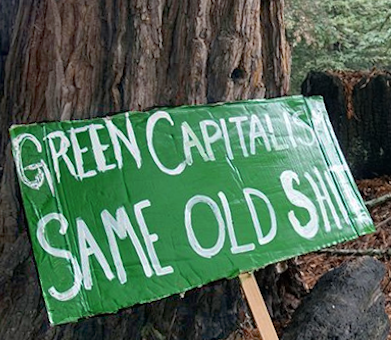
Green Economy, Green Capitalism? The Case Against The Case for Climate Capitalism

By Nick Grover - The Bullet, May 14, 2021

Even now, with a ten-year timeframe left for action, it’s rare for the climate crisis to be treated as the emergency it is. So, credit where due to Tom Rand. In his The Case for Climate Capitalism: Economic Solutions for a Planet in Crisis (Toronto: ECW Press, 2020), Rand calls for a rapid transition away from fossil fuels and toward renewables; he blames the political and business elite for the mess and says they will have to pay the price as markets turn against oil and assets are stranded; he even advocates for expansion of public transit. Where the book gets less refreshing is Rand’s tone toward the people who have been saying these things all along: his secondary enemy, leftists fusing demands for climate action with calls for economic justice.

Rand’s Case for Climate Capitalism aims to preserve and “co-opt” the forces of capitalism to usher in a transition toward green tech. His case is presented as simple pragmatism: the emergency we face affords us no time to discuss economic reforms; we must unite and do what works instead of holding out for a perfect system. His concern is that left ideas like the Green New Deal and Leap Manifesto – which wed strong climate action with job guarantees, labour protections, taxing the rich, and expanding social programs – alienate conservatives and the business class when we need them in our coalition to save the planet.

Congress Should Enact a Federal Renewable Electricity Standard and Reject Gas and False Solutions

By various - (690 Organizations), May 13, 2021

Dear Majority Leader Schumer, Speaker Pelosi, Chairman Manchin, and Chairman Pallone,

On behalf of our millions of members and activists nationwide, we, the undersigned 697 organizations—including climate, environmental and energy justice, democracy, faith, Indigenous, and racial justice groups—urge you to pass a Renewable Electricity Standard (RES) in the infrastructure package and reject gas and other false climate solutions to address the climate emergency.

As Congress prepares to pass a historic infrastructure package and President Biden has globally pledged to slash carbon emissions by 50% below 2005 levels by 2030, we should look to the 28 states, Washington, D.C., and Puerto Rico that have passed Renewable Electricity Standards (also known as renewable portfolio standards), as opposed to only seven states with Clean Electricity Standards (CES). The bold leadership demonstrated in RES-leading states like Hawaii, Vermont, and Washington, D.C. provide a roadmap to building a new renewable energy future. Funding this transition must start with shifting all fossil fuel subsidies to mass renewable energy deployment.

Renewable energy sources are sources that naturally replenish and are most often defined as solar, wind, and geothermal power. In contrast, so-called “clean” energy standards generally encompass these renewable sources but also include other technologies, like gas with or without carbon capture and sequestration, biomass, and nuclear, which are significant sources of pollution and carry a host of health and safety risks. In order to avoid perpetuating the deep racial, social, and ecological injustices of our current fossil-fueled energy system, Congress should ensure that any federal energy standard does not include these dirty energy sources.

Specifically, we write to express our concern that recent Clean Electricity Standard (CES) legislation, including the CLEAN Future Act (H.R. 1512), embed these injustices because they include gas and false solutions. The inclusion of gas and carbon capture and storage as qualifying energies in any CES undermines efforts to end the fossil fuel era and halt the devastating pollution disproportionately experienced by Black, Brown, Indigenous, and other communities of color in this country. Even a partial credit for fossil fuel resources that attempts to factor in lifecycle emissions runs the risk of subsidizing environmental harm for years to come. Allowing dirty energy to be bundled with clean energy under a federal energy standard would prolong the existence of sacrifice zones around dirty energy investments and delay the transition to a system of 100 percent truly clean, renewable energy.

Utility Workers Union and UCS estimate costs to transition U.S. coal miners and power plant workers in joint report

By Elizabeth Perry - Work and Climate Change Report, May 12, 2021

Hard on the heels of the April statement by the United Mine Workers Union, Preserving Coal Country: Keeping America’s coal miners, families and communities whole in an era of global energy transition, the Utility Workers Union of America (UWUA) jointly released a report with the Union of Concerned Scientists on May 4: Supporting the Nation’s Coal Workers and Communities in a Changing Energy Landscape. This report is described as “a call to action for thoughtful and intentional planning and comprehensive support for coal-dependent workers and communities across the nation.” The report estimates that in 2019, there were 52,804 workers in coal mining and 37,071 people employed at coal-fired power plants – and that eventually all will lose their jobs as coal gives way to cleaner energy sources. Like the United Mine Workers, the report acknowledges that the energy shift is already underway, and “rather than offer false hope for reinvigorated coal markets, we must acknowledge that thoughtful and intentional planning and comprehensive support are critical to honoring the workers and communities that have sacrificed so much to build this country.”

Specifically, the report calls for a minimum level of support for workers of five years of wage replacement, health coverage, continued employer contributions to retirement funds or pension plans, and tuition and job placement assistance. The cost estimates of such supports are pegged at $33 billion over 25 years and $83 billion over 15 years —and do not factor in additional costs such as health benefits for workers suffering black lung disease, or mine clean-up costs. The report states: “we must ensure that coal companies and utilities are held liable for the costs to the greatest extent possible before saddling taxpayers with the bill.” Neither do the cost estimates include the recognized needs for community supports such as programs to diversify the economies, or support to ensure that essential services such as fire, police and education are supported, despite the diminished tax base. 

The report points to the precedents set by Canada’s Task Force on Just Transition for Canadian Coal Power Workers and Communities ( 2018), the German Commission on Growth, Structural Change and Employment (2019), as well as the New Mexico Energy Transition Act 2019 and the Colorado Just Transition Action Plan in 2020. The 12-page report, Supporting the Nation’s Coal Workers and Communities in a Changing Energy Landscape was accompanied by a Technical Report, and summarized in a UCS Blog which highlights the situation in Illinois, Michigan, and Minnesota. A 2018 report from UCS Soot to Solar also examined Illinois.

The National Black Climate Summit

Job creation potential of nature-based solutions to climate change

By Elizabeth Perry - Work and Climate Change Report, May 10, 2021

U.K. think tank Green Alliance commissioned research to measure the economic impact of nature-based investments for a green recovery, and released the results on May 4. The full report, Green Renewal – The Economics of Enhancing the Natural Environment, was written by WPI Economics, and states: “Looking at just three types of enhancement (woodland creation, peatland restoration and urban green infrastructure) we find that an expanded programme of nature restoration could create at least 16,050 jobs in the 20% of constituencies likely to face the most significant employment challenges. We present place-based analysis of the labour market and nature based solutions, which can also be found on an interactive webpage here.” The report emphasizes that nature-based interventions can create jobs in areas that need them the most – stating that two thirds of the most suitable land for planting trees is in constituencies with worse than average labour market challenges.

Jobs for a Green Recovery is a summary report written by Green Alliance, based on the economic WPI report. It emphasizes the impact of Covid on youth employment, stating that 63% of those newly unemployed in 2020-21 are under 25, argues that nature-based jobs are long-term, skilled and productive, and makes specific recommendations for the British government so that such jobs can become part of the U.K. green recovery. Green Alliance estimates that investments in nature-related jobs have a high cost-benefit ratio, with £4.60 back for every £1 invested in peatland, £2.80 back in woodland, and £1.30 back for salt marsh creation.

Jobs for a Green Recovery includes brief U.K. case studies. An interesting a related Canadian example can be found in the new Seed the North initiative, described in The Tyee here . Seed the North is a small start-up company in Northern B.C., with big ambition to scale up. Currently, the project collects wild seed from Canadian trees, uses innovative technology to encase the seed in bio-char, and then uses drone technology to plant seeds in remote forest areas. The result: increased regeneration of disturbed land, restored soil health, a statistically significant contribution to carbon sequestration, and economic benefits flowing through co-ownership to the local First Nations communities who participate.

Pages

The Fine Print I:

Disclaimer: The views expressed on this site are not the official position of the IWW (or even the IWW’s EUC) unless otherwise indicated and do not necessarily represent the views of anyone but the author’s, nor should it be assumed that any of these authors automatically support the IWW or endorse any of its positions.

Further: the inclusion of a link on our site (other than the link to the main IWW site) does not imply endorsement by or an alliance with the IWW. These sites have been chosen by our members due to their perceived relevance to the IWW EUC and are included here for informational purposes only. If you have any suggestions or comments on any of the links included (or not included) above, please contact us.

The Fine Print II:

Fair Use Notice: The material on this site is provided for educational and informational purposes. It may contain copyrighted material the use of which has not always been specifically authorized by the copyright owner. It is being made available in an effort to advance the understanding of scientific, environmental, economic, social justice and human rights issues etc.

It is believed that this constitutes a 'fair use' of any such copyrighted material as provided for in section 107 of the US Copyright Law. In accordance with Title 17 U.S.C. Section 107, the material on this site is distributed without profit to those who have an interest in using the included information for research and educational purposes. If you wish to use copyrighted material from this site for purposes of your own that go beyond 'fair use', you must obtain permission from the copyright owner. The information on this site does not constitute legal or technical advice.