You are here

International Longshore and Warehouse Union (ILWU)

Green Unionism on the Chevron Richmond Refinery Workers Picket Line

By That Green Union Guy - IWW Environmental Union Caucus, April 15, 2022

Since Monday, March 21, 2022, the workers at the Chevron oil refinery in Richmond, California, members of the United Steelworkers Local 5 have been on strike and picketing the facility after voting down the company’s latest contract offer, which workers say contained insufficient wage increases. The bosses have responded by bringing in scabs (including managers from other Chevron facilities). The strike has gotten a good deal of media coverage:

However, the capitalist (and progressive) media have mostly missed some important details.

First of all, the striking refinery workers and their elected union leaders continue to emphasize that their issues extend beyond narrow bread and butter issues, such as wages and benefits. A major concern that they continue to articulate is that Chevron continues to try and cut unionized safety jobs and refuses to hire sufficient workers to safely and adequately staff the facility. Workers have complained of 12-hour days and six-day workweeks. All of these deficiencies not only risk the health and safety of the workers, but the surrounding, mostly BIPOC communities as well. Worse still, they have adverse environmental effects, a problem that hasn't been lost on the striking workers. As stated by USW Local 5 representative, B.K White:

“If we had more people and could get a better pay rate, maybe our members wouldn’t feel obligated to come in and work as many as 70 hours a week to make ends meet. We don’t believe that is safe. (that and the use of replacement workers) is at the detriment of the city of Richmond and the environment.”

Even less noticed by the media has been the presence of environmental justice activists (including, but not limited to, the Asian Pacific Environmental Network, Communities for a Better Environment, Extinction Rebellion, Fossil Free California, Richmond Progressive Alliance, Sierra Club, Sunflower Alliance, Sunrise Movement, and 350), various socialist organizations (including DSA in particular), and members from the nearby front-line BIPOC communities, who have joined the pickets in solidarity with the workers, something the workers have also not hesitated to point out. Indeed, in spite of the fact that many environmental justice activists and community members are harshly critical of Chevron's role in turning the city of Richmond into a capital blight infested sacrifice zone, they recognize that the workers are not their enemies nor are the latter responsible for the damage done by the company. On the contrary, many recognize that the unionized workforce is one of the best mitigations against far worse capital blight (it bears mentioning that there has also been a good deal of support and picket line presence from rank and file workers and union officials from many other unions, including the AFSCME, IBEW, IWW, ILWU, SEIU, UFCW, and the Contra Costa County Central Labor Council).

Such seemingly unlikely bonds of solidarity, though delicate and, at times, fragile didn't arise out of thin air, but, in fact, have resulted from years of painstaking grassroots organizing.

ILWU Supports CalPERS Divestment from Fossil Fuels

Resolution Urging Support of SB 1173 (Gonzalez) Fossil Fuel Divestment Act
Adopted by the ILWU NCDC – March 26, 2022

WHEREAS, climate change, through rising sea levels, drought, heat waves, and increased wildfires is already negatively affecting human wellbeing, ecosystems and biodiversity; and 

WHEREAS, climate change is an issue of environmental justice, disproportionately impacting Indigenous communities, communities of color, and low income communities due to historical oppression, inequity of power, and lack of access to resources for prevention and relief; and

WHEREAS, the World Economic Forum recognizes the climate crisis as “a child-rights crisis” and says “the adverse weather events caused by a warming planet affect children first and worst”; and

WHEREAS, an analysis from the Harvard T.H. Chan School of Public Health indicates that the effects of heat, wildfires, storms, floods, and droughts can negatively affect both the physical and mental health of children. The negative effects on children’s physical health from the burning of fossil fuels and climate change include impacts on allergies, asthma, brain development, low birth weight, and preterm birth; and

WHEREAS, the American Academy of Pediatrics recognizes that the physical and mental impacts of climate change “not only directly threaten the lives and safety of children, they put them at risk of mental health problems—and can also cause lasting effects when they destroy their communities and their schools”; and

WHEREAS, a review of the psychological effects of climate change on children finds that “effects of climate change place children at risk of mental health consequences including PTSD, depression, anxiety, phobias, sleep disorders, attachment disorders, and substance abuse. These in turn can lead to problems with emotion regulation, cognition, learning, behavior, language development, and academic performance”; and 

WHEREAS, independent studies by financial consulting firms Blackrock and Meketa found divestment reduces risk, and improves, not weakens, investment returns; and

WHEREAS, a Corporate Knights study found if CalPERS and CalSTRS had divested in 2010 they would have gained $11.9 and $5.5 billion respectively by 2019; and 

WHEREAS, the International Panel on Climate Change concluded in 2018 that we have 12 years to make dramatic cuts in the use of fossil fuels (coal, oil, gas and tar sands) if we are to keep warming to 1.5o C and avoid more catastrophic change; and

WHEREAS, the fossil fuel industry is the single most powerful obstacle to addressing climate change, using their immense lobbying power in Washington D.C. and Sacramento to block climate legislation; and 

WHEREAS, fossil fuel companies' own scientists knew their products were causing climate change, but the companies kept it secret; and 

WHEREAS, to effectively address climate change, most fossil fuel reserves must remain in the ground, never to be used. This makes fossil fuel stocks a risky investment; and

WHEREAS, divestment in specific segments or business operations by CalPERS and CalSTRS is already standard practice and is specifically allowed by the California Constitution; and

WHEREAS, divestment means selling directly held or commingled assets including fossil fuel public equities and corporate bonds; and

WHEREAS, the California Climate Jobs Plan provides a comprehensive roadmap for decarbonization and just transition from a fossil fuel based economy; and

WHEREAS, The ILWU Northern California District Council has endorsed the California Climate Jobs Plan (in February 2022);

THEREFORE LET IT BE RESOLVED, that the ILWU NCDC strongly supports SB 1173 (Gonzalez) the fossil fuel divestment act. And upon passage, a copy of this resolution will be sent to Senator Lena Gonzalez’s office requesting that the ILWU NCDC be listed as an official supporter of the bill.

California Climate Jobs Plan Continues to Gain Union Endorsements

By That Green Union Guy - IWW Environmental Union Caucus - March 11, 2022

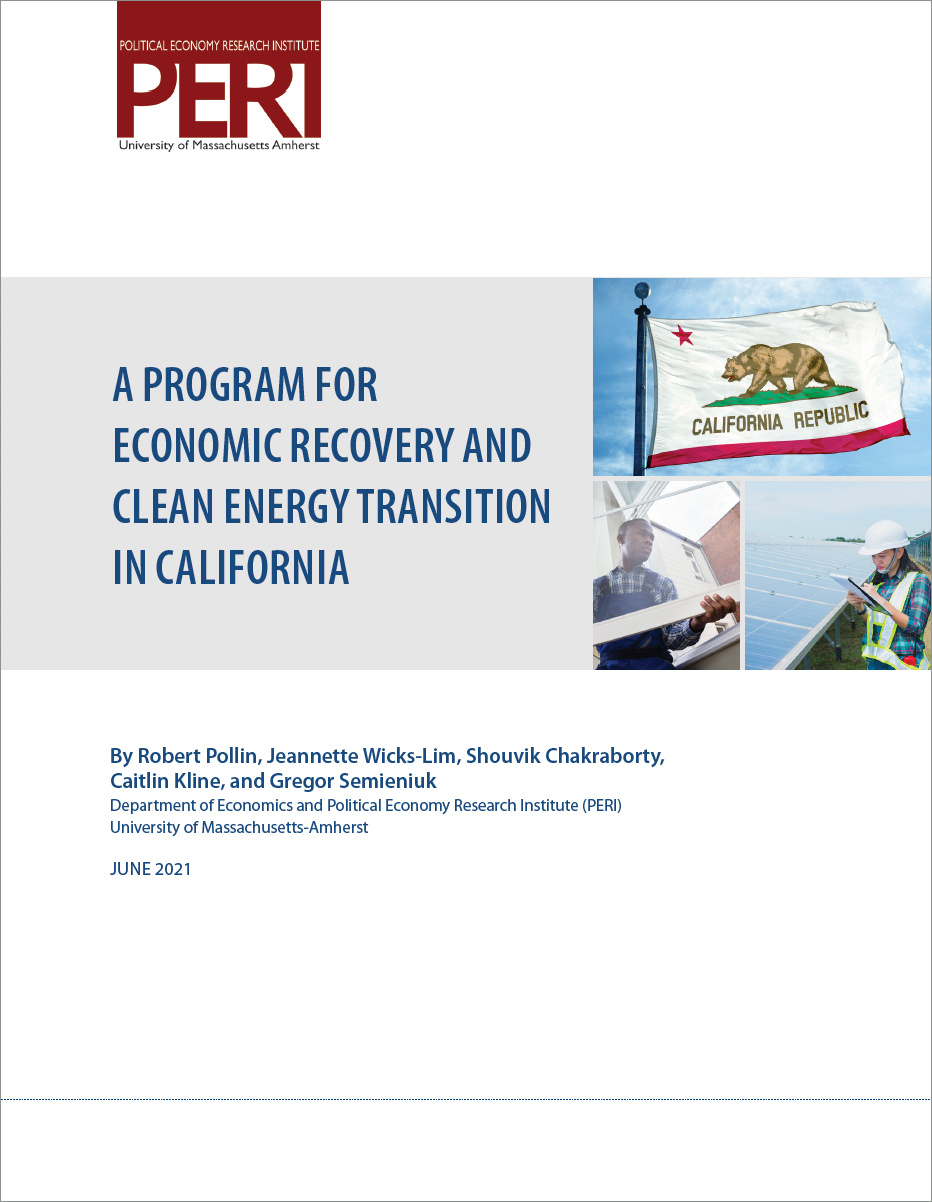
The California Climate Jobs Plan, popularly known as "the Pollin Report"--which has been described as a "sholvel ready just transition/Green New Deal" plan--and was immediately endorsed by nineteen California based labor unions, including three United Staeelworkers Union locals which primarily represent refinery workers upon its unveiling has since gained the support of many additional unions. The following unions (so far) have since endorsed the plan (knowing that while the plan isn't perfect, it's at least a step in a positive direction):

November 2021:

  • Inland Boatmen's Union (IBU), SF Bay Region (an affiliate of the ILWU)
  • Railroad Workers United
  • IWW San Francisco Bay Area General Membership Branch

February 2022:

  • International Lonshore and Warehouse Union (ILWU) Northern California District Council (NCDC)

The council is composed of delegates from the following ILWU Locals:

  • ILWU Local 6 (Bay Area Warehouse)
  • ILWU Local 10 (Bay Area Longshore)
  • ILWU Local 34 (Bay Area Shipping Clerks)
  • ILWU Local 75 (Bay Area Dock Security Guards)
  • ILWU Local 91 (Bay Area “Walking Bosses”)
  • ILWU Local 14 (Eureka; combined)
  • ILWU Local 18 (Sacramento; ditto)
  • ILWU Local 54 (Stockton)
  • Bay Area IBU (already endorsed individually)
  • and the pensioners from all of the above.

However, the NCDC's endorsement does not automatically mean that each of its constituent locals have individually endorsed the plan.

The more unions that endorse and take an active role in motivating the proposal either by lobbying at the California state level, engaging in public actions to promote the goals of the plan, or even engaging in workplace actions (whereaver relevant and practiceble), the greater chances the plan has of being realized.

(That said, it should be noted that this is not an IWW organizing project, although IWW members have been active in securing additional union endorsements).

A sample resolution (a copy of the text adopted by the SF Bay Area IBU) is available here.

Download the plan - here.

ILWU Northern California District Council (NCDC) Resolution in Support of Public Ownership of the Railroads

Adopted by Unanimous Vote: February 16, 2023
Whereas, rail infrastructure the world over is held publicly, as are the roads, bridges, canals, harbors, airports, and other transportation infrastructure; and

Whereas, numerous examples of rail infrastructure held publicly have operated successfully across North America for decades, usually in the form of local/ regional commuter operations and state-owned freight trackage; and

Whereas, due to their inability to effectively move the nation’s freight and passengers during WWI, the U.S. government effectively nationalized the private rail infrastructure in the U.S. for 26 months; and

Whereas, at that time it was agreed by shippers, passengers, and rail workers that the railroads were operated far more effectively and efficiently during that time span; and

Whereas, every rail union at that time supported continued public ownership (the “Plumb Plan”) once the war had ended; and

Whereas, specifically, when the rank & file rail workers were polled by their unions in Decem­ber 1918, the combined totals were 306,720 in favor of continued nationalization with just 1,466 in favor of a return to private ownership; and

Whereas, the entire labor movement at that time was in favor of basic industry being removed from private hands, with the delegates to the 1920 AFL Convention voting 29,159 to 8,349 in fa­vor, overruling the officialdom of the AFL and its conservative position; and

Whereas, in the face of today’s crumbling infrastructure, crowded and clogged highways and city streets, poor air quality, lack of transportation alternatives and deepening climate crisis, ex­panded rail transportation – for both freight and passenger - presents a solution to these social ills and problems; and

Whereas, the rail industry today however is contracting – rather than expanding – at a time when we need more trains, trackage, rail workers, and carloads, not fewer; and

Whereas, the private rail industry is moving 5 to 10% less freight than it did 16 years ago, and in recent years has shuttered diesel shops and classification yards, and has drastically reduced the number of employees; and

Whereas, the private rail freight industry is generally hostile to proposals to run any additional passenger trains on their tracks – despite having legal common carrier obligations to do so - making it difficult if not impossible to expand the nations’ passenger rail network; and

Whereas, the rail industry has come to focus solely on the “Operating Ratio” as a measure of their success, and in doing so have engaged in massive stock buybacks and other measures that deliver short-term gains for stockholders but at the expense of the long-term health and vitality of the industry; and

Whereas, the Class One carriers’ failures to move freight effectively have contributed greatly to the ongoing supply chain crisis, resulting in some of the highest inflation rates in many years; and

Whereas, these “Fortune 500” corporations have raked in record profits, in both “good” years and “bad”, right through the “Great Recession,” the pandemic, and otherwise, right up to the most recent Quarterly financial announcements; and

Whereas, during these years of record profits, these same Class One carries have:

  • Failed to solicit nor accept new but “less profitable” freight traffic.
  • Forwarded less freight than 16 years ago.
  • Stonewalled practically every attempt by Amtrak and other agencies to add passenger ser­vice.
  • Failed to run Amtrak passenger trains on time, despite regulation and law to do so.
  • Downsized the infrastructure, physical plant, and capacity.
  • Eliminated nearly a third of the workforce.
  • Outraged shippers and their associations by jacking up prices, providing poor service, and
  • assessing new demurrage charges.
  • Thumbed their nose at state and federal governments.
  • Blocked road crossing and increased derailments by the implementation of extremely long trains.
  • Threatened and attempted at every turn to run trains with a single crew member.
  • Opposed proposed safety measures, from Positive Train Control (PTC) to switch point indi­cators;
  • the End-of-Train Device (EOT) to Electronically Controlled Pneumatic Brakes (ECP).
  • Taken a hostile stance towards the myriad unions, refused the bargain in good faith, consist­ently demanding concessions, all the while expecting these “essential workers” to labor through the pandemic without a wage increase.

Therefore, be it Resolved that the ILWU NCDC supports the public ownership of the rail infrastructure of the U.S., Canada, and Mexico, to be operated henceforth in the public interest, placed at the service of the people of all three nations; and

Be it Further resolved that the ILWU NCDC urge all of its members to voice their support for this proposal; and

Be it Further Resolved that the ILWU NCDC urges all ILWU locals and IBU regions to take a similar stand; and

Be it finally Resolved that the ILWU NCDC urges all labor unions, environmental and com­munity groups, social justice organizations, rail advocacy groups and others to push for a mod­ern publicly owned rail system, one that serves the nation’s passengers, shippers, communities, and citizens.

Green Unionism against Precarity

By That Green Union Guy - IWW Environmental Union Caucus, January 1, 2022

Editor's Note: all but one or two of the links in this article link to multiple articles, located on the IWW Environmental Union Caucus site, categorized by topic. Therefore, it is to the reader's interest to explore all of the articles brought forth by each link, at their convenience (and that body of information is ever evolving over time).

An edited version of this article appears in New Politics 72.

In a real sense, under capitalism, all workers are "precarious", meaning that they can be downsized, replaced, deskilled, outsourced, etc. It's simply a matter of degrees.

The ultimate peak in precarity is "gig work" (which has actually always existed; the names simply keep changing, but the concept is the same).

Unions represent a check against precarity, though this occurs on a graduated scale. The stronger the union, the less the workers' precarity.

Union strength manifests in various ways: it can result from a well organized, international, militant democratic union (ideal, but rare, with few real world examples, such as ILWU, and the IWW, of course), though more often than not it's a result of concentration of elite craft workers in skilled trades unions, which represents a strong guard against precarity, but only for workers in the union, in which case, solidarity is limited.

Other checks against precarity include high demand for skilled craft workers in rare supply, High demand for hard to replace workers (such as workers that required skilled credentials, such as teachers or transport workers), or tight labor markets (which exist in our semi-post COVID-19 world, due to a combination of factors spelled out in the Vox article).

This is nothing more than class struggle 101, as expertly phrased by Karl Marx, et. al.

There are new forms of precarity emerging due to climate catastrophe (brought on by capitalism). Workers find themselves facing new health and safety hazards and/or threats to their working environment.

Suds and Socialism Forum: Workers and the Environment

Freight Automation: Dangers, Threats, and Opportunities for Health and Equity

By staff - RAMP, HIP, and Moving Forward Network, April 20, 2021

The freight transportation system in the United States is a fundamental part of our economy, infrastructure and environment, but many freight system frontline workers labor in arduous conditions yet receive low wages and limited benefits.

Freight Automation: Dangers, Threats, and Opportunities for Health and Equity explores how automation in the freight transportation system affects the health of workers, communities, and the environment—and also how these effects will be inequitably felt by people with low incomes and communities of color. Created PHI’s Regional Asthma Management and Prevention, Moving Forward Network, Human Impact Partners and community partners, the report also provides recommendations for policies and programs that promote health and equity for frontline workers and fence-line communities.

Read the text (PDF).

Insatiable Shipping Companies Set the Table for the Suez Canal Ship Debacle

By Justin Hirsch - Labor Notes, April 7, 2021

A lot of ink has been spilled to explain exactly what happened in the Suez Canal, where a massive container ship got wedged across the narrow channel, idling ships or forcing lengthy detours around South Africa’s Cape of Good Hope.

Early speculation on social media laid blame on the captain and crew, mechanical failures, or mysterious forces of nature. Was it the fault of a drunken navigator, as was claimed in the 1989 grounding of the Exxon Valdez, which spilled oil across Prince William Sound? Was there a failure of the steering gear that controls the ship’s rudder, or a did a loss of propulsion make it impossible to control the steel behemoth?

High winds were present on the day the bulbous bow of the Ever Given, bound for Rotterdam, made landfall just a few miles into the canal. Was the crew, as one Financial Times article suggested, perhaps overcorrecting for this crosswind while a hydrological phenomenon called the “bank effect” built up water pressure on one side of the vessel, shoving it sideways without warning?

Accident investigators will access the vessel’s voyage data recorder, listen to audio recordings of every command, and consider every choice made by the officers and crew. They will undoubtedly write a report that will disappoint conspiracy theorists and allay the fears of ocean carriers and beneficial cargo owners (BCO’s), or the entities that own the cargo inside the container.

Their final report will make for interesting reading, partially for what it will say and largely for what it will not. It’s unlikely to lay any blame on the material factors in a changing global container shipping industry that set the table for this public spectacle.

California Offshore Wind: Workforce Impacts and Grid Integration

By Robert Collier, et. al. - UC Berkeley Labor Center, September 2019

This report presents research findings on offshore wind development, pursuant to a Proposition 84 Sea Grant from the California Ocean Protection Council to the UC Berkeley Labor Center and Energy & Environmental Economics (E3). Our study addresses two separate but complementary questions for California in the years and decades ahead: 1) what benefits would the emergence of a major offshore wind power sector create for California workers and communities, and what policies might optimize these impacts; and 2) would offshore wind power be a competitive source of renewable energy in comparison to other clean energy sources? These questions are discussed in two sections: Workforce Needs and Policies for Offshore Wind (Chapters 1-6) and Integrating Offshore Wind in California’s Grid: An Assessment of Economic Value (Chapters 7-11).
The urgency of these questions derives from the fact that recent studies by the California Energy Commission (CEC) and California Public Utilities Commission (CPUC) indicate that the state will require two to six times more renewables capacity by 2045 than is installed today. However, California’s planning processes have only recently begun to consider offshore wind as a component of this future energy supply.

The exponential development of offshore wind power around the world and its projected growth on the East Coast of the United States shows that offshore wind could serve an important role in California’s clean energy supply. Globally, offshore wind capacity now tops 22 gigawatts (GW), a tenfold increase over the past decade, with about 20 percent of that installed in 2018 alone. This total is projected to reach between 154 GW and 193 GW by 2030, with at least half expected to be in Europe and much of the rest in China.3 In the United States, several Northeastern states have made offshore wind a cornerstone of their future clean energy portfolios, with about 22 GW of new capacity mandated by 2035.

California differs from the East Coast and much of Europe in that the state’s deep coastal waters will require its wind turbines to be on floating platforms rather than on structures fixed to the seabed. This floating technology has been successfully demonstrated in multiple locations worldwide, with larger-scale commercial projects being planned and contracted for deployment in the near future. While the cost of floating offshore wind today is higher than fixed-bottom offshore wind, the technology is well understood and its cost is expected to decline rapidly with commercialization and greater scale of deployment.

Read the report (PDF).

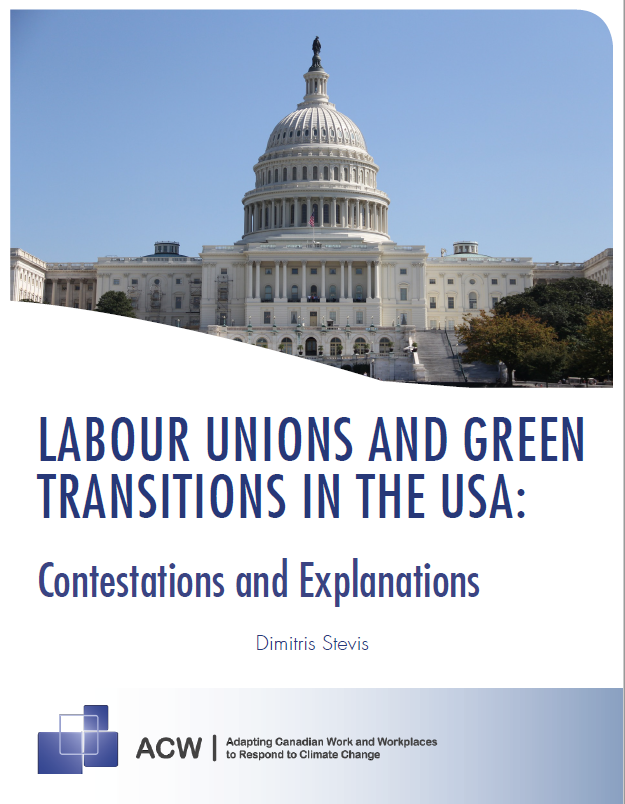
Labor Unions and Green Transitions in the USA

By Dimitris Stevis - Adapting Canadian Work and Workplaces to Respond to Climate Change, February 27, 2019

“In broad terms there are now two camps amongst US labour unions with respect to climate change and renewables (the two not always related). On one side, are those unions that believe that something needs to be done about climate change and that renewables are a good strategy. On the other side are those that are opposed to meaningful climate policy –even as they claim that climate change is a problem.”

This report outlines the deep cleavages with respect to climate policy but also argues that the views of unions are more complex and contradictory than the opposition-support dichotomy. Additionally, it seeks to understand what explains the variability in union responses to climate change and policy. What can account for the contradictions evident amongst and within unions?

Read the report (PDF).

Pages

The Fine Print I:

Disclaimer: The views expressed on this site are not the official position of the IWW (or even the IWW’s EUC) unless otherwise indicated and do not necessarily represent the views of anyone but the author’s, nor should it be assumed that any of these authors automatically support the IWW or endorse any of its positions.

Further: the inclusion of a link on our site (other than the link to the main IWW site) does not imply endorsement by or an alliance with the IWW. These sites have been chosen by our members due to their perceived relevance to the IWW EUC and are included here for informational purposes only. If you have any suggestions or comments on any of the links included (or not included) above, please contact us.

The Fine Print II:

Fair Use Notice: The material on this site is provided for educational and informational purposes. It may contain copyrighted material the use of which has not always been specifically authorized by the copyright owner. It is being made available in an effort to advance the understanding of scientific, environmental, economic, social justice and human rights issues etc.

It is believed that this constitutes a 'fair use' of any such copyrighted material as provided for in section 107 of the US Copyright Law. In accordance with Title 17 U.S.C. Section 107, the material on this site is distributed without profit to those who have an interest in using the included information for research and educational purposes. If you wish to use copyrighted material from this site for purposes of your own that go beyond 'fair use', you must obtain permission from the copyright owner. The information on this site does not constitute legal or technical advice.