You are here

decarbonization

A Green New Eskom: Transforming Power, Transforming South Africa

By staff - Climate Justice Coalition, November 2021

The campaign for a Green New Eskom is being led by the Climate Justice Coalition, a coalition of South African civil society, grassroots, trade union, and community-based organisations. We are calling for a rapid and just transition to a more socially owned, renewable energy powered economy, providing clean, safe, and affordable energy for all, with no worker and community left behind in the transition.

The Problem: Eskom’s old, unreliable and polluting coal power stations plunge us into rolling blackouts i.e. load-shedding or load reductions. Eskom has been mired in corruption, which has driven it deep into debt, sent electricity prices soaring, and robbed the public purse of trillions of rands.

Looking at Eskom now, it can be hard to think that it can be part of the solution to our problems rather than the cause of them. It can be hard to think of Eskom as anything but a headache, a drain on the taxpayer, and one of the gravest threats to our economy and environment.

The Solution: A better Eskom is possible. One that provides affordable, reliable and clean energy. An Eskom that drives a just transition to a more socially-owned renewable energy future that empowers and benefits communities, workers, businesses and all South Africans.

Not only is a transformed Eskom possible, it is absolutely vital. We simply cannot ensure a prosperous and sustainable future for South Africa without fixing Eskom. This may be one of the biggest and most important tasks in creating a better South Africa for all.

Read the entire statement (PDF).

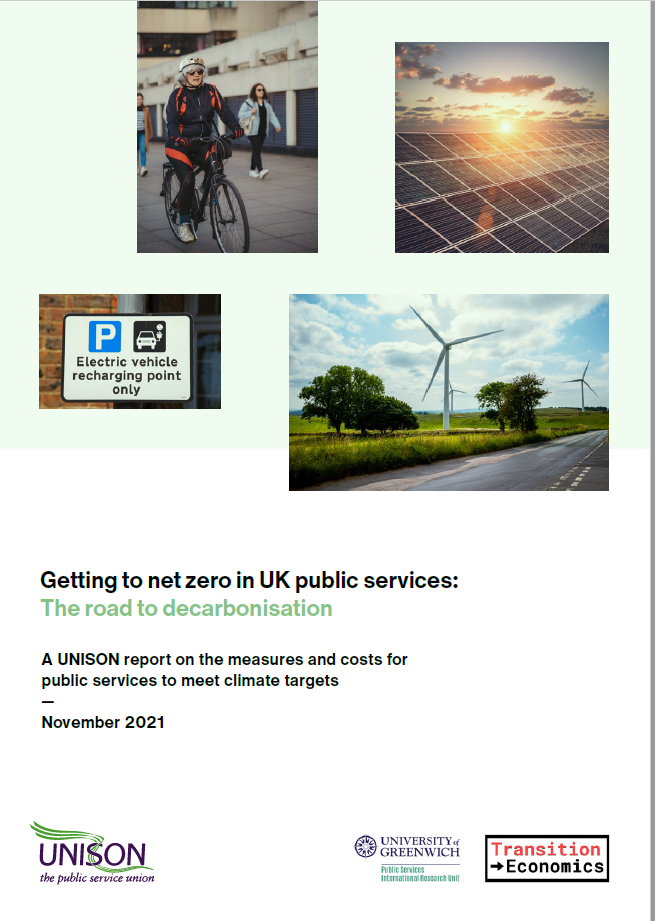
Getting to Net Zero in UK Public Services: The Road to Decarbonisation

By Dr. Vera Weghmann, et. al. - Unison, November 2021

Public services as a whole (excluding transport) represent about 8% of the UK’s direct greenhouse gas emissions. The NHS alone represents about 4% of the UK’s emissions. When procurement, construction, and social housing are taken into account, public services’ impacts are much greater.

Different sectors within the overall framework of public services have declared their decarbonisation plans. Some are ahead of the national targets. The NHS has declared that it will reach net zero by 2040, with an ambition to reach an 80% reduction by 2028 to 2032. More than one-third of local authorities (single- and upper-tier) committed themselves to decarbonise their local area by or before 2030.

The government aims to reduce direct emissions from public sector buildings by 75% against a 2017 baseline by the end of the Sixth Carbon Budget.

This report identified 21 different measures that should be taken across buildings, transport, electricity generation, waste, procurement and land use along with costed measures for each of nine different public services.

In our analysis, the UK’s public services need a capital investment injection of over £140 billion to 2035 to meet their Net Zero obligations. This will set the public sector on track to meet their climate targets and contribute to the UK’s overall carbon reduction aims. The analysis also identified measures that required annual operational expenditures of £1 billion to hit net zero targets. UNISON fully advocates that quality public services are best delivered by public ownership of public services and utilities rather than privatisation, outsourcing or PFI contracting of public services.

As well as improving the quality of life for service users, workers and the wider community, a number of the measures will also result in significant savings to public services’ budgets, through lower energy bills, cheaper to run fleets, and procurement savings. UNISON fully advocates that quality public services are best delivered by public ownership of public services and utilities rather than privatisation, outsourcing or PFI contracting of public services.

Read the text (PDF).

Report on Canada’s low carbon future makes recommendations for community and worker transitions

By Elizabeth Perry - Work and Climate Change Report, November 1, 2021

 A new report from the Canadian Institute for Climate Choices analyzes the trends in the global transition to a low carbon economy, and warns that 800,000 Canadian jobs could be at risk if we fail to support strategic industries. The report states that Canada is particularly vulnerable to market disruptions because over 70 per cent of our goods exports and over 60 per cent of foreign direct investment in Canada are in vulnerable sectors – not only fossil fuels, but also such as auto parts and vehicles, minerals, and energy intensive industries such as steel and aluminum.

The report, Sink or Swim: : Transforming Canada’s economy for a global low-carbon future is a business analysis with the overall message that transition offers opportunity, and Canada needs to act more quickly to “catch the wave”. Besides examining the benefits and sectors of opportunity in the low carbon transition, the the report includes a recommendation to: “Develop local and people-focused transition plans that drive new areas of job creation, improve the resilience of the workforce and empower Indigenous economic leadership.” More specifically, the report concludes with : “ Federal, provincial, territorial, municipal, and Indigenous governments should work together to develop detailed transition plans to support workers and communities and improve overall well-being. Transition plans should aim to attract new sources of growth and jobs, support worker transition and skill development, improve youth education outcomes and readiness, ensure alignment with Sustainable Development Goals, and empower Indigenous economic leadership.”

The Sink or Swim discussion starts from a fundamental statement that “achieving success is also about more than supporting affected workers in transition-vulnerable companies or sectors. Success will come from generating strong and inclusive economic growth that improves the wellbeing of all Canadians.” The ensuing discussion recognizes that multinational companies have weak connections and relationships to local communities, making them more likely to relocate than to re-invest. Using census data, it identifies 55 communities of 10,000 people or more that have more than 3% of their workforce employed in transition-vulnerable sectors, highlighting the Wood Buffalo area in the oil sands of Alberta, and Thompson Manitoba, a nickel-mining community. The report offers recommendations for communities, focusing on the critical areas of infrastructure investment, financing, and the need for local capacity to analyze labour markets and financial opportunities– using the examples of the InvestEU advisory hub and the Colorado Office of Just Transition.

Regarding workers, the report documents the increased vulnerability of youth, minorities, and especially Indigenous workers. It sees the solution for all as improved education and training opportunities – describing programs in B.C. , the North, and for Indigenous workers. The report also states: “all post-secondary education programs—including trades, engineering, science, economics, and business—can support transition success by incorporating future skills and knowledge needs into their curricula and programming.” 

The Road to Ruin? - Electric vehicles and workers’ rights abuses at DR Congo’s industrial cobalt mines

By staff - Rights and Accountability in Development (RAID) and the Centre d’Aide Juridico-Judiciaire (CAJJ), November 2021

Cobalt is everywhere. It is a silvery-blue mineral used in the rechargeable batteries that power our mobile phones, laptops and tablets, and in larger quantities, the electric vehicles that will soon dominate our roads. It is a strategic mineral in the plan to decarbonise and move away from fossil fuels towards renewable energy. Accelerating this switch is one of the priorities to tackle the climate crisis and industry experts forecast that electric vehicle sales will skyrocket in the next 10 years. This will require a dramatic increase in cobalt production.

The booming demand for cobalt has a dark side, however. The Democratic Republic of Congo, one of Africa’s poorest nations, holds the lion’s share of the world’s cobalt reserves. In 2020, 70% of the world’s cobalt was extracted from within its borders with tens of thousands of workers labouring in large-scale industrial mines to dig up the ore. Multinational mining companies that own many of Congo’s mines, eager to demonstrate their “green” and “responsible” credentials, say they produce “clean” and “sustainable” cobalt, free from human rights abuses, and that their operations contribute to good jobs and economic opportunities.

This report, based on extensive research over two years, paints a very different picture. It shows dire conditions for many Congolese workers in the industrial mines, often characterised by widespread exploitation and labour rights abuses. Many workers do not earn a “living wage” – the minimum remuneration to afford a decent standard of living – have little or no health provision, and far too often are subjected to excessive working hours, unsafe working conditions, degrading treatment, discrimination and racism.

In recent years attention has mainly focused on Congo’s artisanal mining sector, partly because of the risks of child labour it creates, whereas the conditions for workers in the large-scale industrial mines have gone largely unnoticed. This report examines workers’ rights at Congo’s industrial mines where the large majority of cobalt is coming from, producing some 80% of the cobalt exported from the country (in contrast to the 20% produced in artisanal mines).

The findings presented in this report are based on detailed research over 28 months by UK-based corporate watchdog Rights and Accountability in Development (RAID) and the Centre d’Aide Juridico- Judiciaire (CAJJ), a Congolese legal aid centre specialised in labour rights. The research team carried out extensive field research in and around Kolwezi, a mining town where many of Congo’s cobalt and copper mines are located. It is informed by 130 interviews of workers and former workers at five mining companies, as well as interviews with subcontractors, union representatives, lawyers, Congolese local authorities, medical staff and industry experts.

Read the text (PDF).

Climate Jobs: Building a Workforce for the Climate Emergency

By Suzanne Jeffery, editor, et. al - Campaign Against Climate Change, November 2021

This report was written by the Campaign Against Climate Change Trade Union Group (CACCTU). It builds on and develops the earlier work produced by CACCTU, One Million Climate Jobs (2014). The editorial group and contributors to this report are trade unionists, environmental activists and campaigners and academics who have collaborated to update and expand the previous work. Most importantly, this updated report is a response to the urgency of the climate crisis and the type and scale of the transition needed to match it.

This report shows how we can cut UK emissions of greenhouse gases to help prevent catastrophic climate change. We explain how this transformation could create millions of climate jobs in the coming years and that the public sector must take a leading role. Climate jobs are those which directly contribute to reducing emissions. This investment will give us better public transport, warmer homes, clean air in our cities and community renewal in parts of the country which have long been neglected. Most importantly, it will give us a chance for the future, avoiding the existential threat of climate breakdown.

Read the text (Link).

The Green New Deal–From Below

By Jeremy Brecher - Labor Network for Sustainability, October 30, 2021

This is the first in a series of commentaries on “The Green New Deal–From Below.” This commentary explains the idea of a Green New Deal from Below and provides an overview of the series. Subsequent commentaries in this series will address dimensions of the Green New Deal from below ranging from energy production to the role of unions to microgrids, coops, anchor institutions, and many others.

The Green New Deal is a visionary program to protect the earth’s climate while creating good jobs, reducing injustice, and eliminating poverty. Its core principle is to use the necessity for climate protection as a basis for realizing full employment and social justice.

The Green New Deal first emerged as a proposal for national legislation, and the struggle to embody it in national legislation is ongoing. But there has also emerged a little-noticed wave of initiatives from community groups, unions, city and state governments, tribes, and other non-federal institutions designed to contribute to the climate protection and social justice goals of the Green New Deal. We will call these the Green New Deal from Below (GNDfB).

The purpose of this commentary is to provide an overview of Green New Deal from Below initiatives in many different arenas and locations. It provides an introduction to a series of commentaries that will delve more deeply into each aspect of the GNDfB. The purpose of the series is to reveal the rich diversity of GNDfB programs already underway and in development. The projects of Green New Dealers recounted here should provide inspiration for thousands more that can create the foundation for national mobilization–and reconstruction.

The original 2018 Green New Deal resolution submitted by Rep. Alexandria Ocasio-Cortez called for a national 10-year mobilization to achieve 100% of national power generation from renewable sources; a national “smart grid”; energy efficiency upgrades for every residential and industrial building; decarbonizing manufacturing, agriculture, transportation, and other infrastructure; and helping other countries achieve carbon neutral economies and a global Green New Deal. It proposed a job guarantee to assure a living wage job to every person who wants one; mitigation of income and wealth inequality; basic income programs; and universal health care. It advocated innovative financial structures including cooperative and public ownership and public banks. Since that time a wide-ranging discussion has extended and fleshed out the vision of the Green New Deal to include an even wider range of proposals to address climate, jobs, and justice.

The Green New Deal first emerged as a proposal for national mobilization, and national legislation has remained an essential element. But whether legislation embodying the Green New Deal will be passed, and how adequate it will be, continues to hang in the balance. Current “Build Back Better” legislation has already been downsized to less than half its original scale, and many of the crucial elements of the Green New Deal have been cut along the way. How much of the Green New Deal program will actually be passed now or in the future cannot currently be known.

But meanwhile, there are thousands of efforts to realize the goals of the Green New Deal at community, municipal, county, state, tribal, industry, and sectoral levels. While these cannot substitute for a national program, they can contribute enormously to the Green New Deal’s goals of climate protection and economic justice. Indeed, they may well turn out to be the tip of the Green New Deal spear, developing in the vacuum left by the limitations of national programs.

The Green Horizon We See Beyond the Big Blue: How Seafarers Will Lead the Just Transition Needed for a Sustainable Shipping Future

By staff - International Transport Workers Federation Seafarer's Section, October 29, 2021

Bush and forest fires, floods, heatwaves, extreme storms and rising sea levels – the life-threatening events which herald dangerous climate change are already taking place around us with increasing frequency. Scientists are clear that humans’ impact on the Earth’s climate is reaching a tipping point beyond which a safe climate is in doubt.

At the heart of the problem is our reliance on greenhouse gas-producing fossil fuels to power industries like shipping, a reliance with a long history. On a global level, international cargo shipping is responsible for about three percent of global greenhouse gas emissions. From the early 1800s, coal was used to fire steam boilers for paddle steamers, which was switched to oil variants when technology improved. Fast forward to today and billions of litres of fossil fuels are used every year to power over 50,000 vessels that keep the world’s supply chain moving.

A Panamax container ship, an averaged sized cargo vessel, consumes about 63,000 gallons (286,403 litres) of marine fuel per day travelling at between 20 and 25 knots.

The global shipping industry must break its dependency on fossil fuels. The rapid expansion of international shipping over the past 50 years has been enabled by the reliance on cheap heavy fuel oil, known as bunker fuel. Key players in the industry have lobbied against restrictions on its use, despite it being one of the most polluting of all fossil fuels.

While it is true that international shipping has low carbon intensity – that is emissions per unit of moved cargo – the total emissions of the industry is very high due to the sheer volume of global maritime shipping. Until now, the focus on carbon intensity as opposed to total carbon emissions has led to false confidence about the carbon footprint of the industry compared to other sectors.

Now that more people are understanding the impact shipping is having on our climate, our industry’s reputation is being damaged. Seafarers want to be able to tell their friends and family that they’re part of a sector taking real and equitable action to curb dangerous climate change. It’s time to act.

Read the text (PDF).

Canadian Pension fund managers pledge climate action; Unions can push for more

By Elizabeth Perry - Work and Climate Change Report, October 26, 2021

In the run-up to COP26, and on the same day that Canada’s Big Six Banks joined the United Nations Net-Zero Banking Alliance (NZBA), Canadian institutional investors and some of its pension fund managers also hit the news, by releasing a new Canadian Investor Statement on Climate Change. Coordinated by the Responsible Investment Association (RIA), the statement signed on October 25 states: “We recognize that a transition to a net-zero economy will involve a major transformation of sectors and industries. We encourage all companies and stakeholders to facilitate a just transition that does not leave workers or communities behind. We also recognize that the financing required for transition activities and climate solutions presents an investment opportunity….. We further recognize that Indigenous Peoples have managed collective wealth for millennia – including lands, waters, and …..We support a transition to a net-zero economy informed by Indigenous perspectives, that supports Indigenous economic opportunities, and encourages business practices that align with the principles of the United Nations Declaration on the Rights of Indigenous Peoples (UNDRIP).”

The Statement sets out specific expectations for investees which include just transition, and pledges five actions for the investment community, such as integrating climate-related risks and opportunities into the investment processes and developing a climate action plan to achieve net-zero by 2050. Further, the 36 signatories pledge to “ Ensure that any climate-related policy advocacy we undertake supports a just transition and the ambition of achieving global net-zero emissions by 2050 or sooner, and engage with our industry associations to encourage climate advocacy efforts that are consistent with these goals.”

Pension funds which have signed on to the Statement (so far) include: British Columbia Investment Management Corporation, British Columbia Municipal Pension Board of Trustees, British Columbia Public Service Pension Board of Trustees, Canada Post Corporation Pension Plan, Caisse de dépôt et placement du Québec, Ontario Pension Board, Pension Plan of The United Church of Canada, University of Toronto Asset Management (UTAM), and the University Pension Plan.

 “Only Labor Can Force Canadian Pension Funds to Divest From Oil “ (Jacobin, October 19) puts this lofty new institutional Statement in perspective, as it takes a more critical look at one of the leading pension fund managers, the Caisse de dépôt et placement du Québec, and its September announcement that it would quit all oil production investments at the end of 2022. After also highlighting examples of the fossil and mineral exploration investments of some of Canada’s major pension funds, the article concludes: “ ‘Financial sustainability’ — despite the Caisse’s announcement — will continue to take precedence over climate justice.” 

Thus, the main point of the Jacobin article is to urge unions to take action:

 “….the unions who represent the beneficiaries of these pension funds can fight to make sure that the deferred wages of workers are used for the common good. In many cases, unions appoint trustees to boards of investment funds. If the labor movement chose to organize around these issues, it would be a game changer. …. Public sector funds are subject to legislation and can be reformed through political action. Although they’ve been carefully designed to be free of democratic accountability, they are not immune to external pressure. Sustained organizing by unions and their members can lead to greater amounts of worker control over the use to which these large sums of money are put.”

Britain’s oil and gas workers want a green transition – but the industry doesn’t

By Erik Dalhuijsen - The Guardian, October 23, 2021

I’ve worked in oil for decades, and seen what happens when jobs dry up with no plan B. Now industry leaders must face reality too.

Moving to a green energy system and a zero-emissions society without leaving people behind is an enormous challenge. Many oil and gas workers are actually ready for the change, but the oil and gas industry itself is slowing the process, holding back real progress.

Having worked in the oil industry in Aberdeen and abroad for decades, what I have seen feels like the industry applying all of its power to self-preservation, in the face of the immutable truths that fossil fuels will one day run out and that we must keep what of them remains in the ground.

Oil and gas workers need alternatives and fast. I have seen what happens in communities where oil and gas jobs dry up with no plan B in place. When the price of oil crashed in 2014, thousands of people in the region lost their job. I know former colleagues who used to work on multimillion-pound projects and are now unemployed or working in shops on the minimum wage.

I know that moving from oil and gas to renewables is possible. My skills helped me understand and troubleshoot the emissions models that underpin sustainable development plans. My skills allowed me to evaluate and optimise integrated renewable supply systems, and also decarbonise sewage treatment processes. Many people in the oil industry – including those who work offshore – have even more skills that can be transferred into the renewable energy sector, such as working on offshore wind farms.

But it still feels like the industry is refusing to adapt, all the while pretending to be leaders in “energy transition”. In the hope of selling more gas, the industry is pushing dirty (blue) hydrogen based on the yet-untested promise that carbon capture and storage will be able to remove any emissions at scale.

Our Oil Jobs Need Good Replacements: For a clean energy future, workers hear promises but not plans

By Norman Rogers - United Steelworkers Local 675, October 23, 2021

Just days after the latest oil spill off the Huntington Beach coast, Gov. Gavin Newsom came to Orange County. In response to renewed calls to ban offshore drilling after about 25,000 gallons of crude oil poured into the Pacific Ocean, the governor commented, “Banning new drilling is not complicated. The deeper question is how do you transition and still protect the workforce?”

I belong to the workforce Newsom speaks of. I’ve worked at a Los Angeles oil refinery for over 22 years as a member of United Steelworkers Local 675. USW represents thousands of workers across Los Angeles, Kern and Contra Costa counties who run refineries, oil wells, pipelines and terminals. Over the last 100-plus years, our workers have shown up and labored without fail through earthquakes, riots, world wars, fires and most recently the pandemic. We supply fuel for plane trips, backup generators for hospitals and materials for syringes that have been crucial as we contain the coronavirus crisis.

Even before the renewed calls to halt drilling, we have felt like our jobs are threatened. When we watch football, we see repeated ads for hybrid and electric cars and now electric trucks like the Ford F-150 Lightning. In California, every new car sold after 2035 is to be an electric vehicle.

The writing is on the wall. As California pursues our goal of cutting emissions 40% by 2030, the resulting closure of the oil and gas industry means about 37,000 fossil fuel workers will need reemployment, while an additional 20,000 workers or so will voluntarily retire in the next nine years.

My father always said, “Failing to plan is planning to fail.” Though the energy transition is inevitable, a just version is not. Workers know what happens when whole industries go away: Companies maneuver behind our backs, squeeze every last drop of work out of a dying auto plant, steel mill or coal mine and shutter it overnight, devastating communities and stiffing workers out of jobs, pensions and healthcare. The fear is real of jobs lost with no plan for when operations begin to phase out.

We’re also concerned for our communities: The loss in tax revenue will cripple county and city budgets, hampering our schools, libraries and other services. The loss of our good-paying jobs will have a serious ripple effect, especially in Kern and Contra Costa counties.

Many speak of a “just transition,” but we’ve never seen one. No worker or community member will ever believe that an equitable transition is possible until we see detailed, fully funded state safety net and job creation programs.

To offer these safety nets, California needs to establish an Equitable Transition Fund for fossil fuel workers covering wage replacement, income and pension guarantees, healthcare benefits, relocation and peer counseling for professional and personal support. It should also provide access to education and training for existing and future jobs that are safe and healthy. California also needs to account for the funding gaps communities face when their tax bases shrink, so schools and libraries can stay open.

Longer term, transitioning the workforce should mean creating stable jobs with good pay and benefits. Right now, we earn well over minimum wage, meaning we can support our families. Many of us can own homes with fossil fuel jobs, and some of us earn six figures. If we start new work, we want to be able to continue supporting our loved ones.

We can create good new jobs for fossil fuel workers and others by investing in California’s climate goals. USW Local 675 was one of 20 unions, including three fossil fuel unions, that endorsed the California Climate Jobs Plan, a study published in June and led by economist Robert Pollin.

With money from California’s budget, federal funds, bonds and new revenue sources, the plan outlines $70 billion of public investments annually in safety net programs as well as renewable energy and energy efficiency projects, infrastructure upgrades and ecological agriculture. 

The goal is to reduce emissions and create 1 million new jobs in California by 2030. This will create opportunities for electricians, carpenters, bus drivers, teachers, engineers, planners and maintenance workers — including workers affected by the pandemic.

The best way to guarantee that these are good jobs and reduce disparity is to make sure they’re union jobs. Data showthat union representation means higher wages, better benefits and working conditions, and a better life for workers and the communities they support.

With a fully funded equitable transition plan — meeting the immediate need for a safety net for workers and communities, and offering a bold vision to restructure our economy — we can jump-start recovery and move California’s workers, communities and the planet toward a more secure future.

Norman Rogers is the second vice president of United Steelworkers Local 675.

Pages

The Fine Print I:

Disclaimer: The views expressed on this site are not the official position of the IWW (or even the IWW’s EUC) unless otherwise indicated and do not necessarily represent the views of anyone but the author’s, nor should it be assumed that any of these authors automatically support the IWW or endorse any of its positions.

Further: the inclusion of a link on our site (other than the link to the main IWW site) does not imply endorsement by or an alliance with the IWW. These sites have been chosen by our members due to their perceived relevance to the IWW EUC and are included here for informational purposes only. If you have any suggestions or comments on any of the links included (or not included) above, please contact us.

The Fine Print II:

Fair Use Notice: The material on this site is provided for educational and informational purposes. It may contain copyrighted material the use of which has not always been specifically authorized by the copyright owner. It is being made available in an effort to advance the understanding of scientific, environmental, economic, social justice and human rights issues etc.

It is believed that this constitutes a 'fair use' of any such copyrighted material as provided for in section 107 of the US Copyright Law. In accordance with Title 17 U.S.C. Section 107, the material on this site is distributed without profit to those who have an interest in using the included information for research and educational purposes. If you wish to use copyrighted material from this site for purposes of your own that go beyond 'fair use', you must obtain permission from the copyright owner. The information on this site does not constitute legal or technical advice.