

You are here

just transition

UAW Ramps Up Pressure on Biden to Protect Workers in Electric Vehicle Transition

By Julia Conley - Common Dreams, August 15, 2023

The president of the United Auto Workers on Tuesday called on U.S. President Joe Biden to use his position of power to help ensure a just transition to electric vehicles—pushing for a major investment in green technology that would also guarantee that workers in the U.S. can earn a decent living in the evolving auto industry.

Biden's actions on the electric vehicle (EV) front, Shawn Fain toldThe Guardian, have been "disappointing."

It has been a year since the president signed his signature climate and jobs law, the Inflation Reduction Act, which includes incentives for car companies to ramp up manufacturing of EVs and for consumers to purchase them.

The law has paved the way for the "Big Three" automakers—Ford, Stellantis, and General Motors (GM)—to build EV battery plants in joint ventures with companies such as Samsung, SK On, and LG Energy Solution, but the federal incentives and loans have been given to the firms without the guarantee of fair pay and working conditions for the people who will work in the plants.

A Just Transition in Agriculture and Soil Health for Regional Climate Resilience

By Julie Snorek and Julie Davenson, et. al. - Food Solutions, August 14, 2023

From community work to state and federal level advocacy a Just Transition “focuses on the values, agency, relations and processes that underlie both structures and systems” and “create the capacities that empower individuals and communities to take action on their own behalf.”¹ A Just Transition puts governance, power, and democracy at the center and acknowledges that sustainability transitions, especially in agriculture, will only be addressed by shifts in political-economic power.

Domains of a Just Transition include access to natural ecosystems, knowledge, networks, systems of exchange, gender and equity.² When analyzing work toward a Just Transition, the question must be asked: Whose knowledge is considered valid, and is therefore enabled and valued, through contemporary modes of knowledge production and mobilization? The social dynamics of marginalization and inequality pose a major barrier to the development of sustainable food systems in this regard. When all types of knowledge are valued, including community, indigenous, and practitioner, then community voices are lifted up to create solutions for their own needs and overturn inequities across the food system.

Thus, the starting point is to expand networks through participatory governance to identify and respond to community needs and flex the “democracy muscle.” In other words, true change towards climate resilience through agriculture is only going to come when community leadership and decision-making at all levels of governance are understood and centered – a task that will require a wholesale mindset shift.

Download a copy of this publication here (PDF).

Harbor Commissioners Approve ‘Once in a Generation’ Project Labor Agreement for Humboldt Offshore Wind Terminal Project; Union Reps Laud Unanimous Decision

Text and images by Isabella Vanderheiden - Lost Coast Outpost, August 11, 2023

Local contractors and labor union members packed Eureka’s Wharfinger Building Thursday night to give the Humboldt Bay Harbor, Recreation and Conservation District Board of Commissioners their two cents on a Project Labor Agreement (PLA) for the Humboldt Offshore Wind Terminal Project that could guarantee local jobs for years to come.
The PLA outlines the general terms and conditions for labor employment affiliated with the first stages of port development on Humboldt Bay. The agreement has sparked opposition from some local construction companies that run non-union shops as it will require non-union workers to pay toward the union trust fund.

The Harbor District has spent the last year working with members of the Humboldt-Del Norte County Building and Construction Trades Council, the State Building and Construction Trade Council of the State of California, and other local labor representatives to develop the agreement, which is required by federal law. The contractors and subcontractors who are awarded contracts to work on the heavy lift marine terminal will be subject to the provisions of the agreement, including no-strike, no-lock-out clauses to eliminate delays associated with labor unrest. 

“This is an agreement between the district and the labor unions that we’re going to have a smooth labor transition and that there’s going to be no disruption to the workforce,” said Larry Oetker, executive director of the Harbor District. “But in return, there are some hiring stipulations that are included in [the document].”

The agreement details hiring priorities for “disadvantaged workers,” or local residents who, prior to the project, experienced barriers to employment, as noted in section 2.9.

In a Summer of Record Heat, These Striking Workers Are Making Climate Demands

By Sarah Lazare - Workday Magazine, August 8, 2023

July was the hottest month on record, and possibly the hottest in the history of human civilization, and August is bringing more scorching temperatures and supercharged storms. On July 16, the heat index at the Persian Gulf International Airport weather station in Iran climbed to 152 degrees Fahrenheit, a level that tests humanity’s ability to survive. Meanwhile, in vast swaths of the United States, people watched smoke from Canadian wildfires turn their skies noxious hues of orange and gray, only to then be hit with storms and heat waves. The scientific consensus has long held that climate change is human-made and real. But this summer, it seems a threshold has been crossed.

Amid this climate crisis, 1,400 locomotive builders and clerical workers on strike in Erie, Penn. are modeling how unions—and workers walking off the job—can make climate justice demands of an employer. 

Locals 506 and 618 of the United Electrical, Radio and Machine Workers of America (UE) have been on strike since late June. One of their demands has already captured nationwide attention for its centrality to building labor’s overall power. They are insisting on the right to strike over non-discipline grievances—things like subcontracting work, or forcing someone to take vacation they don’t want to. Such language, the workers hope, will build more accountability into the grievance process, as well as protect the union’s strongest tool: the strike. Workers are also asking for the guarantee that their employer will not make unilateral changes to their healthcare benefits throughout the duration of the contract, and they are asking for improved pay to keep pace with inflation. Their employer is the Fortune 500 company Westinghouse Air Brake Technologies Corporation (or Wabtec), which is valued at some $20 billion and manufactures railway locomotives. The mammoth company acquired GE Transportation for $11.1 billion in 2019.

The union’s demands are also aimed at improving society as a whole. There is another stipulation that workers put forward in the bargaining process: They want the company to help the union win a green overhaul of the rail locomotive industry, with the overall goal of drastically reducing emissions that spew carbon and pollution into the atmosphere.

This is not the first time that a union has pushed for environmental improvements. Unions threw their support behind an Illinois law passed in 2021 aimed at creating clean energy jobs and retraining fossil fuel workers. And the United Auto Workers, under the leadership of reformer Shawn Fain, are calling for the growing electric vehicle industry to provide dignified union jobs. But UE general president Carl Rosen says that the fact that UE is “directly challenging a private-sector major employer on this has made environmental justice groups very excited.”

US autoworkers may wage a historic strike against Detroit’s 3 biggest automakers; with wages at EV battery plants a key roadblock to agreement

By Marick Masters - The Conversation, August 7, 2023

The United Auto Workers union, which represents nearly 150,000 employees of companies that manufacture U.S.-made vehicles, has been engaged since July 2023 in the labor negotiations it undergoes every four years with the three main unionized automakers.

By late August, it still wasn’t clear that the UAW would agree to a new contract with Ford, General Motors and Stellantis – the automaker that manufactures Chrysler and 13 other vehicle brands – by their impending deadline. The contracts expire at 11:59 p.m. Sept. 14.

The union’s leaders skipped the traditional handshake ceremonies it usually holds with these automakers, which are often called the Big Three or Detroit Three. The union instead held grassroots photo-ops: UAW leaders greeted rank-and-file members at one Ford, one GM and one Stellantis factory. On Aug. 25, the UAW announced that 97% of its members had authorized a strike “if the Big Three refuse to reach a fair deal.” It’s a major milestone.

I’m a labor scholar who has studied the history of UAW collective bargaining with the Detroit Three. Given that the UAW is making major demands at a time of rising union assertiveness and ambition, I believe it’s reasonable to wonder whether U.S. automakers will be the next industry to face a strike.

In 2023, there have been strikes by screenwriters, actors, health care workers and hotel staff, as well as vigorous organizing by workers for warehouse and delivery services at Amazon, UPS and FedEx.

Building Worker and Community-focused Economic Transitions in Coal Country

Workers and the Green-Energy Transition: Evidence from 300 Million Job Transitions

By E. Mark Curtis, Layla O'Kane, and R. Jisung Park - National Bureau of Economic Research, August 2023

Using micro-data representing over 130 million online work profiles, we explore transitions into and out of jobs most likely to be affected by a transition away from carbon-intensive production technologies. Exploiting detailed textual data on job title, firm name, occupation, and industry to focus on workers employed in carbon-intensive (“dirty”) and non-carbon-intensive (“green”) jobs, we find that the rate of transition from dirty to green jobs is rising rapidly, increasing ten-fold over the period 2005-2021 including a significant uptick in EV-related jobs in recent years. Overall however, fewer than 1 percent of all workers who leave a dirty job appear to transition to a green job. We find that the persistence of employment within dirty industries varies enormously across local labor markets; in some states, over half of all transitions out of dirty jobs are into other dirty jobs. Older workers and those without a college education appear less likely to make transitions to green jobs, and more likely to transition to other dirty jobs, other jobs, or non-employment. When accounting for the fact that green jobs tend to have later start dates, it appears that green and dirty jobs have roughly comparable job durations.

Download a copy of this publication here (link).

As Big 3 Auto Contracts Expire: Hurried Line Speeds and Horrible Hours

By Keith Brower Brown - Labor Notes, July 25, 2023

David Sandoval remembers when he and his co-workers had a whole 72 seconds to assemble their sections of each seat for the Ford F-150, back when he started at a Michigan parts plant in 2004.

Today, 60 seconds is the deadline managers give each team racing at a dozen stations: to bolt the frame together, lay electronics, add heating and cooling gear, set cushions, and attach trim. Robotic lifting arms help on only one or two steps; handheld tools and elbow grease must do the rest. Each crew is told to clear 680 seats in a 10-hour shift.

That harsh speedup makes it small wonder that repetitive motion injuries are piling up for U.S. auto workers, while the Big 3 auto companies—Ford, General Motors, and Stellantis (formerly Chrysler)—posted $250 billion in profits in just the last four years.

On September 14, union contracts expire for 144,000 Big 3 workers. A company-wide strike at one of the three looks likely, especially after United Auto Workers members elected a reform slate to lead their union. The new president, Shawn Fain, has pledged a contract campaign and a strike–if needed–to end wage tiers, and to put workers at the wheel of the transition to electric vehicles (EVs).

To understand how that contract fight starts from conditions on the shop floor, Labor Notes interviewed workers at each of the Big 3 companies and an independent parts supplier.

From the Midwest to the South, auto workers say that their plant managers have seized on the pandemic and the EV transition to push an unsafe work pace, longer shifts and more of them, and divisions between workers. Meanwhile, some company executives are threatening layoffs and are openly preparing for a strike by stocking inventory and hiring temporary workers.

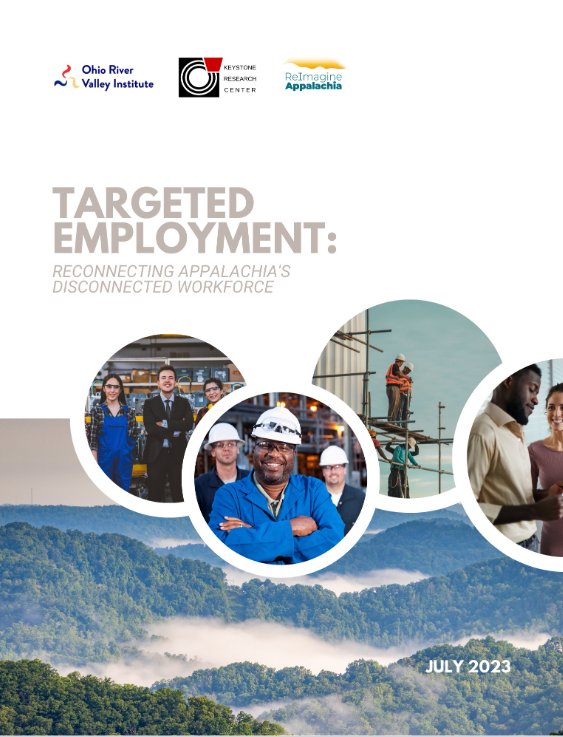
Targeted Employment: Reconnecting Appalachia’s Disconnected Workforce

By Claire Kovach, Stephen Herzenberg, Amanda Woodrum, and Ted Boettner - ReImagine Institute, Keystone Research Center, Ohio River Valley Institute, July 25, 2023

The Appalachian region has long suffered from not having enough good paying jobs. Even when the unemployment rate is low, too many Appalachians are disconnected from the workforce entirely due to a myriad of factors. The result has been a long-term structural unemployment problem that has persisted for decades, with too many Appalachian adults out of the workforce entirely and unable to secure a decent paying job where they live.

A federal job subsidy program that is targeted at breaking down barriers to employment – such as improving the skills and experience of potential workers to meet current employer demands in their local labor market – and connecting them with a job could not only boost incomes and improve the livelihood of thousands of Appalachians but also give people self-esteem, a source of identity, and feel more connected to their community.

This report examines the economic conditions of Appalachia with a particular focus on the Appalachian counties of four states—Kentucky, Ohio, Pennsylvania, and West Virginia—that comprise the footprint of ReImagine Appalachia and the Ohio River Valley Institute. This includes describing how Appalachia has been a “region apart” from the rest of America, including its history of resource extraction and exploitation, the collapse of the steel industry, and now coal, that has led to large employment losses in the area, and how the region’s uneven development has led to chronically low rates of employment, disenfranchisement from the labor market and even loss of hope underpinning the opioid epidemic from which the Appalachian region was particularly hard hit.

Download a copy of this publication here (PDF).

UAW Begins Big 3 Negotiations in a BIG WAY

Pages

The Fine Print I:

Disclaimer: The views expressed on this site are not the official position of the IWW (or even the IWW’s EUC) unless otherwise indicated and do not necessarily represent the views of anyone but the author’s, nor should it be assumed that any of these authors automatically support the IWW or endorse any of its positions.

Further: the inclusion of a link on our site (other than the link to the main IWW site) does not imply endorsement by or an alliance with the IWW. These sites have been chosen by our members due to their perceived relevance to the IWW EUC and are included here for informational purposes only. If you have any suggestions or comments on any of the links included (or not included) above, please contact us.

The Fine Print II:

Fair Use Notice: The material on this site is provided for educational and informational purposes. It may contain copyrighted material the use of which has not always been specifically authorized by the copyright owner. It is being made available in an effort to advance the understanding of scientific, environmental, economic, social justice and human rights issues etc.

It is believed that this constitutes a 'fair use' of any such copyrighted material as provided for in section 107 of the US Copyright Law. In accordance with Title 17 U.S.C. Section 107, the material on this site is distributed without profit to those who have an interest in using the included information for research and educational purposes. If you wish to use copyrighted material from this site for purposes of your own that go beyond 'fair use', you must obtain permission from the copyright owner. The information on this site does not constitute legal or technical advice.
