You are here

Black, Indigenous, and People of Color (BIPOC)

Talking Climate: Labor

A Green New Eskom: Transforming Power, Transforming South Africa

By staff - Climate Justice Coalition, November 2021

The campaign for a Green New Eskom is being led by the Climate Justice Coalition, a coalition of South African civil society, grassroots, trade union, and community-based organisations. We are calling for a rapid and just transition to a more socially owned, renewable energy powered economy, providing clean, safe, and affordable energy for all, with no worker and community left behind in the transition.

The Problem: Eskom’s old, unreliable and polluting coal power stations plunge us into rolling blackouts i.e. load-shedding or load reductions. Eskom has been mired in corruption, which has driven it deep into debt, sent electricity prices soaring, and robbed the public purse of trillions of rands.

Looking at Eskom now, it can be hard to think that it can be part of the solution to our problems rather than the cause of them. It can be hard to think of Eskom as anything but a headache, a drain on the taxpayer, and one of the gravest threats to our economy and environment.

The Solution: A better Eskom is possible. One that provides affordable, reliable and clean energy. An Eskom that drives a just transition to a more socially-owned renewable energy future that empowers and benefits communities, workers, businesses and all South Africans.

Not only is a transformed Eskom possible, it is absolutely vital. We simply cannot ensure a prosperous and sustainable future for South Africa without fixing Eskom. This may be one of the biggest and most important tasks in creating a better South Africa for all.

Read the entire statement (PDF).

Perspectives on a Global Green New Deal

By Harpreet Kaur Paul, et. al - Global Green New Deal, November 2021

Promises of a ‘Green New Deal’ have captured the imagination of climate activists, scholars and policymakers across Europe and North America. Unless grounded in principles of global justice, the promise of green jobs and infrastructure in the Global North could simply mean a continuation of colonial patterns of inequality and exploitation around the world. What would it mean for the Green New Deal to be globally fair? Published by the London Office of the Rosa Luxemburg Stiftung and The Leap, Perspectives on a Global Green New Deal tackles this question head on.

Harpreet Kaur Paul and Dalia Gebrial bring together climate justice insights experts from around the world, to explore the key themes that will define the future of any equitable and just global green new deal.

Read the text (link).

The Road to Ruin? - Electric vehicles and workers’ rights abuses at DR Congo’s industrial cobalt mines

By staff - Rights and Accountability in Development (RAID) and the Centre d’Aide Juridico-Judiciaire (CAJJ), November 2021

Cobalt is everywhere. It is a silvery-blue mineral used in the rechargeable batteries that power our mobile phones, laptops and tablets, and in larger quantities, the electric vehicles that will soon dominate our roads. It is a strategic mineral in the plan to decarbonise and move away from fossil fuels towards renewable energy. Accelerating this switch is one of the priorities to tackle the climate crisis and industry experts forecast that electric vehicle sales will skyrocket in the next 10 years. This will require a dramatic increase in cobalt production.

The booming demand for cobalt has a dark side, however. The Democratic Republic of Congo, one of Africa’s poorest nations, holds the lion’s share of the world’s cobalt reserves. In 2020, 70% of the world’s cobalt was extracted from within its borders with tens of thousands of workers labouring in large-scale industrial mines to dig up the ore. Multinational mining companies that own many of Congo’s mines, eager to demonstrate their “green” and “responsible” credentials, say they produce “clean” and “sustainable” cobalt, free from human rights abuses, and that their operations contribute to good jobs and economic opportunities.

This report, based on extensive research over two years, paints a very different picture. It shows dire conditions for many Congolese workers in the industrial mines, often characterised by widespread exploitation and labour rights abuses. Many workers do not earn a “living wage” – the minimum remuneration to afford a decent standard of living – have little or no health provision, and far too often are subjected to excessive working hours, unsafe working conditions, degrading treatment, discrimination and racism.

In recent years attention has mainly focused on Congo’s artisanal mining sector, partly because of the risks of child labour it creates, whereas the conditions for workers in the large-scale industrial mines have gone largely unnoticed. This report examines workers’ rights at Congo’s industrial mines where the large majority of cobalt is coming from, producing some 80% of the cobalt exported from the country (in contrast to the 20% produced in artisanal mines).

The findings presented in this report are based on detailed research over 28 months by UK-based corporate watchdog Rights and Accountability in Development (RAID) and the Centre d’Aide Juridico- Judiciaire (CAJJ), a Congolese legal aid centre specialised in labour rights. The research team carried out extensive field research in and around Kolwezi, a mining town where many of Congo’s cobalt and copper mines are located. It is informed by 130 interviews of workers and former workers at five mining companies, as well as interviews with subcontractors, union representatives, lawyers, Congolese local authorities, medical staff and industry experts.

Read the text (PDF).

Clean Power to the People

By Al Weinrub - Organizing Upgrade, October 27, 2021

As predicted, the climate has been screaming out with intensified ferocity at the assault on the earth by the global fossil fuel economy. Extreme weather conditions are wreaking havoc on communities across the world, leading many climate activists in the U.S. and elsewhere to declare a climate emergency, requiring an urgent, intensified transition from fossil fuels to renewable energy.

But thinking of this transition as mainly a shift in energy technology, as de-carbonizing the economy, is to misunderstand the deep roots of the climate crisis in an extractive economic system based on racialized social and economic inequality.

Emphasizing de-carbonization of energy without broad institutional transformation—an approach called carbon fundamentalism—leaves us still at the mercy of the corporate energy establishment. That approach, as we shall see, is actually amplifying the already devastating impacts of the climate crisis. “It ignores the specific needs of people of color, it promotes programs that force low-income people to pay unfairly for carbon reduction, it exposes our communities to increased risks, and it sacrifices justice in the urgent rush to reduce carbon,” says Jessica Tovar of the Local Clean Energy Alliance. “Time and again, it ends up throwing people of color under the bus.”

We need more than clean energy to address the climate crisis. We need to move from a large, centralized private utility model to a locally based, decentralized energy model. We need an energy system centered on democracy and justice.

Learning About a Just Transition

Hoodwinked in the Hothouse: Examining False Corporate Schemes advanced through the Paris Agreement

Illinois sets U.S. standard for equity and labour standards in new Climate and Equitable Jobs Act

By Elizabeth Perry - Work and Climate Change Report, October 6, 2021

The Climate and Equitable Jobs Act  (SB2408) is a 900-page bill signed into law by the Governor of Illinois in September 2021. It is summarized by Natural Resources Defence in a blog titled “Illinois Passes Nation-Leading, Equitable Climate Bill”, by David Roberts in his new blog, Volts, and by the Illinois Clean Jobs Coalition press release

Why does David Roberts call it “ one of the most environmentally ambitious, worker-friendly, justice-focused energy bills of any state in the country”? Some highlights: the CEJA requires Illinois to achieve a 100% zero-emissions power sector by 2045 (including their coal power plant), while encouraging electrification of transportation and buildings, and reforms to the utility rate structure. It increases the existing Solar for All funding (by 5 times) to help low-income families to switch to solar energy, creates a Green Bank to finance clean energy projects. For workers, the Act requires that all utility-scale renewable energy projects must use project-labor agreements, and all non-residential clean-energy projects must pay prevailing wages. Diversity hiring reports will be required to prove that projects have recruited qualified BIPOC candidates and apprentices. The Act also provides funds for 13 Clean Jobs Workforce Network Hubs across the state, to deliver workforce-development programs to low-income and underserved populations. According to David Roberts, “The Department of Commerce and Economic Opportunity and the Illinois Department of Employment Security will work together to develop a “displaced worker bill of rights,” with $40 million a year to go toward transition assistance for areas dependent on fossil fuel production or generation.”

The CEJA is a model not only for what it contains, but also how it was achieved. Roberts calls it “a model for how diverse stakeholders can reach consensus” and describes the years-long process in detail: “The state’s labor community was sensitive to the fact that it had largely been left out of the 2016 bill; the legislation contained no labor standards, and recent years have seen Illinois renewable energy projects importing cheaper out-of-state workforces. Labor didn’t want to get left behind in the state’s energy transition, so it organized a coalition of groups under the banner Climate Jobs Illinois and set about playing an active role in negotiations. Environmental and climate-justice groups organized as the Illinois Clean Jobs Coalition. All the groups introduced energy bills of their own. And then they spent years banging their heads together. A special shout-out goes to the environmental-justice community in Illinois, which used three years of relentless grassroots organizing to build an incredible political force, without which the bill couldn’t have passed and wouldn’t have been as equity-focused.” The result, according to Roberts, “As far as I know, this gives Illinois the most stringent labor and equity requirements of any state clean energy program. Similar policies tying renewable energy projects to labor standards have passed in Connecticut, New York, and Washington, but no other state’s energy policy has as comprehensive a package of labor, diversity, and equity standards.”

People's Utility Justice Playbook​

By Yesenia Rivera and Johanna Bozuwa - Energy Democracy Project, October 2021

Have you ever wondered who is in charge of your electricity? And why?

The People’s Utility Justice Playbook has two components:

  1. a “History of Utilities” report to summarize the history of utilities for everyone to understand how our current energy system originated.
  2. a “People’s Utility Justice Playbook” to expose the tactics from electric utilities that are undermining community’s efforts, so we can build our organizing strength—to not only fight back but also to build the democratic energy system for climate justice.

This is the basic information we need to fight back against energy utilities attempting to slow or stop progress toward economic and climate justice.

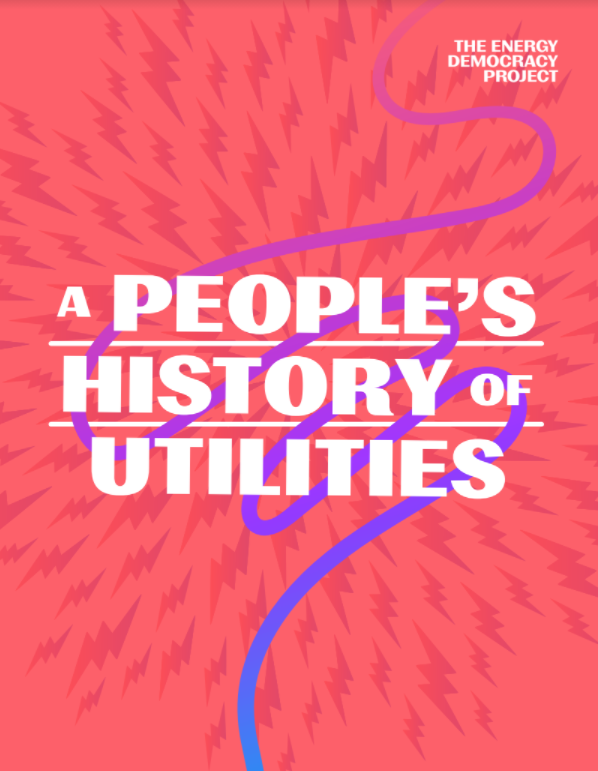
History of Utilities​

Electric utilities have expanded into almost every aspect of our lives to become one of the most powerful and concentrated industries on Earth. To have a better understanding of what we’re fighting against, we first need to learn about the history of energy utilities! This PDF summarizes the entire timeline and how the rise of energy democracy came about.

People's Utility Justice Playbook

In order to fight the industry-owned utilities’ tactics, we need our own strategies for combat!

We have our very own playbook sourced from energy justice activists on the ground. They suggest strategies and tactics they employ when fighting against utilities that anyone fighting against utilities could use!

Read the History (PDF).

Read the Playbook (PDF).

Social Justice and Trade Union statements at the PreCOP in Milano

By Gina Cortes Valderrama - Women Gender Climate, September 30, 2021

Thank you, my name is Gina Cortes Valderrama and I speak on behalf of five diverse rights-based constituencies- Women and Gender, Trade unions, Indigenous Peoples, Youth, the Climate Action Network, and Demand Climate Justice. We are speaking collectively to demand ambition, justice, and people-powered solutions. Together, we represent over 3000 organizations in more than 160 countries.

Let’s start with reality:

  • In 2020, five years after Paris promised to uphold human rights in all climate actions, a record number of activists were murdered as they worked to protect the environment
    and land rights.
  • The recent UNFCCC NDC synthesis report warns emissions will be 16 percent above the 2010 level by 2030 - even after the latest mitigation pledges -, while science tells us we need to halve emissions until then.
  • In addition, according to the OECD figures, 2019 climate finance remained $20bn below the target for 2020. And it is virtually certain that the $100bn will not be met in 2021.
  • In all circumstances, the connection between climate impacts and inequality are abundantly clear. These inequities are further exacerbated when a few rich nations have yet refused a TRIPS waiver and ensured vaccine equity with adequate support...

Read the entire text (PDF).

Pages

The Fine Print I:

Disclaimer: The views expressed on this site are not the official position of the IWW (or even the IWW’s EUC) unless otherwise indicated and do not necessarily represent the views of anyone but the author’s, nor should it be assumed that any of these authors automatically support the IWW or endorse any of its positions.

Further: the inclusion of a link on our site (other than the link to the main IWW site) does not imply endorsement by or an alliance with the IWW. These sites have been chosen by our members due to their perceived relevance to the IWW EUC and are included here for informational purposes only. If you have any suggestions or comments on any of the links included (or not included) above, please contact us.

The Fine Print II:

Fair Use Notice: The material on this site is provided for educational and informational purposes. It may contain copyrighted material the use of which has not always been specifically authorized by the copyright owner. It is being made available in an effort to advance the understanding of scientific, environmental, economic, social justice and human rights issues etc.

It is believed that this constitutes a 'fair use' of any such copyrighted material as provided for in section 107 of the US Copyright Law. In accordance with Title 17 U.S.C. Section 107, the material on this site is distributed without profit to those who have an interest in using the included information for research and educational purposes. If you wish to use copyrighted material from this site for purposes of your own that go beyond 'fair use', you must obtain permission from the copyright owner. The information on this site does not constitute legal or technical advice.