You are here

California

Richmond Progressive Alliance Listening Project, Episode 2: At Our Expense

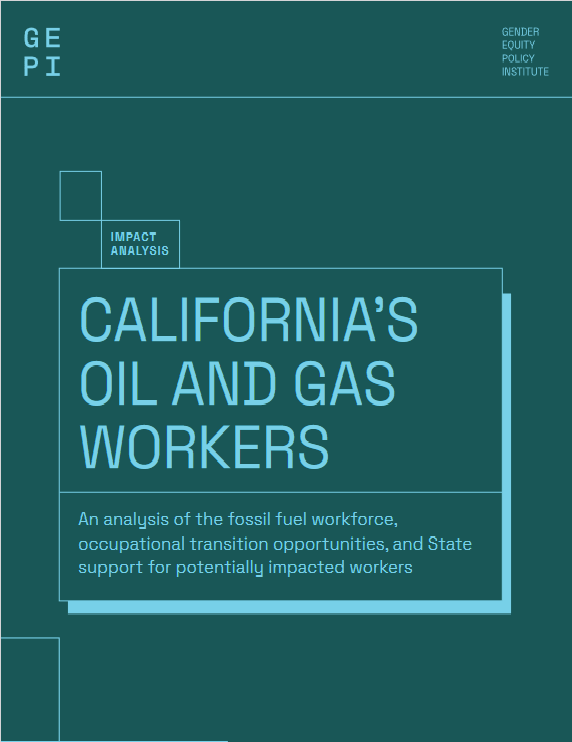
Impact Analysis: California’s Oil and Gas Workers

By Staff - Gender Equity Policy Institute, January 23, 2023

California’s ambitious climate goals, supported by state and federal investment, will create enormous economic opportunity over the coming decades. To meet the 2045 target of carbon neutrality, a 100% clean electric grid, and a 90% reduction in oil consumption and refinery production, the state will need to modernize its electrical grid and build storage capacity to meet increased demand for electricity. Carbon management techniques, plugging orphan wells, and the development of new energy sources such as geothermal will all come into play, providing economic opportunities to workers and businesses alike. Reducing use of polluting fossil fuels will likewise result in significant health benefits to Californians, especially to communities disproportionately burdened by polluting enterprises and proximity to freeways.

Supported by state investment and federal funding through the Infrastructure Investment and Jobs Act and the Inflation Reduction Act, the actions necessary to tackle the challenges of climate change are projected to create 4 million new jobs in the state. California is investing in developing the clean energy workforce, with an equity commitment to recruit and train historically disadvantaged and under- represented communities.

Decarbonizing the economy and accelerating the adoption of clean energy is necessary if we are to preserve a habitable planet. Progress to a carbon neutral future is already well underway in the state. Wind and solar power are less expensive than natural gas or coal powered electricity. A large majority of Californians are concerned about climate change and support action to address its impacts.

However, as with all sectoral economic change, some industries will grow and thrive, while others will shrink, leaving some of their workers behind. Labor unions and trades groups are rightly concerned that workers are not forced to abandon skills developed over their careers and thrown into an inhospitable labor market with no support.

Thus, a key challenge in meeting California’s climate action goals is to devise a fair, equitable, and empirically-based policy to provide support for workers at risk of unemployment and income loss as many factors combine to reduce demand in state for oil and gas products.

Richmond Progressive Alliance Listening Project, Episode 1: Lay of the Land

As the Biden Administration Eyes Wind Leases Off California’s Coast, the Port of Humboldt Sees Opportunity

By Emma Foehringer Merchant - Inside Climate News, January 5, 2022

The administration wants to sell its first lease in 2022, and a new bill in California requires a plan. Some in Humboldt have been waiting years for this moment to arrive.

In the early 20th century, the U.S. Census Bureau declared Humboldt County, California—now famous for its redwoods—the “principal center” of the state’s lumber industry. In 1900, the product accounted for nearly 60 percent of the region’s exports. 

But now, though lumber yards and wood suppliers still line Humboldt Bay, the industry is a shadow of its former self. 

“You look at old photographs of Humboldt Bay from back then and there’s mills everywhere, pulp mills and ships and docks,” said Matthew Marshall, executive director of the Redwood Coast Energy Authority. “As that retracted there’s a lot of available land and waterfront …. So, there’s a big opportunity.”

The Redwood Coast Energy Authority (RCEA)—a power organization formed by the County of Humboldt and Northern Californian cities such as Trinidad and Eureka—has been working for years to prepare for that opportunity. In 2018, RCEA submitted an unsolicited application to the U.S. Department of the Interior in hopes of building wind energy in waters just west of Humboldt Bay. 

Want to Know How We Can Win a Just Transition? States Hold a Key

By Mindy Isser - In These Times, November 16, 2021

The climate justice movement has undoubtedly picked up steam in the last three years as talk of a Green New Deal has made its way into the mainstream. But even after uphill and innovative organizing, our federal government has not adequately responded to the serious and existential threat of climate change: The Build Back Better bill, touted by the Biden administration as our generation’s great hope for action on climate change, has been almost completely gutted in Congress, where it still awaits passage. And after the ultra-wealthy took private jets to and from the United Nations Climate Change Conference (COP26) in Glasgow, it does not appear that the urgent action we need will come any time soon. As temperatures increase and storms become worse, the environmental situation is even more dire: Humans can expect ​“untold suffering,” scientists warn, including mass extinction and death, if we don’t act fast.

Amid our elected leaders’ monumental failures, the climate justice movement has smartly moved its focus away from pet projects, like small-scale lawsuits, and towards organizing to build a movement with enough popular support to change our political system. To get the numbers we need — of workers in the many millions — it is necessary to ensure that climate solutions, whether it’s stopping coal extraction or halting fossil fuel digging, don’t abandon workers in those industries. This is the idea behind a ​“just transition,” which aims to move to an environmentally sustainable economy while making sure all workers have safe and dignified work. 

State by state, organizers are working hard to make a just transition a reality and, fortunately, there are a few wins to point to. Unions and environmental groups won a joint victory this June, when the Climate and Community Investment Act, SB 999, passed in Connecticut. The legislation will do three important things: require prevailing wages for construction workers on renewable energy projects, ensure renewable energy projects create good, union jobs for Connecticut residents from disadvantaged communities, and negotiate community benefits agreements, which are agreements that describe a developer’s obligations to the broader community.

This state-level legislation is a step toward an urgent — and existential — need. Kimberly Glassman is the director of the Foundation for Fair Contracting of Connecticut, a non-profit organization that represents both building trades unions and union contractors to monitor public works’ projects for compliance with wage and other labor laws. She told In These Times, ​“As we transition away from fossil fuel dependent energy into green energy, [we have to make sure] that the workforce that has built their livelihoods in the fossil fuel industry has a way to transition and has access to good paying jobs in the green energy sector.” 

Boiling Point: Unions Clash with Solar Industry

By Gary Coronado - Los Angeles Times, November 11, 2021

Until recently, I had never heard of the Contractors State License Board, or CSLB. It’s a California agency that regulates the construction industry, with a goal of protecting public health and safety. Most of its 15 members are appointed by the governor.

Why am I telling you this? Because CSLB sent shock waves through the solar industry this summer when it ruled that rooftop solar companies would no longer be allowed to install batteries — an increasingly popular tool for keeping the lights on during blackouts — without getting a new license that might require them to overhaul their workforce. Solar industry leaders were apoplectic, saying the new requirement would be impossible to meet and would crash the market. They filed a lawsuit to block it.

The groups pushing the rule change framed it as a safety issue. By requiring solar companies to use certified electricians to handle battery installations, they’ve argued, state officials can limit the risk of lithium-ion battery fires, explosions and other hazards.

So on the surface, at least, this is a technical dispute over battery safety and workforce training requirements. But just below the surface lurks a long-simmering conflict between the rooftop solar industry and organized labor.

If that sounds familiar, well, you probably read my latest story (which I still hope you’ll subscribe to The Times to access, if you haven’t already), or last week’s edition of Boiling Point. In both pieces, I noted that most rooftop solar jobs are nonunion, unlike most jobs building large-scale solar farms. It’s a reality that has created constant tension in California, with politically powerful electrical and building trades unions pushing lawmakers to support big solar farms at the expense of rooftop installations.

Songs About and by Judi Bari at the Mendocino County Museum, Remembering Judi Bari Exhibit

Our Oil Jobs Need Good Replacements: For a clean energy future, workers hear promises but not plans

By Norman Rogers - United Steelworkers Local 675, October 23, 2021

Just days after the latest oil spill off the Huntington Beach coast, Gov. Gavin Newsom came to Orange County. In response to renewed calls to ban offshore drilling after about 25,000 gallons of crude oil poured into the Pacific Ocean, the governor commented, “Banning new drilling is not complicated. The deeper question is how do you transition and still protect the workforce?”

I belong to the workforce Newsom speaks of. I’ve worked at a Los Angeles oil refinery for over 22 years as a member of United Steelworkers Local 675. USW represents thousands of workers across Los Angeles, Kern and Contra Costa counties who run refineries, oil wells, pipelines and terminals. Over the last 100-plus years, our workers have shown up and labored without fail through earthquakes, riots, world wars, fires and most recently the pandemic. We supply fuel for plane trips, backup generators for hospitals and materials for syringes that have been crucial as we contain the coronavirus crisis.

Even before the renewed calls to halt drilling, we have felt like our jobs are threatened. When we watch football, we see repeated ads for hybrid and electric cars and now electric trucks like the Ford F-150 Lightning. In California, every new car sold after 2035 is to be an electric vehicle.

The writing is on the wall. As California pursues our goal of cutting emissions 40% by 2030, the resulting closure of the oil and gas industry means about 37,000 fossil fuel workers will need reemployment, while an additional 20,000 workers or so will voluntarily retire in the next nine years.

My father always said, “Failing to plan is planning to fail.” Though the energy transition is inevitable, a just version is not. Workers know what happens when whole industries go away: Companies maneuver behind our backs, squeeze every last drop of work out of a dying auto plant, steel mill or coal mine and shutter it overnight, devastating communities and stiffing workers out of jobs, pensions and healthcare. The fear is real of jobs lost with no plan for when operations begin to phase out.

We’re also concerned for our communities: The loss in tax revenue will cripple county and city budgets, hampering our schools, libraries and other services. The loss of our good-paying jobs will have a serious ripple effect, especially in Kern and Contra Costa counties.

Many speak of a “just transition,” but we’ve never seen one. No worker or community member will ever believe that an equitable transition is possible until we see detailed, fully funded state safety net and job creation programs.

To offer these safety nets, California needs to establish an Equitable Transition Fund for fossil fuel workers covering wage replacement, income and pension guarantees, healthcare benefits, relocation and peer counseling for professional and personal support. It should also provide access to education and training for existing and future jobs that are safe and healthy. California also needs to account for the funding gaps communities face when their tax bases shrink, so schools and libraries can stay open.

Longer term, transitioning the workforce should mean creating stable jobs with good pay and benefits. Right now, we earn well over minimum wage, meaning we can support our families. Many of us can own homes with fossil fuel jobs, and some of us earn six figures. If we start new work, we want to be able to continue supporting our loved ones.

We can create good new jobs for fossil fuel workers and others by investing in California’s climate goals. USW Local 675 was one of 20 unions, including three fossil fuel unions, that endorsed the California Climate Jobs Plan, a study published in June and led by economist Robert Pollin.

With money from California’s budget, federal funds, bonds and new revenue sources, the plan outlines $70 billion of public investments annually in safety net programs as well as renewable energy and energy efficiency projects, infrastructure upgrades and ecological agriculture. 

The goal is to reduce emissions and create 1 million new jobs in California by 2030. This will create opportunities for electricians, carpenters, bus drivers, teachers, engineers, planners and maintenance workers — including workers affected by the pandemic.

The best way to guarantee that these are good jobs and reduce disparity is to make sure they’re union jobs. Data showthat union representation means higher wages, better benefits and working conditions, and a better life for workers and the communities they support.

With a fully funded equitable transition plan — meeting the immediate need for a safety net for workers and communities, and offering a bold vision to restructure our economy — we can jump-start recovery and move California’s workers, communities and the planet toward a more secure future.

Norman Rogers is the second vice president of United Steelworkers Local 675.

How capitalism Drives the Climate Crisis

Unions and Climate Activists Find Common Cause in Opposing Airport Expansion

By Dayton Martindale - Truthout, September 27, 2021

Airport employees and community allies protest a proposed expansion of Los Angeles International Airport on September 14, 2021; image by author.

“Are you scared you’re going to lose all your jobs ’cause there will be no planes?”

The audience chuckled at MSNBC host Chris Hayes’s first question for Sara Nelson, international president of the Association of Flight Attendants, at a March 2019 special on the Green New Deal. Nelson, an ardent climate advocate, dismissed the notion out of hand: “We still have to get around.” The real threat to flights, she insisted, is an increase in extreme weather events. It is climate inaction, then, that could keep planes from flying, rather than climate action.

Across the Atlantic, the messaging is notably different. Environmentalists across the U.K. and France have campaigned against airport expansions, and the Swedish language now has a word (flygskam) for the climate shame felt by those who fly. In August 2019, Swedish climate change activist Greta Thunberg chose to ride a boat to New York to reduce emissions and draw attention to the crisis.

So, will we have to keep any airplanes on the ground? The answer is complicated, depending on how quickly certain technologies become widespread, how willing we are to tolerate financial and environmental costs of jet fuel alternatives, and whether we aim to eliminate greenhouse gas emissions entirely or merely reach “net-zero” emissions (in which scenario we would continue to emit, but attempt to offset the climate impact through carbon capture and storage).

But there is a growing consensus that even in technologically optimistic scenarios, some constraints on demand will be necessary to curtail the expected growth in flights over the decades to come. Many climate activists argue that because these technologies are uncertain, we should start reducing flights as soon as possible. And some early indications — such as an ongoing union-led fight against an airport expansion in Los Angeles — suggests that the climate movement’s most powerful ally against rampant growth in air travel may be labor.

Few demonstrators at the Los Angeles International Airport (LAX) during a September 14 rally held greenhouse gas emission foremost in their minds as they decried the proposed expansion. The 50 or so protesters — most wearing the shirt of either SEIU United Service Workers West (SEIU-USWW) or Unite Here Local 11 — were more vocal about issues such as health care, wages, and the impact of air pollution and traffic congestion at their jobs and in their neighborhoods. The two unions, representing thousands of food, custodial and passenger service employees at the airport, were joined by Sunrise LA and other community and environmental groups outside a meeting of the Los Angeles Board of Airport Commissioners (BOAC).

An SEIU-USSW press release argues that the current plans to expand LAX “ignore the needs of workers at the airport as well as those who are most impacted by it: nearby neighborhood residents,” but they do not oppose the expansion outright. Instead, the labor groups want to see a community benefits agreement — an enforceable contract between the airport and community groups that allows workers and residents to provide substantive input, ensuring any airport development respects economic and environmental justice. If this demand is not met, SEIU-USWW President David Huerta tells Truthout, the union “could transition into direct opposition.”

Any solution must ensure worker voices are heard, says Sunrise LA spokesperson Josiah Edwards. Airport employees kept LAX running through the pandemic for inadequate pay, and already bear a heavy environmental burden. That they are not invited to the BOAC’s closed-door meetings is “a clear instance of environmental injustice,” Edwards says.

Pages

The Fine Print I:

Disclaimer: The views expressed on this site are not the official position of the IWW (or even the IWW’s EUC) unless otherwise indicated and do not necessarily represent the views of anyone but the author’s, nor should it be assumed that any of these authors automatically support the IWW or endorse any of its positions.

Further: the inclusion of a link on our site (other than the link to the main IWW site) does not imply endorsement by or an alliance with the IWW. These sites have been chosen by our members due to their perceived relevance to the IWW EUC and are included here for informational purposes only. If you have any suggestions or comments on any of the links included (or not included) above, please contact us.

The Fine Print II:

Fair Use Notice: The material on this site is provided for educational and informational purposes. It may contain copyrighted material the use of which has not always been specifically authorized by the copyright owner. It is being made available in an effort to advance the understanding of scientific, environmental, economic, social justice and human rights issues etc.

It is believed that this constitutes a 'fair use' of any such copyrighted material as provided for in section 107 of the US Copyright Law. In accordance with Title 17 U.S.C. Section 107, the material on this site is distributed without profit to those who have an interest in using the included information for research and educational purposes. If you wish to use copyrighted material from this site for purposes of your own that go beyond 'fair use', you must obtain permission from the copyright owner. The information on this site does not constitute legal or technical advice.