You are here

just transition

Invest in Transit Equity, Invest in Transit Workers

By Julie Chinitz, et. al - Alliance for a Just Society, the Labor Network for Sustainability, and TransitCenter, February 2022

On Transit Equity Day 2022, Transit Riders and Workers Join Together to Call for Prioritizing Workforce Investments

A new report by the Alliance for a Just Society, the Labor Network for Sustainability, and TransitCenter shows how inadequate investments in our public transit workforce have resulted in service cuts in cities, towns, and states across the country. Investments in the public transit workforce are urgently needed to boost economic opportunity and racial equity in our communities.

The report, released on Transit Equity Day, February 4, 2022, notes how inadequate investments in job quality, the aging transit workforce, and the effects of the COVID-19 pandemic have reduced transit staffing levels, and left many public transit systems unable to meet the needs of the communities they serve. That’s a problem for the millions of people in cities and rural communities across the country who rely on public transit every day.

The report also includes recommendations to help rebuild a strong transit workforce in communities across the country. The report emphasizes that the starting point to addressing any workforce problem is to engage in a dialogue with transit employees themselves, through their democratically elected union representatives, as well as riders and other community stakeholders. Operators, maintenance employees, and other transit workers know better than anyone how to improve job quality in order to hire and retain a skilled, stable and professional transit workforce. Labor-management negotiations can forge the most appropriate policy solutions to providing safe and healthy environments for transit workers; improving their working conditions; expanding access to good transit jobs; and ensuring workers have the skills and training needed to adapt to modernization efforts like electrification.

Read the full report below, including detailed recommendations for building a stable, skilled, and experienced public transit workforce.

About the Alliance for a Just Society

The Alliance for a Just Society’s National Campaign for Transit Justice is working to ensure just transit drives the future of the economy. Started in response to the emergency faced by public transit systems around the country during the pandemic, we mobilize riders, transit workers, small businesses, and transit agencies to #SaveTransit. Learn more at allianceforajustsociety.org

About Labor Network for Sustainability

Founded in 2009, the Labor Network for Sustainability sets out to be a relentless force for urgent, science-based climate action by building a powerful labor-climate movement to secure an ecologically sustainable and economically just future where everyone can make a living on a living planet. Since 2018, LNS has convened the Transit Equity Network joining together transit riders, workers, environmental and environmental and climate justice organizations to host actions on Feb. 4, Transit Equity Day, recognizing public transit as a civil rights, workers’ rights and climate justice issue. Learn more at www.labor4sustainability.org. Learn more about Transit Equity Day.

About TransitCenter

TransitCenter is an applied research and advocacy foundation dedicated to improving transit in major US cities. Learn more at transitcenter.org.

Read the text (PDF).

A Green New Deal for Transportation: Establishing New Federal Investment Priorities to Build Just and Sustainable Communities

By Yonah Freemark, Billy Fleming, Caitlin McCoy, Rennie Meyers, Thea Riofrancos, Xan Lillehei, and Daniel Aldana Cohen - Climate and Community Project, February 2022

The transportation system is the connective tissue that transforms pockets of communities into a networked society. It links home, school, work, and play. It drives economic growth, social mobility, and employment opportunities. 

The transportation sector currently emits more carbon pollution than any other sector in the US economy. The automobiles we drive, the trucks, trains, and ships that deliver our goods, the airline flights we take, and other transportation activities account for about 28 percent of US greenhouse gas emissions. The passage of President Biden’s Infrastructure Investment and Jobs Act is replete with new funding for state and local highway expansion, and seems likely to further exacerbate the sector’s emissions. More than 120 years after electric vehicles briefly achieved popularity in the 1900s, petroleum products still power over 91 percent of today’s transportation system. Americans collectively drive more than three trillion vehicle miles per year, most of those as a single driver in an automobile. Life in the United States is organized around personal automobiles powered by petroleum. For a Green New Deal in transportation to be possible, that has to change. A climate-safe future requires a swift and just decarbonization of the transportation sector, a major expansion of public and active transportation, and the parallel decarbonization of the electricity sector.

Transportation often exacerbates social inequity and racial injustice within and between communities. Its infrastructure speeds the movement of those who are better off, to the detriment of those who are most in need. In far too many communities, governments, planners, and engineers prioritize vehicles over people and efficiency in travel time at the cost of quality of life. Choices made by elected officials and transportation agencies about how funds are allocated at the federal, state, and local levels have played a major role in reinforcing these outcomes over the past century.

In 2021, Congress passed the Infrastructure Investment and Jobs Act – the centerpiece of President Biden’s Bipartisan Infrastructure Framework. It provides substantial new funds for intra-city public transit, intercity passenger rail, and new electric vehicle charging infrastructure. It also includes $7.5 billion in new discretionary funding for innovative transit projects in the RAISE program (formerly BUILD and TIGER), along with new incentives for roadway repair and maintenance. However, the bill also allocates $350 billion towards new road and highway projects that will be administered by state and local departments of transportation. Much of this funding is likely to be spent on highway expansion projects. In short, the Infrastructure Investment and Jobs Act is poised to invest in a small number of innovative, low-carbon public transit projects alongside a massive new investment in roads and highways – locking in higher emissions for the sector than those that predated the bill. In other words, the Infrastructure Investment and Jobs Act could invest dramatically more on highway expansion than on innovative, low-carbon public transit projects. That dynamic has to change.

In this report, we propose a series of critical opportunities for new transportation-related policies to improve equal access, mobility, and opportunity in our transportation system, reduce emissions, support global climate cooperation, and develop long-lasting infrastructure and workforce development strategies on a changing planet. We argue for a move away from past policies that encouraged the release of greenhouse gases and other air pollutants while furthering social inequity. Crucially, this report aims to shift the conversation surrounding the transportation sector and decarbonization from focusing exclusively on electric vehicles and high-speed rail to addressing the many disparate parts of America’s transportation system. This includes a focus on intra- and intercity rail in addition to high-speed rail; an approach to electric vehicles that pairs supply-side policies (e.g. manufacturing tax credits) with a more progressive demand-side approach that benefits low and middle-income households with few public transit options instead of wealthy, coastal city residents who tend to purchase high-end luxury electric vehicles (e.g. Tesla).

Instead, the transportation system should be viewed as a strategic lever for investing in good-paying low-carbon jobs, justice, and a decarbonized economy. We build on the important progress Congress members have made through their introduction of bills such as the Moving Forward Act to identify a series of policies that would further that ambition.

Read the text (PDF).

Getting Infrastructure Dollars for Your Union and Community

By Oren Kadosh - Labor Network for Sustainability, February 2022

The federal rollout of the Infrastructure Investment and Jobs Act (“IIJA” – colloquially known as the “Bipartisan Infrastructure Law”) is now beginning.

The IIJA set overall requirements that any construction jobs created with IIJA funding would pay a prevailing rate of wage (the “Davis-Bacon” standard). This can help to ensure a minimum wage rate (a “floor,” so to speak) for construction jobs.

The IIJA also allows Department of Transportation-funded construction projects to require local hiring. The DOT’s first IIJA competitive grant rollout is the Rebuilding American Infrastructure with Sustainability and Equity (RAISE) Grant Program. Eligible applicants include State, local, and Tribal governmental entities, transit agencies, or a consortium of these. Applicants are asked to include information in their applications about how their projects would create good-paying jobs, including through strong labor standards, the use of project labor agreements, and distribution of workplace rights notices. To be the most competitive, applicants are encouraged to utilize registered apprenticeship and local and economic hire agreements.

Grant funds may not be used to support or oppose union organizing — an attempt at requiring employer neutrality. DOT says it will prioritize projects that “address environmental justice, particularly for communities that disproportionately experience climate change” and that “to the extent possible, target at least 40 percent of resources and benefits towards low-income communities, disadvantaged communities, communities underserved by affordable transportation, or overburdened communities.”

It remains to be seen how much force this language will have. A powerful labor-climate movement is can help ensure that projects actually create family-sustaining jobs, halt climate change, and move us closer to racial, environmental, and economic justice.

What Germany’s Effort to Leave Coal Behind Can Teach the U.S.

By Alec MacGillis - ProPublica, January 31, 2022

In late September, just before the German parliamentary elections, the Alternative für Deutschland held a large campaign rally in Görlitz, a picturesque city of about 56,000 people across the Neisse River from Poland. I was making my way down a narrow street toward the rally when I entered a square that had been dressed up as Berlin circa 1930, complete with wooden carts, street urchins and a large poster of Hitler.

Görlitz, which was barely damaged in the Second World War, often stands in for prewar Europe in movies and TV shows. (“Babylon Berlin,” “Inglourious Basterds” and other productions have filmed scenes there.) It was a startling sight nonetheless, especially since, a few hundred yards away, a crowd was gathering for the AfD, the far-right party whose incendiary rhetoric about foreign migrants invading Germany has raised alarms in a country vigilant about the resurgence of the radical right.

In fact, at the rally, the rhetoric about foreigners from the AfD’s top national candidate, Tino Chrupalla, was relatively mild. Germany’s general success with handling the wave of more than a million refugees and migrants who arrived in the country starting in 2015 has helped undermine the party’s central platform. Chrupalla moved on from migrants to other topics: the threat of coronavirus-vaccination mandates for schoolchildren, the plight of small businesses and the country’s desire to stop burning coal, which provides more than a quarter of its electricity, a greater share even than in the United States.

Coal has particular resonance in the area around Görlitz, one of the country’s two large remaining mining regions. Germany’s coal-exit plan, which was passed in 2020, includes billions of euros in compensation for the coal regions, to help transform their economies, but there are reports that some of the money has been allocated to frivolous-sounding projects far from the towns most dependent on mining. Chrupalla, who is from the area, listed some of these in a mocking tone and told the crowd that the region was being betrayed by the government, just as it had been after German reuni­fication, when millions in the former East Germany lost their jobs, leading many to abandon home for the West. “We are being deceived again, like after 1990,” he said.

Such language was eerily familiar. For years, I had been reporting on American coal country, where the industry’s decadeslong decline has spurred economic hardship and political resentment. In West Virginia, fewer than 15,000 people now work in coal mining, down from more than a 100,000 in the 1950s. The state is the only one that has fewer residents than it did 70 years ago, when the U.S. had a population less than half its current size — a statistic that is unlikely to surprise anyone who has visited half-abandoned towns such as Logan, Oceana and Pine­ville. Accompanying the decline has been a dramatic political shift: A longtime Democratic stronghold, West Virginia was one of only 10 states to vote for Michael Dukakis in 1988; in 2020, it provided Donald Trump with his second-­largest margin of victory, after Wyoming, which also happens to be the country’s largest coal producer, ahead of West Virginia.

California Weighs Help for Oil Workers in Green Future

By Anne C Mulkern - Energy Wire, January 31, 2022

California officials are brainstorming how to help oil industry workers as the state moves to phase out fossil fuels and replace gasoline-powered vehicles with electric cars.

Democratic Gov. Gavin Newsom’s office and legislators are talking to unions representing industry workers, and a new state Assembly document outlines potential solutions. But it’s a complex quandary, raising questions about whether to guarantee workers their current salaries and benefits as their jobs disappear.

“One of the major hurdles in transitioning existing fossil fuels activities to clean energy ones has been the potentially negative economic consequences to workers and communities,” according to a document from the Assembly Office of Policy and Research obtained by E&E News. “As the state implements its ambitious climate goals, there is an opportunity to assist workers impacted by the transition to a green economy.”

Nearly 112,000 people work in 14 fossil fuel and ancillary industries in California as of 2018, according to a report last year from the Political Economy Research Institute (PERI) at University of Massachusetts, Amherst. The total includes oil and gas extraction operations, and support activities, and sectors such as fossil-fuel-based power generation.

What California decides to do about oil industry workers has the potential to ripple beyond the nation’s most populous state, said Catherine Houston, legislative, political and rapid response coordinator with United Steelworkers District 12.That union represents many oil industry workers.

“California typically takes the lead in a lot of these types of things, and we become an example for other states across the nation,” Houston said. “So whatever we do can potentially serve as a federal model.”

Romanian Power Move: Retraining for a Just Transition from coal

By L. Michael Buchsbaum - Energy Transition, January 27, 2022

Following advice from the World Bank, most of Romania’s coal mines started shuttering in 1997. But this pivotal sector’s collapse left hundreds of thousands unemployed with few resources to help them transition to new careers. Only now, as the nation’s last underground mines prepare to close and Bucharest plots their lignite phase-out, are so-called “Just Transition” retraining programs and other projects finally being implemented. Next in the on-going Romanian Power Move series, lead blogger and podcaster, Michael Buchsbaum, reviews the nation’s rocky steps towards a “just” coal transition.

Romania’s black heart: Jiu Valley

After more than a century of mining, by the late 1970s some 180,000 miners were still busy wringing coal out of 14 mining complexes throughout Romania’s Jiu Valley. That changed dramatically beginning in 1997 when – following the restructuring programs imposed by the World Bank – many of the nation’s mines started closing. In a short time, some 90% of the region’s jobs were gone.

Though older and mid-career miners could retire early, as the sprawling mining operations closed, many young people fled. Since the region’s mono-industrial towns were built to house the coal miners who fueled the local economy: good work for most meant getting out. Some 40% of Jiu’s population did just that in the decade before Romania joined the EU in 2007.

“This lack of alternatives was the main issue that brought about negative consequences in the community,” related Roxana Bucata, a journalist and first year PhD candidate at the Central European University in Vienna focusing on energy transitions.

Throughout 2019 and 2020, as a Master’s student studying Just Transitions, Bucata traveled to the region to research how coal’s continuing demise was impacting the Jiu’s population.

Her interviews with local residents found “a general lack of trust towards any kind of authority or regional national union trade management. There’s been a lot of damage here,” she continued.

Now at the end of 2021, less than 4,000 miners are still pulling coal out of the valley’s four struggling deep mines. And with at least two more closures looming in 2022, most remaining workers are just hoping to stay on long enough to qualify for pensions or early buy-outs.

“We need something to replace mining jobs with,” Lucian Enculescu, the leader of the Livezeni ‘Libertatea 2008’ union said to the Guardian recently. “Anything.”

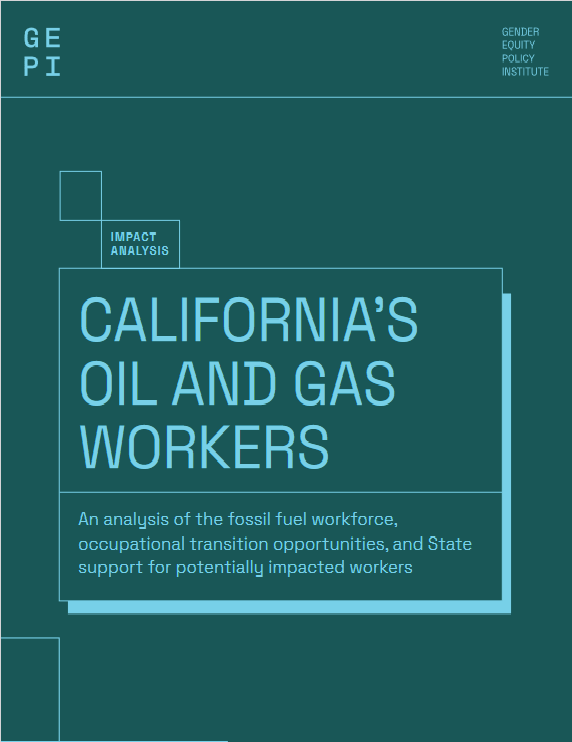
Impact Analysis: California’s Oil and Gas Workers

By Staff - Gender Equity Policy Institute, January 23, 2023

California’s ambitious climate goals, supported by state and federal investment, will create enormous economic opportunity over the coming decades. To meet the 2045 target of carbon neutrality, a 100% clean electric grid, and a 90% reduction in oil consumption and refinery production, the state will need to modernize its electrical grid and build storage capacity to meet increased demand for electricity. Carbon management techniques, plugging orphan wells, and the development of new energy sources such as geothermal will all come into play, providing economic opportunities to workers and businesses alike. Reducing use of polluting fossil fuels will likewise result in significant health benefits to Californians, especially to communities disproportionately burdened by polluting enterprises and proximity to freeways.

Supported by state investment and federal funding through the Infrastructure Investment and Jobs Act and the Inflation Reduction Act, the actions necessary to tackle the challenges of climate change are projected to create 4 million new jobs in the state. California is investing in developing the clean energy workforce, with an equity commitment to recruit and train historically disadvantaged and under- represented communities.

Decarbonizing the economy and accelerating the adoption of clean energy is necessary if we are to preserve a habitable planet. Progress to a carbon neutral future is already well underway in the state. Wind and solar power are less expensive than natural gas or coal powered electricity. A large majority of Californians are concerned about climate change and support action to address its impacts.

However, as with all sectoral economic change, some industries will grow and thrive, while others will shrink, leaving some of their workers behind. Labor unions and trades groups are rightly concerned that workers are not forced to abandon skills developed over their careers and thrown into an inhospitable labor market with no support.

Thus, a key challenge in meeting California’s climate action goals is to devise a fair, equitable, and empirically-based policy to provide support for workers at risk of unemployment and income loss as many factors combine to reduce demand in state for oil and gas products.

5 things Canada could defund to pay for an epic just transition: We could raise $180 billion a year to fund life-giving public goods by defunding five destructive areas of government spending

By Angele Alook, Emily Eaton, David Gray-Donald, Joël Laforest, Crystal Lameman, and Bronwen Tucker - The Breach, January 20, 2023

These days, anyone proposing ambitious new social programs—not to mention a generation-defining agenda like the Green New Deal—is bound to be met with a particular refrain of concern-trolling: “but how are you gonna pay for it?”

The most effective way to combat this is to point to tangible and truly giant expenditures that actively harm our communities—and which too often remain politically invisible. 

For decades, Canadian neoliberalism has ushered in an era of austerity, but the impacts haven’t landed equally. We’ve seen budget cuts for working people and the environment—borne most disproportionately by Black, Indigenous, and other racialized people and communities that are made vulnerable in our society. On the other hand, fossil fuel companies, the military, police, large corporations, and the wealthiest families have all actually received more support from the government. 

We have starved public goods, land, and life in order to feed Big Oil, corporate profits, and the security that capitalist growth requires.

But there are plenty of options to pay for a new direction: taxes on high earners and polluting firms, cutting military expenditure, long-term investment in green infrastructure, to name a few. The real issue is political will and political power. 

The money is there we just need to seize it

Just think about the impressive government policies put in place in the span of weeks when the COVID-19 pandemic first hit. This crisis has shown us that, when it comes down to it, the money and policy tools are there. And it is worth pointing out to anyone who asks this question that what we do not spend on climate action, adaptation, and upholding Indigenous sovereignty today will make this work much more expensive later on.

Including the large flows of public money as part of what’s up for debate helps to open up an accessible and potentially transformative conversation about what we could build instead. By asking tangibly what it would look like for the police to have less power over our communities—and particularly Black and Indigenous communities—we can start a public conversation about imagining and building a truly safe world.

The “refund” part of this strategy would include supporting many solutions, from universal public transit, to direct Treaty-based funding for Indigenous Nations, to affordable energy-efficient public housing, to community-owned renewable energy, to Canada forgiving illegitimate debts and paying reparations abroad to make space for a globally just transition. 

The exact demands can and should be made more specific to communities as they organize. In most of these cases, as we phase out funding for programs that are not serving communities, there are also other programs that will need to be built up at the same time. For example, we need mental health support and public housing alongside the defunding of police and prisons, as many abolitionist groups like Movement for Black Lives and The Red Nation have sketched in more detail.

The following is a non-exhaustive list of $180 billion a year in public money in Canada that could be cut, shifted, and phased out to lessen harm and free up both money and the public imagination towards a decolonial and just transition. 

Winning even one-quarter of this amount in the next few years would free up more than five times what the federal government was planning to spend each year on climate- related infrastructure and programs as of 2021. 

These figures are taken from a 2017 to 2019 average where possible to avoid potential anomalies in government spending during the beginning of the COVID-19 pandemic. For context, in 2019 the federal, provincial, and municipal governments together spent a total of $750 billion a year.

Coal Miners Weren’t Happy When Joe Manchin Derailed Build Back Better

By Austyn Gaffney - Sierra, January 19, 2022

The United Mine Workers of America issued a statement criticizing the senator for withdrawing his support from the legislation:

When West Virginia senator Joe Manchin III, a well-known coal baron, withdrew support from the Build Back Better agenda, the Biden administration’s landmark climate and social safety net bill, an influential coal-mining union was quick to respond.

The United Mine Workers of America (UMWA), a labor union formed in 1890 to organize coal miners seeking safe working conditions and fair pay, released a statement by international president Cecil E. Roberts on December 20 characterizing the union’s relationship with Manchin as “long and friendly” but expressing disappointment that the bill didn’t pass. (On the same day, the AFL-CIO, the largest federation of American labor unions, released a similar statement.)

“We urge Senator Manchin to revisit his opposition to the legislation and work with his colleagues to pass something that will help keep coal miners working,” Roberts wrote, “and have a meaningful impact on our members, their families, and their communities.”

Given the UMWA’s history with Manchin—he has been an honorary member since 2020—it was a notable reminder of just how much is at stake for miners and their communities as the president’s signature measure hangs in the balance. The Build Back Better legislation includes important items for the UMWA, like incentives to build manufacturing facilities in post-coal communities, financial penalties for employers who deny workers their rights to unionize, and an extension of the black lung trust fund, a levy paid by coal companies that provides a small monthly payment to miners with pneumoconiosis, a disease caused by coal dust and silica inhalation. 

A touch of class struggle in Germany’s car industry

By Franziska Heinisch - Progressive International, January 11, 2022

Workers at a Bosch plant in Germany are fighting to keep their jobs with, to their surprise, support from climate activists. Their common demand is that there are no layoffs for climate protection, but instead a transition to ecological production.

ultinational corporations in the automotive industry like Bosch say they need to lay off workers in the transition to less-labour intensive e-mobility. In reality, they want to relocate production to low-wage countries to safeguard profits.

This is a catastrophe,” says Giuseppe Ciccone standing in front of “his” Munich plant during the German trade union IG Metall’s action day on Bosch. Shortly before, he had given a combative speech to about 600 workers. Since then, most of them have gone back to the plant or left. The chairman of the Bosch works council in Munich has been working at the local Bosch plant for almost forty years. He started at the age of 18 and is still there today. The plant and its employees are a central part of his life, “Like a family,” he says. But, as of late, a sense of crisis is prevalent in the family because the future of the plant is at stake.

Last year, Bosch announced plans to close its Munich plant which, until now, has been a production site for combustion engines, manufacturing fuel pumps and valves for diesel and petrol engines that will no longer be used in electric cars. Twenty years ago, about 1,600 people worked there but now there are only about 260 left. Even though it’s actually a rather small site, the struggle of the 260 against the planned closure has come to exemplify the conflict over the car industry and its workers’ future.

Pages

The Fine Print I:

Disclaimer: The views expressed on this site are not the official position of the IWW (or even the IWW’s EUC) unless otherwise indicated and do not necessarily represent the views of anyone but the author’s, nor should it be assumed that any of these authors automatically support the IWW or endorse any of its positions.

Further: the inclusion of a link on our site (other than the link to the main IWW site) does not imply endorsement by or an alliance with the IWW. These sites have been chosen by our members due to their perceived relevance to the IWW EUC and are included here for informational purposes only. If you have any suggestions or comments on any of the links included (or not included) above, please contact us.

The Fine Print II:

Fair Use Notice: The material on this site is provided for educational and informational purposes. It may contain copyrighted material the use of which has not always been specifically authorized by the copyright owner. It is being made available in an effort to advance the understanding of scientific, environmental, economic, social justice and human rights issues etc.

It is believed that this constitutes a 'fair use' of any such copyrighted material as provided for in section 107 of the US Copyright Law. In accordance with Title 17 U.S.C. Section 107, the material on this site is distributed without profit to those who have an interest in using the included information for research and educational purposes. If you wish to use copyrighted material from this site for purposes of your own that go beyond 'fair use', you must obtain permission from the copyright owner. The information on this site does not constitute legal or technical advice.