You are here

education workers

Opinion: Labor taking lead on green economy

By staff - Connecticut Post, April 28, 2022

The American economy is driven by American workers. In Connecticut, many areas of employment have organized labor and fill our unions with bright, hardworking individuals dedicated to moving the state forward and securing a better future for all residents.

However, we still aren’t moving fast enough when it comes to our economic transition toward a green-collar workforce. It is important for labor to lead on climate now. This process begins with individual workers, mainly union members, taking action and organizing around environmental issues.

Labor unions are a powerful political force that can advance environmental protection for the benefit of workers and society as a whole. An initiative of the ILR Worker Institute at Cornell, in partnership with Climate Jobs National Resource Center, “Labor Leading on Climate,” proves that when organized labor leads on an issue like climate change, the outcome is a thriving economy. According to the International Labour Organization the creation of 24 million new jobs is also something that cannot be ignored. The challenge for individual workers, however, is that it isn’t always clear what they can do to advance a clean energy transition in ways that are meaningful and sustainable.

Labor unions and their members can be a driving force of a transition to a clean-energy economy. Sometimes, unions and their members already do this when they advocate for improved workplace conditions. For example, bus drivers can advocate for electric buses to reduce both their exposure to harmful diesel exhaust and air pollution in the communities they serve. Health care professionals can advocate for air pollution reduction measures that can limit asthma prevalence. Educators can present concepts of sustainability to their students and can introduce older students to “green-collar” careers to prepare them for work in the low-carbon economy of the future.

The building trades can rally around clean infrastructure investments. For example, electricians benefit from increased electric vehicle charging installations that are beneficial for the electrification of buildings and industry whereas pipefitters can benefit from geothermal energy projects. State and municipal employees can advocate internally for Lead by Example programs and publicize what their agencies or departments have learned to help businesses and residents transition away from fossil fuels. Manufacturers can seek new opportunities in renewable energy such as manufacturing parts for the Northeast’s emerging offshore wind industry.

The opportunities for unions and their members to engage in environmental advocacy in ways that benefit both workers and the environment are abundant. Workers should not fear a transition to a clean energy economy. While fighting climate change seems like an insurmountable feat, it is also one that shouldn’t be delayed any further. The time to act is now and organized labor can and should take the lead on this issue.

Maine Climate Jobs Report

By J. Mijin Cha, Hunter Moskowitz, Matt Phillips, and Lara Skinner - Maine Labor Climate Council, March 2022

This report, written in consultation with researchers at Cornell University’s Worker Institute, examines the interrelated crises of climate breakdown and inequality, and lays out an ambitious roadmap for how Maine can build a renewable energy economy, create good union jobs, and tackle racial and economic inequality.

The report’s science-based recommendations will broadly help our state achieve four goals: quickly decarbonizing Maine’s economy; ensuring that the tens of thousands of new jobs that get created as part of Maine’s energy transition adhere to high labor standards in terms of pay, benefits, training, and job security; bringing underrepresented workers into the clean-energy workforce through well-run apprentice and pre-apprentice programs; and ensuring a just transition for workers and communities most affected by these changes. 

The report sets bold objectives for building out Maine’s renewable energy economy, including:

  • Electrifying all state and local vehicles, including school and city buses, by 2040;

  • Building a high speed rail corridor from Bangor to Boston while connecting to Lewiston/Auburn;

  • Doing deep energy-efficiency retrofits and installing solar on all K-12 public schools and publicly owned buildings by 2035; and

  • Installing 3GW of renewable energy by 2030 and upgrading Maine’s energy transmission and storage capacity

Read the report (PDF).

Labor Vision TV Green & Healthy Schools Initiative. Climate Jobs Rhode Island

By Autumn Guillotte, Erica Hammond, Mike Roles, Priscilla De La Cruz, and Justin Kelly - Labor Vision RI, January 25, 2022

Activism is working to move pension funds away from stranded fossil assets

By Elizabeth Perry - Work and Climate Change Report, November 11, 2021

 “Canadian pensions are retiring fossil fuel investments” (Corporate Knights magazine, November 9) strikes a hopeful note about the state of Canada’s pension funds, stating: “Canadian pension portfolio exposures to fossil fuel stocks are down to a 10th of what they were 10 years ago, notwithstanding some controversial private equity investments.” The article summarizes analysis from the Canadian Pensions Dashboard for Responsible Investing, a new project of The Natural Step Canada, Smart Prosperity Institute, and Corporate Knights. That full report is a unique overview of sustainability performance, and employs measures such carbon footprint of the portfolio, presence of net-zero targets, the pay link to Environmental Standards (ESG), support for shareholder environmental resolutions, and more.

Another related Corporate Knights article describes youth-driven campaigns which have challenged pension plans to acknowledge and adjust to climate risk. “How young people are using climate litigation to fight for their future” focuses on youth activism targeting pension funds. It describes a years-long challenge to the Retail Employees Superannuation Trust (REST) in Australia, which ultimately ended in the pension fund settling a lawsuit out of court by acknowledging that “climate change is a material, direct and current financial risk” that could “lead to catastrophic economic and social consequences.” The fund also agreed to be more proactive and “ensure that investment managers take active steps to consider, measure and manage financial risks posed by climate change and other relevant ESG risks.” A second example describes the current activist campaign calling for the Ontario Teachers’ Pension Plan (OTPP) to phase out all current fossil fuel investments by 2025 and completely decarbonize its portfolio by 2030. Retired teachers and high school students have mobilized in Toronto, under the leadership of Shift Action for Pension Wealth and Planet Health (Shift), which is organizing similar campaigns at the ten largest Canadian pension funds. In September 2021, the Ontario Teachers Pension Plan Board announced  “industry-leading targets to reduce portfolio carbon emissions intensity by 45% by 2025 and two-thirds (67%) by 2030, compared to its 2019 baseline. These emission reduction targets cover all the Fund’s real assets, private natural resources, equity and corporate credit holdings across public and private markets, including external managers.” The WCR has more detail here .

Relevant to all pension management: new research published in Nature Energy and summarized in The Guardian with this headline: “Half world’s fossil fuel assets could become worthless by 2036 in net zero transition” .

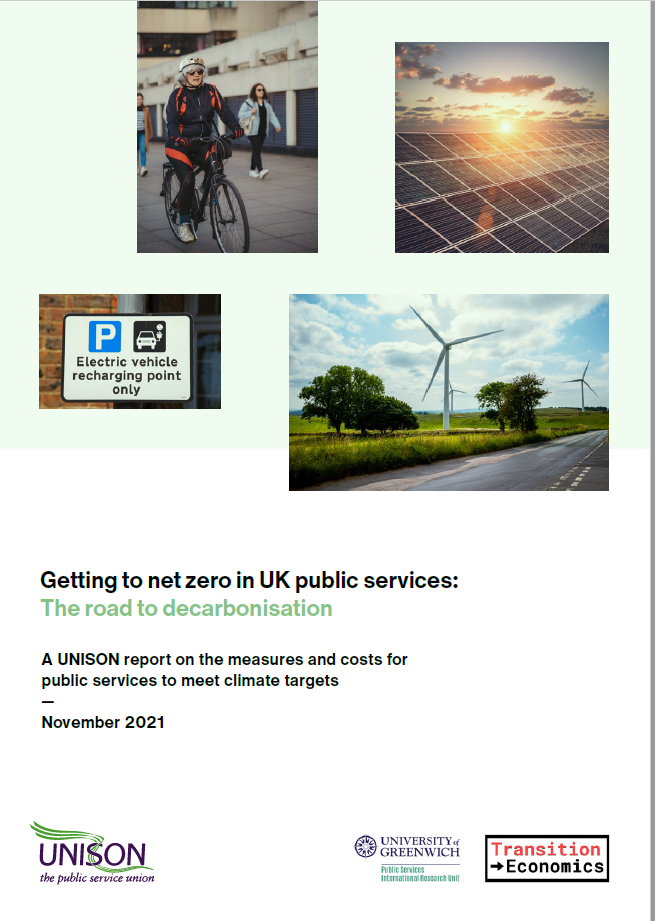
Getting to Net Zero in UK Public Services: The Road to Decarbonisation

By Dr. Vera Weghmann, et. al. - Unison, November 2021

Public services as a whole (excluding transport) represent about 8% of the UK’s direct greenhouse gas emissions. The NHS alone represents about 4% of the UK’s emissions. When procurement, construction, and social housing are taken into account, public services’ impacts are much greater.

Different sectors within the overall framework of public services have declared their decarbonisation plans. Some are ahead of the national targets. The NHS has declared that it will reach net zero by 2040, with an ambition to reach an 80% reduction by 2028 to 2032. More than one-third of local authorities (single- and upper-tier) committed themselves to decarbonise their local area by or before 2030.

The government aims to reduce direct emissions from public sector buildings by 75% against a 2017 baseline by the end of the Sixth Carbon Budget.

This report identified 21 different measures that should be taken across buildings, transport, electricity generation, waste, procurement and land use along with costed measures for each of nine different public services.

In our analysis, the UK’s public services need a capital investment injection of over £140 billion to 2035 to meet their Net Zero obligations. This will set the public sector on track to meet their climate targets and contribute to the UK’s overall carbon reduction aims. The analysis also identified measures that required annual operational expenditures of £1 billion to hit net zero targets. UNISON fully advocates that quality public services are best delivered by public ownership of public services and utilities rather than privatisation, outsourcing or PFI contracting of public services.

As well as improving the quality of life for service users, workers and the wider community, a number of the measures will also result in significant savings to public services’ budgets, through lower energy bills, cheaper to run fleets, and procurement savings. UNISON fully advocates that quality public services are best delivered by public ownership of public services and utilities rather than privatisation, outsourcing or PFI contracting of public services.

Read the text (PDF).

The Green New Deal–From Below

By Jeremy Brecher - Labor Network for Sustainability, October 30, 2021

This is the first in a series of commentaries on “The Green New Deal–From Below.” This commentary explains the idea of a Green New Deal from Below and provides an overview of the series. Subsequent commentaries in this series will address dimensions of the Green New Deal from below ranging from energy production to the role of unions to microgrids, coops, anchor institutions, and many others.

The Green New Deal is a visionary program to protect the earth’s climate while creating good jobs, reducing injustice, and eliminating poverty. Its core principle is to use the necessity for climate protection as a basis for realizing full employment and social justice.

The Green New Deal first emerged as a proposal for national legislation, and the struggle to embody it in national legislation is ongoing. But there has also emerged a little-noticed wave of initiatives from community groups, unions, city and state governments, tribes, and other non-federal institutions designed to contribute to the climate protection and social justice goals of the Green New Deal. We will call these the Green New Deal from Below (GNDfB).

The purpose of this commentary is to provide an overview of Green New Deal from Below initiatives in many different arenas and locations. It provides an introduction to a series of commentaries that will delve more deeply into each aspect of the GNDfB. The purpose of the series is to reveal the rich diversity of GNDfB programs already underway and in development. The projects of Green New Dealers recounted here should provide inspiration for thousands more that can create the foundation for national mobilization–and reconstruction.

The original 2018 Green New Deal resolution submitted by Rep. Alexandria Ocasio-Cortez called for a national 10-year mobilization to achieve 100% of national power generation from renewable sources; a national “smart grid”; energy efficiency upgrades for every residential and industrial building; decarbonizing manufacturing, agriculture, transportation, and other infrastructure; and helping other countries achieve carbon neutral economies and a global Green New Deal. It proposed a job guarantee to assure a living wage job to every person who wants one; mitigation of income and wealth inequality; basic income programs; and universal health care. It advocated innovative financial structures including cooperative and public ownership and public banks. Since that time a wide-ranging discussion has extended and fleshed out the vision of the Green New Deal to include an even wider range of proposals to address climate, jobs, and justice.

The Green New Deal first emerged as a proposal for national mobilization, and national legislation has remained an essential element. But whether legislation embodying the Green New Deal will be passed, and how adequate it will be, continues to hang in the balance. Current “Build Back Better” legislation has already been downsized to less than half its original scale, and many of the crucial elements of the Green New Deal have been cut along the way. How much of the Green New Deal program will actually be passed now or in the future cannot currently be known.

But meanwhile, there are thousands of efforts to realize the goals of the Green New Deal at community, municipal, county, state, tribal, industry, and sectoral levels. While these cannot substitute for a national program, they can contribute enormously to the Green New Deal’s goals of climate protection and economic justice. Indeed, they may well turn out to be the tip of the Green New Deal spear, developing in the vacuum left by the limitations of national programs.

CalPERS Finally Divests More Coal

By Sandy Emerson - Unison, September 24, 2021

CalPERS has finally divested from three more thermal coal companies, as required by law. Following the passage of SB 185 (2015) CalPERS divested from all but three (out of 17) selected thermal coal mining companies: Exxaro, Adaro, and Banpu.  In an email to Fossil Free California, CalPERS’ Managing Investment Director Anne Simpson said that CalPERS no longer owns those companies: “As per the earlier board discussion, the three companies were retained for further engagement, which did not make progress hence the sale.”

The divestment from the remaining three thermal coal companies from the 2017 list shows the power of stakeholder pressure. CalPERS re-started engagements with Exxaro, Adaro, and Banpu in October, 2020, after Fossil Free California published its hard-hitting report “CalPERS Continues to Invest in Coal”. At the March 15, 2021 Investment Committee Meeting, Anne Simpson stated that the companies’ responses were being reviewed and that a decision would be announced toward the end of 2021.

We celebrate the fact that FFCA’s letter-writing campaign generated 626 individual letters to CalPERS, after we sent a series of detailed letters to CalPERS executive and investment staff and published the report. This long-awaited divestment success is thanks to the persistence and commitment of pension members, beneficiaries, and concerned Californians who sent letters, made public comments, and generally kept the pressure on for CalPERS to complete its mandated divestment.

Ontario Teachers Pension Plan sets target to reduce 45% carbon emission intensity in their portfolio by 2025

By Elizabeth Perry - Work and Climate Change Report, September 20, 2021

The Fossil Fuel Non-Proliferation Treaty Initiative is spurring international cooperation to end new development of

The Ontario Teachers Pension Plan Board announced on September 16 “industry-leading targets to reduce portfolio carbon emissions intensity by 45% by 2025 and two-thirds (67%) by 2030, compared to its 2019 baseline. These emission reduction targets cover all the Fund’s real assets, private natural resources, equity and corporate credit holdings across public and private markets, including external managers.” The press release continues: “By significantly growing our portfolio of green investments and working collaboratively with our portfolio companies to transform their businesses, we can make a positive impact by encouraging an inclusive transition that benefits our people, communities and portfolio companies.” Reaction by pension advocacy group Shift Action acknowledges that this is “the strongest climate commitment we’ve seen yet from a Canadian pension plan”, but called for OTPP to explain how it will eliminate its fossil fuel investments. The ShiftAction Backgrounder which accompanies the press release challenges the OTPP’s own estimate that approximately 3% of their assets ($6.6billion) are held in oil and gas assets, and compiles a list of company names and the extent of OTPP investments, including recent investments in 2020 and 2021.

If all of this sounds familiar, it may be because the Ontario Teachers Pension Plan released a Net Zero Emissions Commitment  in January 2021, which was criticized as greenwashing in Breaking down Ontario Teachers’ 2050 net-zero emissions promise (The National Observer , Feb. 4). The article stated: “…If OTPP is serious about adopting a globally significant climate-safe investment strategy, it needs a plan to exclude all new oil, gas and coal investments; a timeline for phasing out existing fossil fuel holdings; a commitment to decarbonize its portfolio by 2030; ambitious new targets for increasing investments in profitable climate solutions; and a requirement for owned companies to refrain from lobbying activities that undermine ambitious climate policy, set corporate timelines for reducing emissions, and link executive compensation to measurable climate goals.” It seems OTPP is moving in the right direction, but ever so slowly – similar to the Canada Pension Plan Investment Board (CPPIB) and the Caisse de dépôt et placement du Québec (CDPQ), as explained in An Insecure Future: Canada’s biggest public pensions are still banking on fossil fuels  released by the Corporate Mapping Project in mid-August .

As California Burns, Teacher Pension Postpones Divestment

By Marcy Winograd - Common Dreams, September 7, 2021

As the climate crisis sent thousands fleeing wildfires in Northern California, CalSTRS, the nation's second largest public pension fund, postponed full divestment from fossil fuels for nearly 30 years.

Over objections from CTADivest, organizers within the powerhouse California Teachers Association, the retirement fund's investment committee voted unanimously September 1, 2021,to support a staff recommendation to adopt a net-zero Greenhouse Gas Emissions (GHG) portfolio by 2050 or sooner. This translates into continued "engagement" or investment in Big Oil until the date the Paris Agreement set for countries to reach net-zero carbon emissions.

What is net-zero anyway? It's the point at which GHG's released by humans are "counterbalanced," in CalSTRS' words, by removing GHG's from the atmosphere, though no one is clear on how to remove these earth-warming gases through carbon capture and storage (CCS) or if it's even possible to inject them back into the ground without burning more fuels, poisoning drinking water or triggering earthquakes.

The CalSTRS vote came two months ahead of the next UN climate conference in Scotland, where the COP26 Coalition, made up of 350.org, CODEPNK and others, is expected to turn out thousands of protesters to demand the world's nations run, not walk, toward divestment from fossil fuels, as well as militarism, a key driver of the climate crisis.

The CalSTRS Board vote to continue investing in fossil fuels also came days after the California Democratic Party reaffirmed a 2015 resolution calling on the state's pension funds to divest from fossil fuels.

California Kids to Teachers' Pension Fund: Divest from Oil

By Marcy Winograd - Common Dreams, August 26, 2021

The kids are mad as hell—and so are teachers who want their California teacher pension fund, CalSTRS, to join 1,000 other institutions collectively divesting $14.5 trillion from the fossil fuel industry that threatens climate catastrophe. The retirement fund divestment fight, led by retired teachers in Fossil Free CA and students from Youth vs Apocalypse and Earth Guardians, estimates CalSTRS' portfolio investments in fossil fuels at $16 billion, mostly in oil and gas delivery systems, but $6 billion in direct investments in oil behemoths, with $400 million in Exxon-Mobil, $350 million in Chevron, $250 million in BP and $108 million in Enbridge Inc. This is the same corporation sending attack dogs to maul water protectors protesting drilling at river crossings on indigenous land, where Enbridge's Line 3 pipeline will send sludgy tar sands through Minnesota. The estimated pollution from the pipeline is equivalent to 50 coal powered plants running for 50 years.

Fossil Free CA and other divestment advocates, including this author, warn that CalSTRS, the nation's second largest pension fund with a $310 billion dollar portfolio, just behind CalPERS' $444 billion in holdings, risks sticking its members, over 700-thousand active and retired California teachers, with stranded assets—unless the pension fund moves the money before it's too late, too late for the portfolio, too late for the planet.

CalSTRS's resistance to divestment from Big Oil comes at a financial cost to rank and file public school teachers. In 2019, the Corporate Knights, a Toronto-based research firm, published a study showing that had CalSTRS divested during the last decade the teacher retirement fund would have generated an additional $5.5 billion. Forbes reports that during that same decade, the energy sector of big fossil fuel companies, such as Exxon (ejected from the Dow in 2020), Chevron and BP, shrunk to the smallest investment sector in Standard and Poor's (S & P) index of the 500 largest US publicly traded companies. This year oil companies underperforming the index saw their credit ratings cut in half.

Pages

The Fine Print I:

Disclaimer: The views expressed on this site are not the official position of the IWW (or even the IWW’s EUC) unless otherwise indicated and do not necessarily represent the views of anyone but the author’s, nor should it be assumed that any of these authors automatically support the IWW or endorse any of its positions.

Further: the inclusion of a link on our site (other than the link to the main IWW site) does not imply endorsement by or an alliance with the IWW. These sites have been chosen by our members due to their perceived relevance to the IWW EUC and are included here for informational purposes only. If you have any suggestions or comments on any of the links included (or not included) above, please contact us.

The Fine Print II:

Fair Use Notice: The material on this site is provided for educational and informational purposes. It may contain copyrighted material the use of which has not always been specifically authorized by the copyright owner. It is being made available in an effort to advance the understanding of scientific, environmental, economic, social justice and human rights issues etc.

It is believed that this constitutes a 'fair use' of any such copyrighted material as provided for in section 107 of the US Copyright Law. In accordance with Title 17 U.S.C. Section 107, the material on this site is distributed without profit to those who have an interest in using the included information for research and educational purposes. If you wish to use copyrighted material from this site for purposes of your own that go beyond 'fair use', you must obtain permission from the copyright owner. The information on this site does not constitute legal or technical advice.