You are here

green unionism

Against climate change, against dictatorship: a message from Cairo

By the Egyptian Campaign for Climate and Democracy - Egypt Solidarity, June 2022

Egypt Solidarity Initiative has received the following message from Egyptian activists who have been involved for many years in campaigns for democracy, trade union and human, and environmental justice. We are publishing this on their behalf because the level of repression prevents the publication of an open appeal from inside the country.

This November the COP 27 conference will be held in the tourist town of Sharm El-Sheikh in the Sinai Peninsula, in Egypt. The governments of the world have broken nearly all the promises made in the Glasgow COP 26. We are all inching closer to a climate catastrophe, but political leaders and major corporations are too immersed in their competition for resources, markets and geopolitical dominance to take the necessary measures to save our planet.

It is becoming clearer every day to millions of people across the globe that only a grassroots movement can force through actual change.

Yet the COP 27 conference is taking place in an isolated heavily policed tourist resort with only one major road in and out, and hotels that are required to charge rates that might push the entire COP beyond the means of many grassroots organisations, particularly those from poorer countries. The Egyptian government has announced that there will be space for opposition during the conference, but what they actually mean is that activists will be offered fake ‘astroturfed’ protests in which state-affiliated NGOs demonstrate near the convention centre to deliver the impression of an independent local civil society. No real Egyptian opposition activists will be allowed near Sharm El-Sheikh during the conference. It would be a shame if genuine global grassroots movements are fooled into taking part in such a state-orchestrated charade.

While the Egyptian government is preparing to host COP27, thousands of people, among them human rights defenders, journalists, peaceful protesters, lawyers, opposition politicians and activists continue to suffer in Egyptian jails in brutal conditions, solely for exercising their rights to freedom of expression, association or peaceful assembly, without legal basis or following grossly unfair trials. Egypt is an African country and part of the Global South. But Egypt is also a country ruled by a brutal and corrupt military dictatorship. The regime of Abdelfattah El-Sisi, will present itself during the conference and in the months leading to it, as championing the needs and demands of the Global South in general and the African continent in particular. This is a great lie. The only thing this regime represents is the military junta that has been in power since 2013.

Unions Making a Green New Deal From Below: Part 2

By Jeremy Brecher - Labor Network for Sustainability, June 2022

This second of two commentaries on “Unions Making a Green New Deal from Below” portrays what it looks like when unions in a town decide to create a local Green New Deal or when unions in a state decide to transform their economy to expand jobs and justice by protecting the climate.

Workers and unions are among those who have the most to gain by climate protection that produces good jobs and greater equality. That’s why unions in the most diverse industries and occupations are creating their own Green New Deal-type programs in localities around the country. Here are some examples:

(TUED Working Paper #14) Beyond Disruption: How Reclaimed Utilities Can Help Cities Meet Their Climate Goals - Video Discussion

By Sean Sweeney, et. al. - Labor Network for Sustainability, May 31, 2022

Web Editor's Note: this webinar discussion focuses on TUED Working Paper #14. Some of the arguments made by the presenters seem to frame advocates of locally controlled, decentralized distributed energy as "unwittingly plaing into the hands of neoliberalism", which is a debatable position (and one that some of the other attendeees push back on). 

AFT and UAW Call for Electric School Buses

Building Our New Electric Fleet

By Harold Meyerson - Resistance Committee, May 31, 2022

Today on TAP: In a signal victory last week, an activist group prevailed on a major bus manufacturer to hire its workers from local, historically disadvantaged communities.

In 1997, after a campaign of several years’ duration, the Los Angeles City Council voted to establish the nation’s first living wage ordinance. Under its terms, businesses with which the city had contracted to do its work—for which the city’s taxpayers were footing the bill—were required to pay their employees a specified, decent wage, as well as offering them a modicum of benefits.

The ordinance, and the campaign that pressured the council to enact it, were the brainstorm of Madeline Janis, the attorney who’d founded and led the Los Angeles Alliance for a New Economy (LAANE). “Taxpayers should not be subsidizing poverty-wage jobs,” Janis argued.

At roughly the same time, in tandem with another progressive community organization, LAANE also persuaded a number of local developers to sign community benefits agreements (CBAs), which obligated those developers to hire local residents—in effect, disproportionately minorities and women—on major construction projects. Previously, such projects were built by a heavily white male workforce that lived nowhere near the city’s center, even as those projects uprooted the self-same minority communities who’d lived and worked there. With the coming of CBAs, minorities began to gain much greater entry to union construction jobs that offered pay and benefits that otherwise would have remained out of reach.

CNT-AIT muestra su rechazo frontal a la construcción de una gasolinera en el solar adyacente al IES Cantabria

By staff - CNT-AIT Enseñanza Cantabria, May 30, 2022

Loosely translated and summarized, this CNT branch is protyesting the establishment of a gas station for both class and ecological reasons:

Desde el sindicato CNT-AIT queremos mostrar nuestro mayor rechazo a la construcción de una gasolinera en la parcela colindante al IES Cantabria. Este rechazo se basa en las siguientes razones:

  • Peligrosidad asociada al tráfico: la gasolinera lleva consigo, lógicamente, un aumento del tráfico de vehículos, de arranques y detenciones, que aumentan las posibilidades de que se de una colisión o un atropello, asunto especialmente grave en el entorno de un centro educativo.
  • Peligrosidad asociada a los accidentes: la gasolinera es, en realidad, un depósito de combustible. Las posibilidades de que se pierda el control sobre ese combustible, por pequeñas que sean, hace necesario que estas instalaciones no se realicen en zonas urbanas, muchísimo menos cerca de edificios donde se hacinan adultos y jóvenes.
  • Peligrosidad asociada a la contaminación ambiental. La emisión de gases puede resultar problemática y empeorar afecciones respiratorias.

Desde el sindicato CNT-AIT creemos que estamos, de nuevo, ante una maraña burocrática en la que ninguna institución se hace responsable. Ni Ayuntamiento, ni Autonomía, ni Estado Central: y el peligro sigue ahí, para trabajadores y estudiantes, y la falta de responsabilidad no va a hacer que ese solucione el problema.

En otras ocasiones, en otras Autonomías, se ha conseguido evitar la construcción de gasolineras. Basten los siguientes ejemplos: Getafe en la Comunidad de Madrid (diciembre de 2020), Villaverde en la Comunidad de Madrid (diciembre de 2013), La Pelusa en Andalucía (octubre de 2021), Murcia en la comunidad homónima (enero de 2020) o Aravaca en la Comunidad de Madrid (1992).

Así las cosas, señalamos que:

  • La construcción de la gasolinera debe ser detenida, dado que las personas que más van a sufrir sus consecuencias (la comunidad educativa del IES Cantabria) así lo ha demandado públicamente.
  • Existen posibilidades reales y, si desde las instituciones públicas no se dan, entendemos que es falta de interés y voluntad y no incapacidad real.

As Illinois Coal Jobs Disappear, Some Are Looking to the Sun

By Kari Lydersen - In These Times, May 26, 2022

While Illinois phases out coal, clean energy jobs hold promise—both for displaced coal workers, and those harmed by the fossil fuel economy.

Matt Reuscher was laid off a decade ago from Peabody Energy’s Gateway coal mine in Southern Illinois, in the midst of a drought that made the water needed to wash the coal too scarce and caused production to drop, as he remembers it.

Reuscher’s grandfather and two uncles had been miners, and his father — a machinist — did much work with the mines. Like many young men in Southern Illinois, it was a natural career choice for Reuscher. Still in his early 20s when he was laid off, Reuscher ​“spent that summer doing odds and ends, not really finding much of anything I enjoyed doing as much as being underground.”

By fall of 2012, he started working installing solar panels for StraightUp Solar, one of very few solar companies operating in the heart of Illinois coal country. He heard about the job through a family friend and figured he’d give it a try since he had a construction background. He immediately loved the work, and he’s become an evangelist for the clean energy shift happening nationwide, if more slowly in Southern Illinois. With colleagues, he fundraised to install solar panels in tiny villages on the Miskito Coast of Nicaragua, and he became a solar electrician and worked on StraightUp Solar installations powering the wastewater treatment center and civic center in Carbondale, Illinois — a town named for coal. 

Solar installation pays considerably less than coal mining, Reuscher acknowledges, but he feels it’s a safer and healthier way to support his family — including two young sons who love the outdoors as much as he does. 

“You work with people who are really conscious about the environment. That rubs off on me and then rubs off on them,” Reuscher notes, referring to his sons.

Illinois has more than a dozen coal mines and more than a dozen coal-fired power plants that are required to close or reach zero carbon emissions by 2030 (for privately-owned plants) or 2045 (for the state’s two publicly-owned plants), though most will close much sooner due to market forces. Reaching zero carbon emissions would entail complete carbon capture and sequestration, which has not been achieved at commercial scale anywhere in the United States. 

Coal mines also frequently lay off workers, as the industry is in financial duress, though Illinois coal is bolstered by a healthy export market. A ​“just transition” — which refers to providing jobs and opportunities for workers and communities impacted by the decline of fossil fuels — has been an increasing priority of environmental movements nation-wide, and was a major focus of Illinois’ 2021 Climate and Equitable Jobs Act (CEJA). The idea is that people long burdened by fossil fuel pollution and dependent on fossil fuel economies should benefit from the growth of clean energy. Reuscher’s story is a perfect example. 

But in Illinois, as nationally, his transition is a rarity. Solar and other clean energy jobs have more often proven not to be an attractive or accessible option for former coal workers. And advocates and civic leaders have prioritized a broader and also difficult goal: striving to provide clean energy opportunities for not only displaced fossil fuel workers, but for those who have been harmed by fossil fuels or left out of the economic opportunities fossil fuels provided.

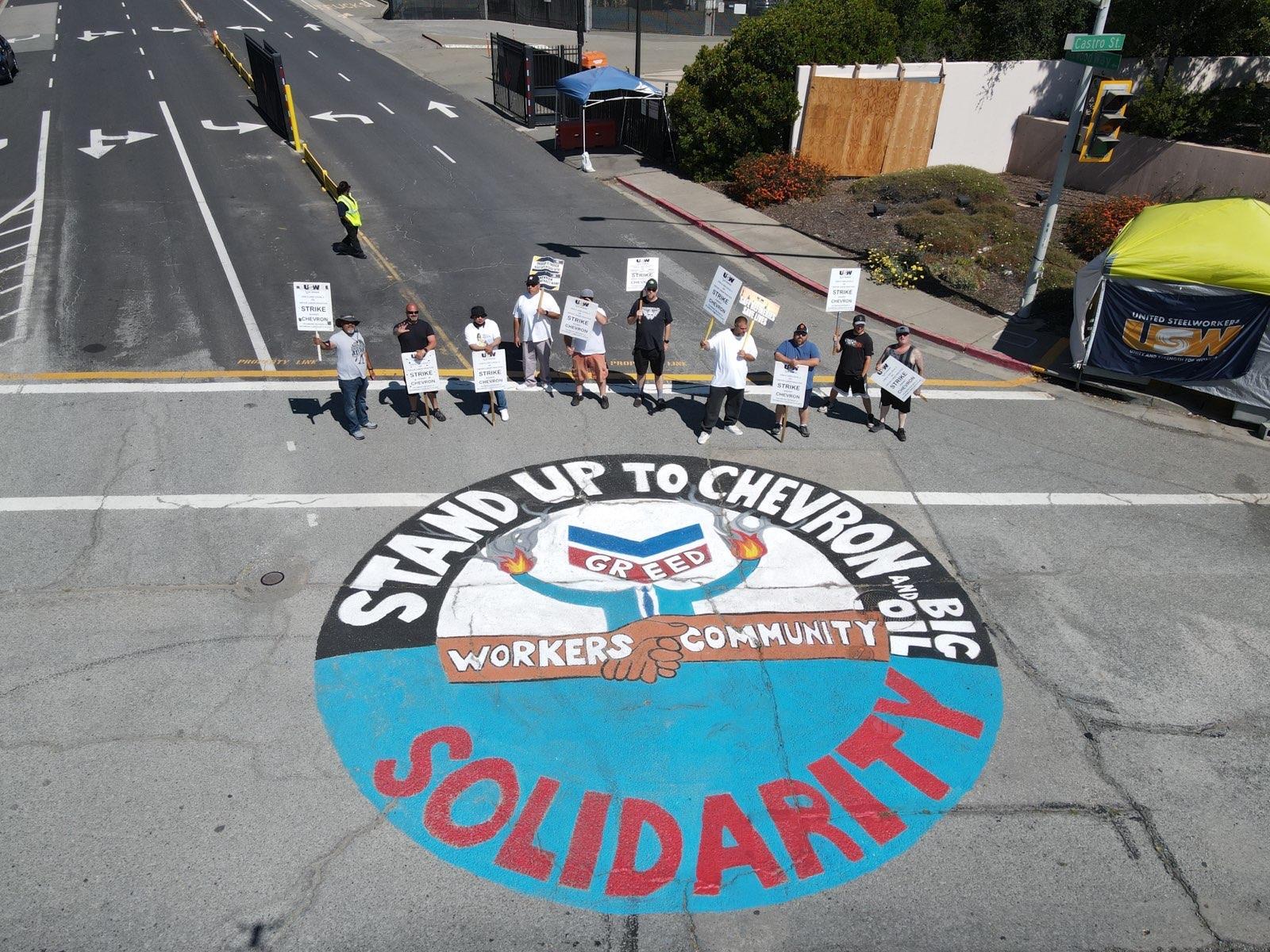
Are Refinery Workers Climate Enemies? - Part 2

By That Green Union Guy - IWW Environmental Union Caucus, May 25, 2022

For context and background, see part one, here. Unlike the first installment, this second response has ommitted the comments that preciptated it, for the sake of clarity, as well as the fact that the author tried to echo the rebutted points in the response. It should be noted that only one individual has expressed outright opposition to showing solidarity with striking refinery workers. It's a foregone conclusion that the overwhelming majority of the IWW does not share this one individual's view.

First of all, let me be clear: my position is that humanity must collectively phase out burning fossil fuels for energy, transportation, and locomotion as rapidly as possible.

That said, nobody seriously believes we can collectively cease burning fossil fuels in a single day, so the likelihood is that the burning of them will continue for some time (I aim to make that as little time as possible).

Regardless of how long it takes, no oil refinery is going to simply shut down just because large masses of people, even 3.5% of the population demand it. It’s not even technically possible, let alone economically or politically possible. Most of the Environmental Justice and Climate Justice organizations (other than a few ultra-sectarian extremists) get this, and they’ve crafted their demands accordingly.

While there’s a degree of variation among the various organizing, most of them call for the following:

  1. No new extraction of new fossil fuel sources;
  2. Rapid phase out of existing fossil fuel sources;
  3. Managed decline of the existing fossil fuel supply chain;
  4. Just transition for any and all affected workers in the entire fossil fuel supply chain;
  5. Repurposing of equipment for non fossil fuel burning purposes;
  6. Bioremediation of damaged ecosystems across the extraction supply chain;
  7. Reparations for the affected communities and tribes.

Supporting refinery workers involved in a strike is not in any way contradictory to the above demands.

Unions crucial to development of climate movement

By staff - Public and Commercial Services Union, May 25, 2022

The trade union movement is crucial to the development of a climate movement, PCS conference heard in a debate on the impact and aftermath of COP26.

Motion A41, moved by Mairtin from DWP Glasgow branch on Wednesday (25) afternoon, criticised the government for greenwashing by promoting market mechanisms as the central plank to solve the climate emergency through emissions trading or carbon offsetting or some other accountancy trick. But leaving solutions to the market will not work.

Mairtin said we will take no lectures from the government on environmental issues: “We’ve been taking notice of environmental issues and talking about diversification for decades. We represent the poorest and most marginalised in society who will be most affected by the environmental disaster.

“We live in the ravages of the environmental crisis and we are the ones who will rebuild our communities.”

That COP26 – the UN Climate Change Conference which took place in Glasgow last year, marked a new level of mass campaigning over the environmental crisis. There was praise for the COP26 Coalition, a coalition of groups and individuals mobilising around climate justice during COP26, for becoming a “dynamic movement involving environmental campaigns, religious organisations, trade unions and the left.”

The motion, which was carried unanimously, said that there are confusions and disagreements that need to be engaged with, such as the belief that moving away from a carbon-based economy will lead to job losses.

Angus from DWP Cambridgeshire who seconded the motion, said COP26 was a ‘cop-out 26’.

“PCS has led the way promoting the green agenda, this needs to continue and we also need to provide more support for our environmental reps,” he said.

The motion said that climate action must take account of the inequality of carbon emissions with the biggest emitters compensating the lowest emitters for climate change, recognised by COP18 in Doha, 2012 as the ‘climate debt’.

Jackie Green, supporting the motion on behalf of the NEC, highlighted how our union is developing a network of green reps nationally.

“As we look to move into a different phase after COP26, we look to mobilise around key events, including the TUC demo on 18 June,” she said.

The motion called on the NEC to:

  • Commit to engage fully with any new coalition that emerges out of the COP26 coalition.
  • Develop a network of green reps and equip them with the knowledge they need through dedicated training that happens on a regular basis.
  • Aim to build regional networks of reps based across different civil service departments.
  • Work in the wider trade union movement to engage other trade unions on this issue and develop cross-union networks.
  • Use those networks and work with the successor to the COP26 coalition to organise a trade union conference around the demand for a Just Transition to a more sustainable economy.

A shorter workweek may increase worker productivity: but that’s not why we need one

By Robert Raymond - Sharable, May 19, 2022

Studies show that a shorter workweek is healthier for people and the planet — but much of the conversation is focused on its impact on worker productivity or efficiency. This is a big mistake.

With the average worker in the United States clocking 47 hours a week, Americans are among the most overworked populations in the world — in fact, they work more hours per year than workers in almost any other industrialized country. 

Advocates of a shorter work week had a brief moment of excitement in California last month when state Democrats proposed a bill that would have required private-sector employers with more than 500 employees to pay hourly workers overtime after logging more than 32 hours a week

Unfortunately, the proposal didn’t make it very far through the legislative bill-making machine before it stalled out in committee. For the foreseeable future, the bill will remain in legislative purgatory. 

However, despite a disappointing outcome, the mere existence of the proposed bill in the state legislature is an important step toward shortening the Californian workweek — something that would be a boon to workers.

There are many benefits of working shorter hours. One that has been particularly compelling to employers is the fact that shorter hours have been linked to increased worker efficiency and productivity. For example, a 2021 study from Japan empirically determined that “when long working hours are reduced, individual productivity increases, and fewer mistakes are made at work.” 

Studies have also shown that working fewer hours actually increases worker happiness — leaving employees feeling more energized and giving them more free time to pursue their interests outside of work. 

I’d hazard a guess that the majority of us would drool over the prospect of fewer hours of wage labor and more hours in our day for rest, leisure, or — as the 19th-century slogan of the 8-hour day movement advocated — more hours to do with “what we will.

In fact, re-framing this discussion around the needs of labor rather than the needs of employers is critical for getting us on a path towards a healthier, more sustainable world where workers thrive.

Pages

The Fine Print I:

Disclaimer: The views expressed on this site are not the official position of the IWW (or even the IWW’s EUC) unless otherwise indicated and do not necessarily represent the views of anyone but the author’s, nor should it be assumed that any of these authors automatically support the IWW or endorse any of its positions.

Further: the inclusion of a link on our site (other than the link to the main IWW site) does not imply endorsement by or an alliance with the IWW. These sites have been chosen by our members due to their perceived relevance to the IWW EUC and are included here for informational purposes only. If you have any suggestions or comments on any of the links included (or not included) above, please contact us.

The Fine Print II:

Fair Use Notice: The material on this site is provided for educational and informational purposes. It may contain copyrighted material the use of which has not always been specifically authorized by the copyright owner. It is being made available in an effort to advance the understanding of scientific, environmental, economic, social justice and human rights issues etc.

It is believed that this constitutes a 'fair use' of any such copyrighted material as provided for in section 107 of the US Copyright Law. In accordance with Title 17 U.S.C. Section 107, the material on this site is distributed without profit to those who have an interest in using the included information for research and educational purposes. If you wish to use copyrighted material from this site for purposes of your own that go beyond 'fair use', you must obtain permission from the copyright owner. The information on this site does not constitute legal or technical advice.