You are here

green jobs

Progressives Call for Embrace of 'Green Steel' Manufacturing

By Kenny Stancil - Common Dreams, May 24, 2023

"It's time that the steel industry take the growing need and demand for fossil-free steel seriously," said one advocate.

Progressive organizers on Wednesday urged steelmakers to swiftly adopt the clean manufacturing methods needed to achieve a shift from coal-based steel to "green steel."

At the Great Designs in Steel conference held in a Detroit suburb, Public Citizen and Mighty Earth activists used a series of digital ads and mobile billboards to call on industry insiders and automotive executives to accelerate the nascent transition from dirty to clean steel by fully embracing low- to zero-carbon production processes—one of many changes that scientists say are necessary to avert the worst consequences of the fossil fuel-driven climate crisis.

"Steel manufacturing remains one of the most energy-intensive and polluting aspects of making a vehicle, but there are solutions to clean it up," Erika Thi Patterson, supply chain campaigns director at Public Citizen, said in a statement. "As companies and governments work to meet net-zero climate commitments, it's time that the steel industry take the growing need and demand for fossil-free steel seriously and embrace the cleaner technologies that exist today."

"Insiders at this conference," Patterson continued, "need to recognize the inevitability of green transportation and move in that direction quickly and forcefully."

At the conference venue, mobile billboards denounced steelmaker Cleveland-Cliffs Inc.'s recent announcement that it plans to stick with coal-powered blast furnaces in the near term. Rival company U.S. Steel, by contrast, is ramping up the use of lower-emission electric arc furnaces at its mini-mills.

Billboards with the message, "Cleveland-Cliffs: Ditch the past, embrace the Green Steel future!" circled the venue for the duration of the meeting.

Battery Jobs Must Be Good-Paying Union Jobs, Says New UAW President

By Dan DiMaggio - Labor Notes, May 18, 2023

Contracts covering 150,000 auto workers at the Big 3 will expire on September 14, and the new leadership of the United Auto Workers is taking a more aggressive stance than in years past.

“We’re going to launch our biggest contract campaign ever in our history,” UAW President Shawn Fain told members in a Facebook live video.

Fain took office in March after winning the union’s first one member, one vote election. Running on the slogan, “No Corruption, No Concessions, No Tiers,” he and the Members United slate swept all the positions they ran for, giving reformers a majority on the international executive board.

While the union has vowed to take on tiered wages and benefits, job security, and plant closures, the transition to electric vehicles (EV) looms especially large.

Since President Biden signed the Inflation Reduction Act last August, companies have announced $120 billion in investments in domestic EV and battery manufacturing. The Act includes big tax credits and incentives for clean energy and EVs.

Ford alone is investing $11 billion in a new EV assembly plant and battery factories in Tennessee and Kentucky. The Biden administration wants EVs to make up half of all new vehicles sold by 2030.

Aviation Workers Demand Industry to Reject Dangerous Growth

By Finlay Asher - Safe Landing, May 4, 2023

Finlay Asher of Safe Landing gave this talk on 4th May 2023 as part of the "Aero Lectures" series organised by the HAW University in Hamburg in cooperation with DGLR, Royal Aeronautical Society (RAeS), ZAL and VDI. He covered the need for aviation decarbonisation, the issues with various technological and policy options, what Safe Landing's positive view of the future for air travel is, and how we think we can achieve it (worker-led movements and Aviation Workers' Assemblies.)

Steel built the Rust Belt. Green steel could help rebuild it

By Katie Myers - Grist, May 11, 2023

In the Mon Valley of western Pennsylvania, steel was once a way of life, one synonymous with the image of rural, working-class Rust Belt communities. At its height in 1910, Pittsburgh alone produced 25 million tons of it, or 60 percent of the nation’s total. Bustling mills linger along the Monongahela River and around Pittsburgh, but employment has been steadily winding down for decades.

Though President Trump promised a return to the idealized vision of American steelmaking that Bruce Springsteen might sing about, the industry has changed since its initial slump four decades ago. Jobs declined 49 percent between 1990 and 2021, when increased efficiency saw the sector operating at its highest capacity in 14 years. Despite ongoing supply chain hiccups and inflation, demand continues growing globally, particularly in Asia. But even as demand for this essential material climbs, so too does the pressure to decarbonize its production.

Earlier this month, the progressive Ohio River Valley Institute released a study that found a carefully planned transition to “green” steel — manufactured using hydrogen generated with renewable energy — could be a climatic and economic boon. It argues that as countries work toward achieving net-zero emissions by 2050, a green steel boom in western Pennsylvania could help the U.S. meet that goal, make its steel industry competitive again, and employ a well-paid industrial workforce.

“A transition to fossil fuel-free steelmaking could grow total jobs supported by steelmaking in the region by 27 percent to 43 percent by 2031, forestalling projected job losses,” the study noted. “Regional jobs supported by traditional steelmaking are expected to fall by 30 percent in the same period.”

Responsible Offshore Wind Development Starts with a Green Port

By Luis Neuner, Jennifer Kalt, Caroline Griffith, and Colin Fiske - Lost Coast Outpost (reposted at Wild California), May 10, 2023

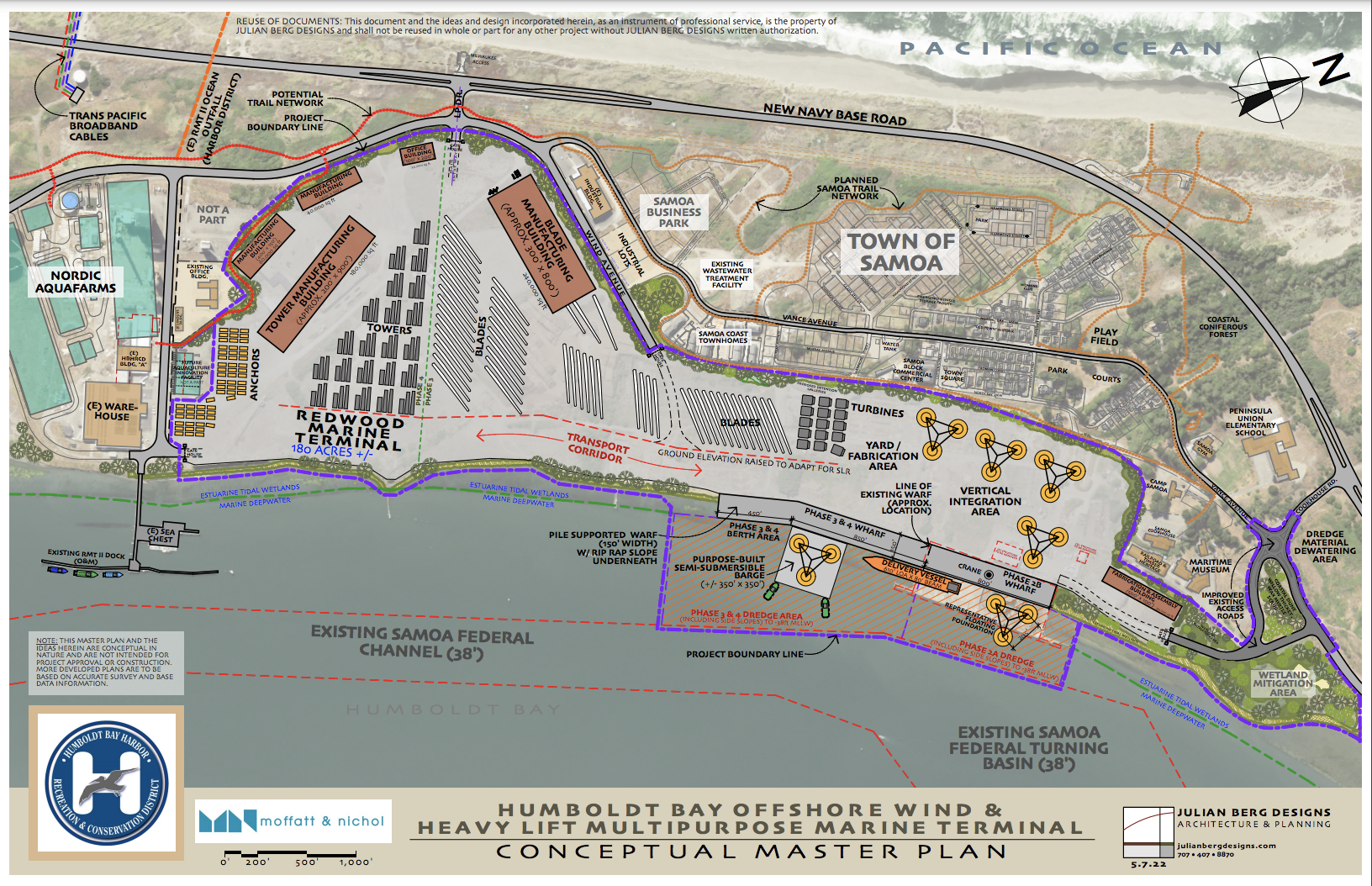
Humboldt Bay Offshore Wind & Heavy Lift Multipurpose Marine Terminal Conceptual Master Plan. Image from Humboldt Bay Harbor Resource & Conservation District.

Humboldt County’s proposed offshore wind project would significantly reduce carbon emissions throughout California by providing upwards of 1.6 gigawatts of clean, renewable-sourced energy. But to ensure the success of offshore wind and to meet the promise of climate action, decision-makers must commit to a green port facility capable of building and servicing the turbines while not further contributing to greenhouse gas emissions or polluting Humboldt Bay.

A key component of a thriving offshore wind industry is a port capable of constructing, assembling, and maintaining wind turbines. The Humboldt Bay Harbor District has partnered with Crowley Wind Services, a multinational port development company, to build this heavy lift terminal on the Samoa Peninsula. There are various potential benefits: port development could create many family-wage jobs and substantially contribute to a growing local economy—all while making important strides towards a clean-energy future to address the climate crisis.

Unfortunately, these types of heavy-lift terminals have a mixed track record for communities. On land, port equipment such as terminal tractors, forklifts, yard trucks, cranes, and handlers commonly run on diesel. In the water, most heavy-duty cargo ships and tugboats also run on diesel or heavy fuel oil, polluting the air. Ships and tugs even burn fuel while docked at the terminal to maintain a base load of electricity. As a result, communities surrounding these ports often suffer from the effects of air pollution. In Los Angeles, for example, air quality studies revealed that these diesel fumes significantly raised cancer risk for people within fifteen miles of the terminals.

Our port doesn’t have to be this way. Recent technological developments have made major progress towards enabling the possibility of a ‘green port.’ Green ports seek to make all aspects of operation sustainable, from the heavy machinery on land to the ships docked at the harbor. This work requires moving away from fossil fuels and shifting towards electrification and other zero-carbon energy sources, such as green hydrogen.

Stop the Cumbria Coal Mine: XRTU at The Big One

Shift the Power!

By Diego Valerio - Labor Network for Sustainability, April 30, 2023

Powershift is a network that mobilize the collective power of young people to mitigate climate change and create a just, clean energy future and resilient, thriving communities for all. In April a Powershift Convergence brought together thousands of climate and social justice activists in Bvlbancha/New Orleans. Diego Valerio, a first-year apprentice in IBEW Local 716 in Houston, Texas who has been organizing worker-led campaigns with the Texas Climate Jobs Project and who has been active with the Labor Network for Sustainability’s Young Worker Project, provides theses reflections on the Convergence:

I attended the latest Powershift Convergence alongside other union workers, LNS staff, and other allies to discuss and learn about the intersection of labor, youth, and environmental justice organizing with resilience in the Gulf South. Workers from the building trades and educator unions facilitated programming to center the idea that prioritizing the well-being of workers is essential when considering a green transition, and to uplift the need for a just transition.

Participants from organized labor encouraged other participants to think more concretely about ensuring that those who are most vulnerable to job losses or other detrimental impacts are supported, particularly through adequate training and education to transition workers into green jobs. They also advocated that the jobs created in the green transition are unionized, and to create social safety nets for those who are unable to transition to new opportunities.

Those at the bottom are often the ones who face the most significant challenges and consequences, and their involvement and empowerment can generate a greater impact. At Powershift I had the opportunity to interact with many inspiring individuals whose passion and commitment to making a positive impact left a lasting impression on me. I am grateful for these experiences and am determined to contribute to the movement in any way I can going forward.

Climate Protection Will Soon Fund Millions of Jobs

By staff - Labor Network for Sustainability, April 30, 2023

According to a new study by the nonprofit Energy Futures Initiative, the Inflation Reduction Act passed last summer will create 1.5 million climate and energy security jobs by 2030 – seven years from now. Over 100,000 will be in manufacturing, with 60,000 coming from battery production alone. Nearly 600,000 jobs will be created in the construction sector, for example constructing electrical transmission lines. The electric utility sector will gain 190,000 jobs.

For the full report:

https://energyfuturesinitiative.org/reports/jobs-emissions-and-economic-growth-what-the-inflation-reduction-act-means-for-working-families-jobs-emissions-and-economic-growth/

New TUC video: plan for heatwaves, cut energy bills, and take climate action!

By Anna Markova - Greener Jobs Alliance, April 29, 2023

The weather’s turning warmer – have you got a heatwave plan at work?

The new TUC video and leaflet shows how union reps and activists can plan for heatwaves and cold snaps, save their workplace money on energy bills, and take climate action at work. 

Watch the video here.

  • 2023 is predicted to beat heat records again – if workers struggled with hot temperatures last year where you work, this year will likely be worse. 
  • Employers will be worried about the cost of keeping the workplace warm in the winter and cool in the summer – energy bills went up two- to three-fold last year and are expected to stay high.

You can protect workers from extreme heat, save energy and mobilise union members by taking climate action.

Read the guide here.

Did you try doing this and want to share your experience? Would you like some more support with future-proofing the building you work in? Emailclimate@tuc.org.uk

From Farmworkers to Land Healers

By Brooke Anderson - Yes! Magazine, April 25, 2023

Immigrant and Indigenous farmworkers in California reclaim the power of their labor.

Sandra de Leon adds branches to a burn pile in Santa Rosa, CA on December 18, 2022. Photo by Brooke Anderson

On most days, Sandra de Leon prunes grapevines in Northern California’s wealthiest vineyards. But today she is dressed head to toe in a yellow fire-resistant suit, helmet, safety goggles, and gloves, carrying a machete and drip torch. She calls out over her crackling mobile radio, “Jefe de quema: aquí Bravo, informandoles que …” (“Burn chief: Bravo unit here, informing you that …”) and then rattles off data in Spanish on the number, size, duration, and temperature of a dozen or so burn piles she is monitoring on the sun-speckled forest floor. 

De Leon is one of 25 immigrant and Indigenous farmworkers gathered on a cold December morning in Sonoma County, California, for the first-in-the-country Spanish-language intentional-burn certification program. Like de Leon, each of these firefighters-(and firelighters!)-in-training has been haunted by fire. During a massive inferno in 2017, de Leon was one of many “essential workers” escorted by vineyard managers through mandatory evacuation zones to harvest grapes while breathing in toxic fumes from nearby blazes. 

“When we arrived at work, there were patrol cars because it was an evacuation zone, but they waved us through to harvest. The skies were red and heavy smoke was in the air. They didn’t give us any protective equipment. No masks,” de Leon says. “There was so much ash on the grapes that when you’d cut the grape, it would get on your face. Our faces were black.”

While she didn’t get sick, she says her co-workers struggled with asthma. De Leon recalls harvesting like this for eight hours and getting paid just $20 per hour. 

“They should have paid us more,” de Leon says. “We risked our lives for their profits.”

Today, however, de Leon and her fellow farmworkers are here to learn about “good fire”—a controlled burn land stewards use to reduce underbrush in overgrown forests to prevent the spread of more destructive wildfires. Thanks to North Bay Jobs With Justice, de Leon and her fellow farmworkers are (re-)learning skills many of their ancestors knew well. And they are putting that know-how to work healing a fire-ravaged landscape and people. 

Pages

The Fine Print I:

Disclaimer: The views expressed on this site are not the official position of the IWW (or even the IWW’s EUC) unless otherwise indicated and do not necessarily represent the views of anyone but the author’s, nor should it be assumed that any of these authors automatically support the IWW or endorse any of its positions.

Further: the inclusion of a link on our site (other than the link to the main IWW site) does not imply endorsement by or an alliance with the IWW. These sites have been chosen by our members due to their perceived relevance to the IWW EUC and are included here for informational purposes only. If you have any suggestions or comments on any of the links included (or not included) above, please contact us.

The Fine Print II:

Fair Use Notice: The material on this site is provided for educational and informational purposes. It may contain copyrighted material the use of which has not always been specifically authorized by the copyright owner. It is being made available in an effort to advance the understanding of scientific, environmental, economic, social justice and human rights issues etc.

It is believed that this constitutes a 'fair use' of any such copyrighted material as provided for in section 107 of the US Copyright Law. In accordance with Title 17 U.S.C. Section 107, the material on this site is distributed without profit to those who have an interest in using the included information for research and educational purposes. If you wish to use copyrighted material from this site for purposes of your own that go beyond 'fair use', you must obtain permission from the copyright owner. The information on this site does not constitute legal or technical advice.