You are here

capital blight

On the IPCC’s latest climate report: What does it tell us?

By Brian Tokar - Institute for Social Ecology, August 19, 2021

This analysis by ISE board and faculty member Brian Tokar has also appeared on Counterpunch, Climate and Capitalism, Monthly Review Online, ZNet and Green Social Thought:

The UN-sponsored Intergovernmental Panel on Climate Change (IPCC) recently released its latest comprehensive report on the state of the earth’s climate. The much-anticipated report dominated the headlines for a few days in early August, then quickly disappeared amidst the latest news from Afghanistan, the fourth wave of Covid-19 infections in the US, and all the latest political rumblings. The report is vast and comprehensive in its scope, and is worthy of more focused attention outside of specialist scientific circles than it has received thus far.

The report affirms much of what we already knew about the state of the global climate, but does so with considerably more clarity and precision than earlier reports. It removes several elements of uncertainty from the climate picture, including some that have wrongly served to reassure powerful interests and the wider public that things may not be as bad as we thought. The IPCC’s latest conclusions reinforce and significantly strengthen all the most urgent warnings that have emerged from the past 30 to 40 years of climate science. It deserves to be understood much more fully than most media outlets have let on, both for what it says, and also what it doesn’t say about the future of the climate and its prospects for the integrity of all life on earth.

First some background. Since 1990, the IPCC has released a series of comprehensive assessments of the state of the earth’s climate, typically every 5 – 6 years. The reports have hundreds of authors, run for many hundreds of pages (this one has over 3000), and represent the international scientific consensus that has emerged from the period since the prior report. Instead of releasing a comprehensive report in 2019, as originally scheduled, the IPCC followed a mandate from the UN to issue three special reports: on the implications of warming above 1.5 degrees (all temperatures here are in Celsius except where otherwise noted), and on the particular implications of climate change for the earth’s lands and oceans. Thus the sixth comprehensive Assessment Report (dubbed AR6) is being released during 2021-22 instead of two years prior. Also the report released last week only presents the work of the first IPCC working group (WGI), focused on the physical science of climate change. The other two reports, on climate impacts (including implications for health, agriculture, forests, biodiversity, etc.) and on climate mitigation – including proposed policy measures – are scheduled for release next February and March, respectively. While the basic science report typically receives far more press coverage, the second report on climate impacts and vulnerabilities is often the most revealing, describing in detail how both ecosystems and human communities will experience the impacts of climate changes.

In the Coal Mines, Workers Are Dying to Make a Living: Mining companies increasingly rely on cheaper contractors who face longer hours and higher risk of accidents

By Kari Lydersen - In These Times, August 18, 2021

Trebr Lenich always called his mother before his drive home from overnight shifts at Mine No. 1, operated by Hamilton County Coal in Hamilton County, Ill. The call she answered the morning of Aug. 14, 2017, worried her. 

“He said, ​‘Mom, I am just so exhausted, so wore out,’ ” Teresa Lenich says. 

Her son routinely worked long hours on consecutive days. That day, he never made it home.

Coworkers following Trebr said his driving was erratic and suspected he was falling asleep, Teresa says. Heading back to the West Frankfort home he shared with his parents, girlfriend and baby daughter, Trebr drove into a ditch and hit an embankment. According to the sheriff’s report, his engine then caught fire. 

Like many young miners, Trebr was employed through a contracting company that provides temporary workers for mines with no promise that they’ll be hired on permanently.

This staffing structure — and the disappearance of labor unions from Illinois mines — has made work less safe and more grueling for miners, according to advocates and multiple studies. Without job security, temporary workers are reluctant to complain about potentially unsafe conditions (including long work hours) and to report accidents. And because temporary workers may have inadequate experience in a particular mine, they might not understand that mine’s specific risks.

Where We Mine: Resource Politics in Latin America

Thea Riofrancos interviewed by Annabelle Dawson - Green European Journal, August 12, 2021

As the drive to expand renewable energy capacity speeds up, there is a rush for lithium and other materials around the world. What will the expansion of rare earth mining in Latin America mean for the indigenous communities and workers who have historically borne the harms of extractivism? Thea Riofrancos, author of Resource Radicals (Duke University Press, 2020), explains how the energy transition in the Global North risks being anything but just without structural changes to supply chains and the governance of extractive industries.

Annabelle Dawson: Your work explores the politics of resource extraction in Latin America, from oil in Ecuador to lithium in Chile. How do you define resource politics or extractivism?

Thea Riofrancos: Resource politics refers to any social or political activity – whether conflict, collaboration, political economy or social mobilisation – that’s attributed to the extraction of resources, and in some cases to stop resource extraction. Scholarship tends to see resource politics as primarily related to elites like state officials and corporate actors. This is pivotal, for example, to the concept of the resource curse, which holds that dependency on resource rents leads to authoritarianism. However, this focus overlooks a range of resource politics such as social movements that oppose extractive projects or demand better regulation and indigenous rights.

Extractivism is a little thornier to define. My research has explored how in Latin America social movements, activists and even some bureaucrats in the case of Ecuador began to use this term to diagnose the problems that they associated with resource extraction. This happened in the context of the 2000 to 2014 commodity boom – a period of intense investment in resource sectors driven by the industrialisation of emerging economies like China – and the Left’s return to power across Latin America during the “Pink Tide”. Activists, left-wing intellectuals and some government officials began to see extractivism as an interlocking system of social and environmental harm, political repression, and corporate and foreign capital domination. So, the concept originates from political activity rather than scholarship [read more about extractivism in Latin America].

We tend to associate resource extraction with notoriously dirty commodities like coal, oil, and certain metals. How are green technologies implicated in all of this?

The transition to renewable energies is often thought of as switching one energy source for another: fossil fuels for renewables. That’s part of it, but this transition fits into a much bigger energy and socio-economic system. You can’t just swap energy sources without rebuilding the infrastructures and technologies required to harness, generate, and transmit that energy. All this has a large material footprint and requires materials such as lithium, cobalt, nickel and rare earth metals [read more about the central role and impact of these rare metals]. More traditional extractive sectors like copper are also very important for decarbonisation.

One very bad outcome would be if the harms related to fossil fuel capitalism were reproduced in new renewable energy systems, subjecting particular communities to the harms of resource extraction in the name of fighting climate change. We need a new energy system quickly – especially in the Global North given the historic emissions of the US and Europe. But in this rush, there’s a real risk of reproducing inequalities and environmental damage. This is especially so with some mining sectors where a boom in the raw materials for green technologies like wind turbines, electric vehicles and solar panels is predicted.

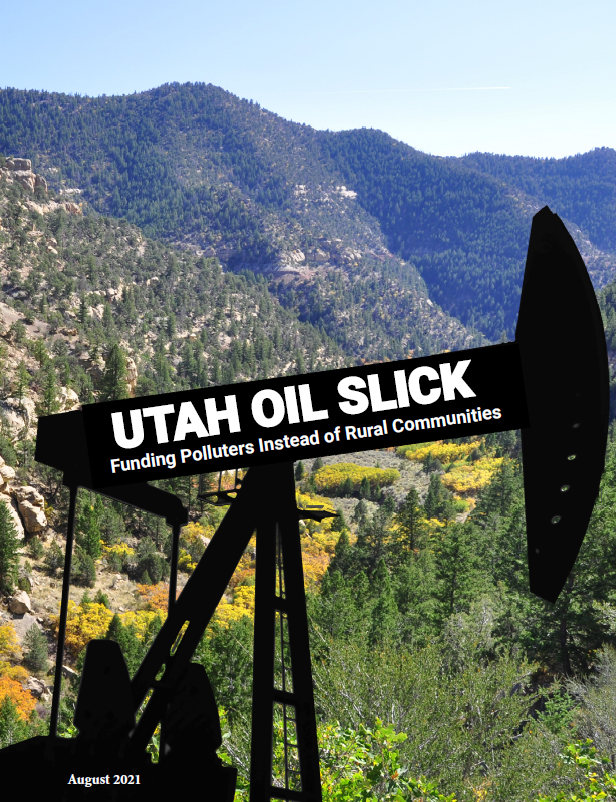
Utah Oil Slick: funding polluters instead of Rural Communities

By Deeda Seed and Adair Kovac - Center for Biological Diversity, et. al., August 2021

Every year Utah receives tens of millions of dollars in federal lease revenues and royalties from oil, gas and mineral extraction as a way to help mitigate the impacts of drilling and mining. Even before scientists linked fossil fuels to the climate crisis, Congress intended this money to be used to help rural communities experiencing rapid growth and infrastructure challenges. The influx of new workers and increased drilling and mining take a toll on communities.

This report from the Utah Clean Infrastructure Coalition shows that, since 2009, the little-known board charged with distributing this public money has funneled more than $109 million to projects that promote or expand fossil fuel extraction in violation of the federal Mineral Leasing Act. That includes more than $2.2 million approved after a state audit found the board was using the public funds improperly.

We examined dozens of public records — including the 2020 audit of the Permanent Community Impact Fund Board by the Utah Legislative Auditor General, meeting minutes, audio tapes and project documents — and found that:

  • Since 2009 the Permanent Community Impact Fund Board, or CIB, has issued $109 million in grants and low- or no-interest loans — all of it public money — to finance road construction, engineering studies, attorney fees and other costs to enable fossil fuel development on public and private land. Beneficiaries include well-connected private firms trying to get approval for the proposed $1.5 billion Uinta Basin Railway.
  • Over the past two years small towns, cities and special improvement districts in two counties have identified more than $60 million for community improvement projects that have not yet been funded. Unfunded projects include water and sewer services, recreation centers, road improvements and public safety equipment. Over this same period, the CIB gave more than $48 million in grants to fossil-fuel related projects.
  • The Utah Legislature failed to oversee the board’s activities. Even worse, in 2021 it changed state law to allow mineral lease revenues and royalties to finance fossil-fuel infrastructure projects, which is illegal under federal law. The new law followed the 2020 state audit criticizing the board’s spending and haphazard decision-making.
  • County governments and local agencies continue to seek public funding for projects that facilitate fossil fuel extraction and enrich private corporations over community needs. Since the audit, Uintah County commissioners approved seeking $39 million in public funds to help a private, Ogden-based oil company build a 640-acre oil refinery in eastern Utah.3 The proposed $1.4 billion Uintah Advantage refinery would have the capacity to refine 40,000 barrels of oil a day, and it may also include a rail yard for the proposed Uinta Basin Railway.

The CIB must stop funding fossil fuel development projects. The Utah Legislature should oversee the board’s grant and loan-making process to ensure it complies with the Mineral Leasing Act, which requires these public funds be used to mitigate harm inflicted on communities by oil, gas and mineral extraction and forbids using the money for economic development. Rural communities should call on legislators to ensure that infrastructure needs are met and public money is spent properly.

As Utah and the western United States experience the devastating consequences of climate change in the form of intense heat, drought and wildfires, it is even more critical that the CIB stop siphoning public funds away from much-needed community projects to finance dangerous fossil fuel extraction that worsens the climate crisis.

Read the text (PDF).

Reclaiming Hydrogen for a Renewable Future: Distinguishing Fossil Fuel Industry Spin from Zero-Emission Solutions

By Sasan Saadat and Sara Gersen - Earth Justice, August 2021

To chart a course toward a safer climate and more habitable planet, we must rapidly reduce emissions of greenhouse gases across our society. The biggest contributor to greenhouse gas emissions is the burning of fossil fuels. Consequently, the clearest path to reducing emissions is to switch from fossil fuels to renewable, zero-emission energy in our transportation, buildings, and power generation (sectors that are collectively responsible for about 75% of United States’ greenhouse gas emissions). This transition would make significant strides in eliminating the devastating public health impacts of pollution throughout the life cycle of fossil fuels—pollution that is most severely concentrated in Black, Brown, Indigenous, and poor communities. A just transition will also require careful policy design and meaningful engagement from frontline communities. Renewable energy, energy efficiency, and electrification are zero-emission solutions that eliminate both greenhouse gases and health-harming air pollution. To meet the scale and urgency of the climate crisis will require deployment of renewable resources on an unprecedented scale— ultimately achieving 100% clean power generation—and a complete transition to efficient, electric models for things like household appliances and cars.

As we electrify everything that can feasibly plug into a clean power grid, “green hydrogen” is a promising tool for transitioning to renewable energy in sectors that lack a viable route to direct electrification. Green hydrogen is hydrogen produced by using 100% renewable electricity to split water molecules.

To understand the potential role of green hydrogen, consider the challenges of cutting climate pollution from one hard-to-electrify sector: maritime shipping. Maritime travel is difficult to decarbonize because battery-powered ocean-going vessels will not be able to handle long-haul voyages across the ocean, at least for the foreseeable future. The hope for green hydrogen is that it may store energy from clean electric resources like wind and solar in a fuel that could be used to propel large, long-haul ships. This vision is at least a decade away from reality, if it overcomes the challenges to cost-effective production and efficient on-vessel storage. Still, it offers a path to displacing the highly polluting bunker fuel currently relied on to move much of the world’s goods across oceans.

Read the text (Link).

Food Sovereignty: 25 years in the making

By Jaime Amorim - La Via Campesina, July 28, 2021

Food sovereignty is intrinsically linked to the debate over what we envision for rural areas and what type of development should be applied, as well as what type of food to produce. And why do we want to produce?”

In the same year that La Via Campesina celebrates 25 years of defining, building, and fighting for “food sovereignty,” the United Nations (UN) will convene a summit for heads of state, members of large businesses and private corporations, multinationals and agribusiness representatives to discuss food systems processes.

The UN Food Systems Summit, or FFS, will take place in September of 2021 during the week of the High-Level panel of the United Nations’ General Assembly. Before the Summit, a pre-Summit will take place in Rome at the end of June.

I will take advantage of this space to debate(discuss?) the two subjects which complement each other in two separate articles. In this first one, I will discuss the 25th anniversary of the debate for food sovereignty. In the second will concern the contradictions surrounding the realization of the Summit on food systems, which will be convened by the Secretary General of the United Nations. This is the decade in which the UN and its member states must accomplish the activities and actions to which they committed by 2030, the objectives defined in order to reach their goals for building Sustainable Development.

The Summit on Food Systems will be held just as the world is experiencing a pandemic that has taken the lives of more than four million people worldwide, victims of COVID-19. At the same time, we see, as a consequence of the crises, the rise in the number of people who suffer hunger worldwide, as well as an increase in unemployment, poverty and violence.

Big Business on the High Seas

By Sarah Ensor - International Socialism, July 26, 2021

A review of Capitalism and the Sea: The Maritime Factor in the Making of the Modern World by Liam Campling and Alejandro Colás

Capitalism and the Sea is an engaging new study of capitalism’s transformation of the human relationship to the sea. It uses a Marxist approach to understand how capitalism constantly reinvents itself to maximise profit and, in the process, intensifies exploitation, privatises vast areas of the sea and commodifies the species that inhabit them. The book is divided into sections on “circulation”, “order”, “exploitation”, “appropriation”, “logistics” and “offshore”. However, it is the excellent chapter on appropriation that offers the pivotal argument, detailing how changing capitalism remodels and reshapes how society interacts with the seas and oceans. These reflections demonstrate how capitalists have been able to extend property relations created on land into all those parts of maritime space that modern technology allows them to reach.

Liam Campling and Alejandro Colás carefully describe how capitalism transformed the conventional forms of trade that went before it. Before plantation slavery formed new markets based on the commodification of human beings and their transportation on slave ships, it was necessary to develop the fundaments of a capitalist credit system such as stock exchanges and “bills of exchange”, an early credit instrument that acted as “a store of universal value” (p42). The sea became the subject of centuries of intense legislative activity designed to reproduce the land-based property relations at sea. By the early 17th century, the struggle over maritime law had become whether the sea was to be free, “mare liberum”, or closed, “mare clausum”? Did territorial sovereignty extend into the sea? Could states control which ships went where and what the ships’ masters and owners did when they got there?

For the British state, the dominant imperial power in the 19th century, “freedom of the seas” meant the right to enforce its own economic interests. Thus the British navy attacked China in 1839 to force it to accept imports of opium, despite Chinese attempts to fight an epidemic of addiction. There were legalistic sleights of hand that removed hindrances to trade during wartime such as the Declaration of Paris in 1856, which allowed “enemy goods” to be transported under “neutral flags”.

Combatting Climate Change, Reversing Inequality: A Climate Jobs Program for Texas

By Lara R. Skinner, J. Mijin Cha, Hunter Moskowitz, and Matt Phillips - ILR Worker Institute, Cornell, July 26, 2021

Texas is currently confronted by three major, intersecting crises: the COVID-19 public health pandemic and ensuing economic crisis; a growing crisis of inequality of income, wealth, race and power; and the worsening climate crisis, which continues to take its toll on Texans through hurricanes, major flood events, wildfires, debilitating heat waves and the significant economic cost of these extreme weather events. These crises both expose and deepen existing inequalities, disproportionately impacting working families, women, Black, Indigenous and people of color (BIPOC) communities, immigrants, and the most vulnerable in our society.

A well-designed recovery from the COVID-19 global health pandemic, however, can simultaneously tackle these intersecting crises. We can put people to work in high-quality, family- and community-sustaining careers, and we can build the 21st century infrastructure we need to tackle the climate crisis and drastically reduce greenhouse gas emissions and pollution. Indeed, in order to avoid the worst impacts of the climate crisis, it is essential that our economic recovery focus on developing a climate-friendly economy. Moreover, there are significant jobs and economic development opportunities related to building a clean energy economy. One study shows that 25 million jobs will be created in the U.S. over the next three decades by electrifying our building and transportation sectors, manufacturing electric vehicles and other low-carbon products, installing solar, wind and other renewables, making our homes and buildings highly-efficient, massively expanding and improving public transit, and much more.

Conversely, a clean, low-carbon economy built with low-wage, low-quality jobs will only exacerbate our current crisis of inequality. The new clean energy economy can support good jobs with good benefits and a pipeline for historically disadvantaged communities to high-quality, paid on-the-job training programs that lead to career advancement. Currently, the vast majority of energy efficiency, solar and wind work is non-union, and the work can be low-wage and low-quality, even as the safety requirements of solar electrical systems, for example, necesitate well-trained, highly-skilled workers.

Read the text (PDF).

DOE Quietly Backs Plan for Carbon Capture Network Larger Than Entire Oil Pipeline System

By Sharon Kelly - DeSmog, July 18, 2021

Obama Energy Secretary Ernest Moniz and major labor group AFL-CIO are behind the “blueprint” for a multi-billion dollar system to transport captured CO2 — and offer a lifeline to fossil fuel plants.

An organization run by former Obama-era Energy Secretary Ernest Moniz, with the backing of the AFL-CIO, a federation of 56 labor unions, has created a policy “blueprint” to build a nationwide pipeline network capable of carrying a gigaton of captured carbon dioxide (CO2).

The “Building to Net-Zero” blueprint appears to be quietly gaining momentum within the Energy Department, where a top official has discussed ways to put elements into action using the agency’s existing powers.

The pipeline network would be twice the size of the current U.S. oil pipeline network by volume, according to the blueprint, released by a recently formed group calling itself the Labor Energy Partnership. Backers say the proposed pipeline network — including CO2 “hubs” in the Gulf Coast, the Ohio River Valley, and Wyoming — would help reduce climate-changing pollution by transporting captured carbon dioxide to either the oil industry, which would undo some of the climate benefits by using the CO2 to revive aging oilfields, or to as-yet unbuilt facilities for underground storage.

The blueprint, however, leaves open many questions about how the carbon would be captured at the source — a process that so far has proved difficult and expensive — and where it would be sent, focusing instead on suggesting policies the federal government can adopt to boost CO2 pipeline construction. 

Climate advocates fear that building such a large CO2 pipeline network could backfire, causing more greenhouse gas pollution by enabling aging coal-fired power plants to remain in service longer, produce pipes that could wind up carrying fossil fuels if carbon capture efforts fall through, and represent an expensive waste of federal funds intended to encourage a meaningful energy transition.

In March, over 300 climate and environmental justice advocacy groups sent a letter to Congress, arguing that subsidizing carbon capture “could entrench the fossil economy for decades to come.”

The AFL-CIO and the Energy Futures Initiative, which jointly produced the blueprint, did not respond to questions about concerns over their proposals.

Proponents of carbon capture, usage, and sequestration (CCUS) often highlight ways that it could be used for sectors like steel and cement whose carbon pollution is generally considered “hard to abate.” Yet, the pipeline network envisioned by Moniz would be capable of carrying over 10 times as much carbon dioxide as the steel and cement industries emit in total nationwide, according to U.S. Environmental Protection Agency (EPA) data from 2019. In fact, it could transport more CO2 than the entire industrial sector emits in the U.S., leaving the rest of the pipeline network’s capacity available for carbon from fossil fuel-fired power plants or from “direct air capture” technologies that would remove ambient CO2 but don’t currently exist at a commercial level

“Even the advocates of direct air capture technology acknowledge that they don’t anticipate that it would be at a scale to make any meaningful reduction in atmospheric CO2 levels until 2060, 2070 and beyond,” said Carroll Muffett, president of the environmental law nonprofit Center for International Environmental Law. “When we’re dealing with a world where we need to cut emissions in the next decade, direct air capture just has no meaningful place in that conversation.”

Instead, the proposed CO2 pipeline network would be used to offer a lifeline to existing fossil fuel power plants. In Appalachia, for example, 90 percent of the carbon emissions the plan seeks to capture would come from existing coal-fired power plants in the Ohio River Valley. Those plants, none of which are currently outfitted with the costly upgrades needed for capture carbon, are already facing difficult questions about their ability to compete economically with wind and solar energy.

Nonetheless, momentum behind the project appears to have been gathering behind the scenes in Washington, D.C., particularly inside the Department of Energy (DOE).

“It’s a great pleasure to have our first kind of public interaction with our good friend, Dave Turk,” Moniz said of Biden’s Deputy Secretary of Energy at the blueprint’s online launch on July 1.

“It’s incredible the volume and quality of the thought-leadership that you all are behind,” Turk, who is second in command to Energy Secretary Jennifer Granholm, told Moniz. “And I think the report that you all have put together is incredibly helpful to show that we need to do more from the DOE side, other agencies, and Congress,” he added, describing the blueprint as “actionable.”

Fighting fossil fascism for an eco-communist future

By The Zetkin Collective and Kai Heron - ROAR Mag, July 15, 2021

The West Coast of North America is, once again, on fire. Last month, Phoenix, Arizona, recorded temperatures of 46 degrees Celcius five days in a row. A new record. Every afternoon, the surface temperature of concrete and tarmac climbed to 82 degrees Celsius — hot enough to cause third-degree burns. In California and Texas, where temperatures were marginally lower, energy grid operators feared a prolonged heat wave would wreak havoc on energy infrastructure, forcing a repeat of last years’ rolling blackouts. For many dependent on air conditioning to stay cool in the sweltering heat, this would cause health complications or even death.

North America’s ongoing heatwave follows months of dry weather across the West Coast that have established the conditions for a summer of unprecedented water shortages, crop failures and wildfires. California and Arizona’s wildfire season started unusually early. One of Arizona’s first fires roared for four days, incinerating 27 square miles of countryside and forcing the evacuation of two townships. As this interview is prepared for publication, more than 60 wildfires are raging across the West Coast, some two times the size of Portland. As has become commonplace in the US, state officials are sending prisoners in to tackle the flames, paying them as little as $1.50 an hour.

Already this year Pakistan and Northern India have been wracked by temperatures reaching 52 degrees Celsius. While the small town of Lytton, 124 miles outside Vancouver, hit 49.6 degrees Celsius, the highest temperature ever recorded in Canada. Meanwhile, Brazil has suffered under its worst drought in 100 years, sending food prices spiraling upwards. At these extremes, life as normal is suspended. People die. Ecosystems collapse. And out of the disarray, reactionary social forces make their move.

Through a toxic combination of long-established anti-immigrant and racializing tropes and a regressive denialist climate agenda, far-right parties and social movements are exercising increased influence across Europe and the Americas. The Zetkin Collective’s White Skin, Black Fuel: The Danger of Fossil Fascism charts the rise of these movements and ideas and, with an eye to the horizon, forecasts the emergence of “fossil fascism.”

Zetkin Collective member Andreas Malm’s most recent individually authored works How to Blow up a Pipeline and Corona, Climate, Chronic Emergency, were rapidly-written conjunctural analyses of our intersecting ecological, epidemiological and political predicaments. Both books sought to drive a red-and-green wedge into conversations about capitalism’s breathless trajectory towards ecological collapse and the limits of prevailing strategies among elements of the capitalist core’s climate movements.

While none of the urgency of these works is lost in White Skin, Black Fuel, it drops into the background as a richly detailed analysis of the interrelations of racial capitalism, fossil fuel extraction, nationalism and climate breakdown takes precedence. The book is an example of engaged scholarly research at its best. A clarion call to movements and a forceful reminder of the reactionary forces that are stacked against us as we fight to realize an eco-communist future.

In this interview Kai Heron speaks to Zetkin Collective members Andreas Malm, Laudy van den Heuvel and Ståle Holgersen about the Collective’s writing process, climate denial and resistance to fossil fascism.

Pages

The Fine Print I:

Disclaimer: The views expressed on this site are not the official position of the IWW (or even the IWW’s EUC) unless otherwise indicated and do not necessarily represent the views of anyone but the author’s, nor should it be assumed that any of these authors automatically support the IWW or endorse any of its positions.

Further: the inclusion of a link on our site (other than the link to the main IWW site) does not imply endorsement by or an alliance with the IWW. These sites have been chosen by our members due to their perceived relevance to the IWW EUC and are included here for informational purposes only. If you have any suggestions or comments on any of the links included (or not included) above, please contact us.

The Fine Print II:

Fair Use Notice: The material on this site is provided for educational and informational purposes. It may contain copyrighted material the use of which has not always been specifically authorized by the copyright owner. It is being made available in an effort to advance the understanding of scientific, environmental, economic, social justice and human rights issues etc.

It is believed that this constitutes a 'fair use' of any such copyrighted material as provided for in section 107 of the US Copyright Law. In accordance with Title 17 U.S.C. Section 107, the material on this site is distributed without profit to those who have an interest in using the included information for research and educational purposes. If you wish to use copyrighted material from this site for purposes of your own that go beyond 'fair use', you must obtain permission from the copyright owner. The information on this site does not constitute legal or technical advice.