You are here

Green New Deal (GND)

Multiplying Labor's Power

For a Living Wage and a Habitable Planet, We Need Climate Jobs Programs

By Paul Prescod - Jacobin, June 2, 2022

Climate and labor activists are coming together to hammer out ambitious but realistic plans for massively expanding the clean-energy sector in a way that also creates good union jobs. For both paychecks and the planet, it’s the only path forward.

The stalling of President Joe Biden’s “Build Back Better” agenda raises serious concerns for those looking to the federal government for strong action on climate change. Much of the more ambitious climate-related aspects of the legislation have already been gutted — and the fact that it still can’t pass a Congress with a Democratic majority is a worrying sign for the future.

But despite the dysfunction at the federal level, there are encouraging developments occurring at the state level. Increasingly, climate and labor activists are coming together to hammer out ambitious but realistic plans for massively expanding the clean-energy sector in a way that creates family-sustaining union jobs.

These state-based efforts are often facilitated by the Climate Jobs National Resource Center. States like New York, Connecticut and Maine have managed to get real buy-in from the building trades on a vision that defies the false jobs versus environment dichotomy. Recently, the Illinois legislature passed landmark climate legislation that puts the state on a path to reaching 100 percent clean energy by 2050, all with the full support of the Illinois AFL-CIO.

Rhode Island has now joined the party. Earlier this year Climate Jobs Rhode Island, a broad labor-environmental coalition, released a report titled “Building a Just Transition for a Resilient Future: A Climate Jobs Program for Rhode Island.” The report, compiled in partnership with the Worker Institute at Cornell, takes a comprehensive approach to limiting carbon emissions — containing recommendations on retrofits, public transportation, renewable energy, and climate resilience.

The Rhode Island initiative is a good model for activists in other states to consider. In addition to meaningfully addressing climate change, there’s no doubt that this program would result in the creation of tens of thousands union jobs. It points the way forward for both the climate and labor movements, which must join together in order for the working class to have any hope of a sustainable future.

Unions Making a Green New Deal From Below: Part 2

By Jeremy Brecher - Labor Network for Sustainability, June 2022

This second of two commentaries on “Unions Making a Green New Deal from Below” portrays what it looks like when unions in a town decide to create a local Green New Deal or when unions in a state decide to transform their economy to expand jobs and justice by protecting the climate.

Workers and unions are among those who have the most to gain by climate protection that produces good jobs and greater equality. That’s why unions in the most diverse industries and occupations are creating their own Green New Deal-type programs in localities around the country. Here are some examples:

Are Refinery Workers Climate Enemies? - Part 2

By That Green Union Guy - IWW Environmental Union Caucus, May 25, 2022

For context and background, see part one, here. Unlike the first installment, this second response has ommitted the comments that preciptated it, for the sake of clarity, as well as the fact that the author tried to echo the rebutted points in the response. It should be noted that only one individual has expressed outright opposition to showing solidarity with striking refinery workers. It's a foregone conclusion that the overwhelming majority of the IWW does not share this one individual's view.

First of all, let me be clear: my position is that humanity must collectively phase out burning fossil fuels for energy, transportation, and locomotion as rapidly as possible.

That said, nobody seriously believes we can collectively cease burning fossil fuels in a single day, so the likelihood is that the burning of them will continue for some time (I aim to make that as little time as possible).

Regardless of how long it takes, no oil refinery is going to simply shut down just because large masses of people, even 3.5% of the population demand it. It’s not even technically possible, let alone economically or politically possible. Most of the Environmental Justice and Climate Justice organizations (other than a few ultra-sectarian extremists) get this, and they’ve crafted their demands accordingly.

While there’s a degree of variation among the various organizing, most of them call for the following:

  1. No new extraction of new fossil fuel sources;
  2. Rapid phase out of existing fossil fuel sources;
  3. Managed decline of the existing fossil fuel supply chain;
  4. Just transition for any and all affected workers in the entire fossil fuel supply chain;
  5. Repurposing of equipment for non fossil fuel burning purposes;
  6. Bioremediation of damaged ecosystems across the extraction supply chain;
  7. Reparations for the affected communities and tribes.

Supporting refinery workers involved in a strike is not in any way contradictory to the above demands.

Green New Deal agendas in tension: what decarbonisation, for what societal future?

By Les Levidow - London Green Left Blog, May 21, 2022

Green New Deal (GND) agendas have gained significant support as means to reconcile environmental sustainability and a net-zero economy with socio-economic equity. Their transformative vision has attracted proposals such as more public goods, workers’ cooperatives and caring activities. Such proposals stimulate people’s imaginations around pilot schemes prefiguring alternatives to a profit-driven, inequitable high-carbon economy.

Green Parties have elaborated a Green New Deal as an ideal wish-list of such measures, variously called truly green, greener or green-socialist. Green Parties initially have done so with little regard to significant allies, which hopefully would be attracted. 

By contrast, multi-stakeholder alliances became a difficult matter in 2019, when GND agendas were promoted within major political parties such as the US Democratic Party and UK Labour Party. They have undergone internal conflicts over decarbonisation pathways, partly expressing conflicts within the labour movement.

Fossil fuel industries have sought system continuity through decarbonisation technofixes, with political support from their sector’s trade unions, thus associating workers’ secure livelihoods with fossil energy. This agenda complements capitalist frameworks of Green Keynesianism and Green Growth, seeking to reconcile perpetual economic growth with environmental sustainability. This false promise helps to soften or defer societal conflicts over an economically disruptive transition.

By contrast, some public-sector trade unions and environmentalist allies have sought a socio-economic transformation. This would go beyond the fossil fuel industry and GDP-driven growth, towards an economy of sufficiency. Such alliances have been coordinated internationally by Trade Unions for Energy Democracy.

Those divergent agendas have conflicted over decarbonisation technofixes. Their false promises have provided an investment imperative for dubious low-carbon remedies, or an alibi to await their feasibility before abandoning fossil fuels, or both at once. This dominant agenda imagines the nation as a unitary economic space needing technoscientific advance for a global competitive advantage.

IPCC Report Calls for “Just Transition”

By Staff - Labor Network for Sustainability, May 2022

The latest report of the Intergovernmental Panel on Climate Change emphasizes the need for immediate action to protect the climate and lays out detailed strategies for how to do it. The report includes a lengthy analysis of ‘just transitions’ in countering climate change. A just transition could entail that

the state intervenes more actively in the eradication of poverty, and creates jobs in lower-carbon sectors, in part to compensate for soon-to-be abandoned fossil-fuel-based sectors, and that governments, polluting industries, corporations and those more able to pay higher associated taxes pay for transition costs, provide a welfare safety net and adequate compensation for people, communities, places, and regions that have been impacted by pollution, marginalized or negatively impacted by a transition from a high- to low-carbon economy and society.

The just transition concept has become

an international focal point tying together social movements, trade unions, and other key stakeholders to ensure equity is better accounted for in low-carbon transitions and to seek to protect workers and communities.

 According to the IPCC, “just transition” also forms a central pillar of the growing movement for a “Green New Deal”—a “roadmap for a broad spectrum of policies, programs, and legislation that aims to rapidly decarbonize the economy while significantly reducing economic inequality.”

The US Green New Deal Resolution for example positions structural inequality, poverty mitigation, and a just transition at its center. In 2019, the European Green Deal proposed including a UDF100 billion “Just Transition Mechanism” to mitigate the social effects of transitioning away from jobs in fossil based industries. National level green new deals with strong just transition components have been proposed in South Korea, Australia, Spain, UK, Puerto Rico, Canada, as well as regional proposals across Latin America and the Caribbean.

The report provides a list of organizations supporting just transition, including the Labor Network for Sustainability.

The report treats a just transition as part of the broader question of climate equity. Its section on “Equity in a just transition” says,

Looking at climate change from a justice perspective means placing the emphasis on

  • a) the protection of vulnerable populations from the impacts of climate change;
  • b) mitigating the effects of the transformations themselves, including easing the transition for those whose livelihoods currently rely on fossil fuel-based sectors; and
  • c) envisaging an equitable decarbonized world. Neglecting issues of justice risks a backlash against climate action generally, particularly from those who stand to lose from such actions.

Unions Making a Green New Deal from Below: Part 1

By Jeremy Brecher - Labor Network for Sustainability, May 2022

While Washington struggles over job and climate programs, unions around the country are making their own climate-protecting, justice-promoting jobs programs.

While unions have been divided on the Green New Deal as a national policy platform, many national and local unions have initiated projects that embody the principles and goals of the Green New Deal in their own industries and locations. Indeed, some unions have been implementing the principles of the Green New Deal since long before the Green New Deal hit the headlines, developing projects that help protect the climate while creating good jobs and reducing racial, economic, and social injustice.

Even some of the unions that have been most dubious about climate protection policies are getting on the clean energy jobs bandwagon. The United Mine Workers announced in March that it will partner with energy startup SPARKZ to build an electric battery factory in West Virginia in 2022 that will employ 350 workers. The UMWA will recruit and train dislocated miners to be the factory’s first production workers. According to UMWA International Secretary-Treasurer Brian Sanson, “We need good, union jobs in the coalfields no matter what industry they are in. This is a start toward putting the tens of thousands of already-dislocated coal miners to work in decent jobs in the communities where they live.”[1]

Are Refinery Workers Climate Enemies?

By an anonymous ex-member of the IWW (with a response by That Green Union Guy) - ecology.iww.org, April 28, 2022

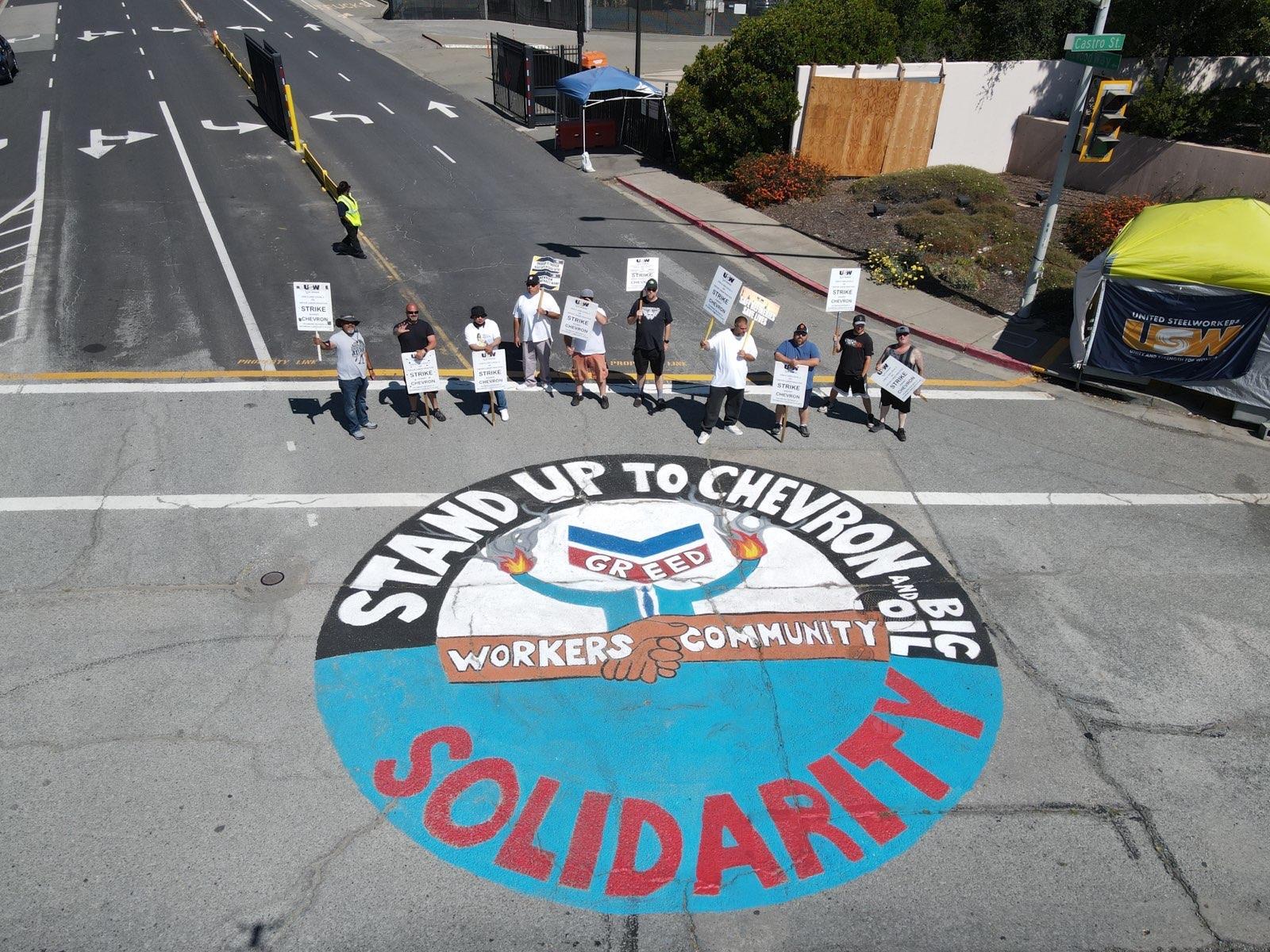
Editor's Note: Since Monday, March 21, 2022, the workers at the Chevron oil refinery in Richmond, California, members of the United Steelworkers Local 5 have been on strike and picketing the facility after voting down the company’s latest contract offer, which workers say contained insufficient wage increases and demanded cuts in union staffing that focused on health and safety in the refinery. The bosses have responded by bringing in scabs (including managers from other Chevron facilities). Meanwhile, USW Local 5 members have been picketing the refinery 24-7, and have been, at times, joined by members of the local BIPOC and/or environmental justice community. After IWW EUC cofounder and long-time Bay Area IWW General Membership Branch member, x344543, brought a call for solidarity with the striking workers to the April branch meeeting, a disgruntled member (who has since resigned from the organization), sent the following letter to the branch (name deleted for privacy reasons).

Message from a Disgruntled (former) Member:

I’m sorry to say how disappointed I am in the IWW. I’m a relatively new wobbly and although I believe in standing in solidarity with fellow workers it seems at some point lines must be drawn.

As I’ve read through these last emails about the USW Local 5 and the call to action for us to stand with them as they strike, many questions come to mind. The first one is what if fellow climate activists, many of whom are wobblies were to implement a protest blockade to stall production of this refinery in defense of the environment? I wonder if those refinery workers with whom we are picketing would come outside and join our protest line? I also wonder if they would be interested in the invitation to join the 2022 Global Climate Strike that you forwarded to us? In both cases I assume it is reasonable to conclude they would not.

As wobblies, where do we draw the line? What if oil pipeline workers go to strike for hazard pay because a tribal nation, whose land the pipeline is planned to cross blocks safe access to thier jobsite in protest of the poisoning of thier waterways? Would the IWW Environmental Caucus also put a call out to picket with those Union workers? We draw the line when it comes to police unions who’s membership is hellbent on beating and imprisoning people protesting civil injustices. Why are we supporting refinery workers? This makes no sense. Iunderstand that just about every industry is to some degree tainted with These workers primary job is to process and prepare for market the product that’s catapulted us into the current global warming apocalyptic meltdown!

Webinar: Investing in Workers for a World Beyond Fossil Fuels

Rallies Held Across US for 'Climate, Care, Jobs, and Justice'

By Kenny Stancil - Common Dreams, April 23, 2022

Scores of people in communities around the United States took to the streets on Saturday to demand swift and bold legislative and executive action to tackle the fossil fuel-driven climate crisis as well as skyrocketing inequality.

At "Fight for Our Future" rallies held in Washington, D.C., Phoenix, Atlanta, and more than 40 additional cities across the country, the message was simple: Time is running out for Congress and President Joe Biden to make the bold investments needed to create millions of unionized clean energy and care sector jobs that can simultaneously mitigate greenhouse gas pollution along with economic and racial injustice.

The nationwide mobilization—organized by a coalition of more than 20 labor, civil rights, and environmental justice groups including SEIU, NAACP, the Sierra Club, the Sunrise Movement, the Center for Popular Democracy, and the Green New Deal Network—took place one day after Earth Day.

Pages

The Fine Print I:

Disclaimer: The views expressed on this site are not the official position of the IWW (or even the IWW’s EUC) unless otherwise indicated and do not necessarily represent the views of anyone but the author’s, nor should it be assumed that any of these authors automatically support the IWW or endorse any of its positions.

Further: the inclusion of a link on our site (other than the link to the main IWW site) does not imply endorsement by or an alliance with the IWW. These sites have been chosen by our members due to their perceived relevance to the IWW EUC and are included here for informational purposes only. If you have any suggestions or comments on any of the links included (or not included) above, please contact us.

The Fine Print II:

Fair Use Notice: The material on this site is provided for educational and informational purposes. It may contain copyrighted material the use of which has not always been specifically authorized by the copyright owner. It is being made available in an effort to advance the understanding of scientific, environmental, economic, social justice and human rights issues etc.

It is believed that this constitutes a 'fair use' of any such copyrighted material as provided for in section 107 of the US Copyright Law. In accordance with Title 17 U.S.C. Section 107, the material on this site is distributed without profit to those who have an interest in using the included information for research and educational purposes. If you wish to use copyrighted material from this site for purposes of your own that go beyond 'fair use', you must obtain permission from the copyright owner. The information on this site does not constitute legal or technical advice.