You are here

just transition

The Future of Climate Strikes

By Jeremy Brecher - Labor Network for Sustainability, February 2020

This is the first in a series of commentaries on the Future of Climate Strikes. This introductory commentary asks whether strikes and forms of mass direct action “people power” might help halt climate destruction and bring about a Green New Deal. For the entire Future of Climate Strike series see here.

During the week of September 20, 2019 more than seven million people around the world participated in what was dubbed a global climate strike. They held more than six thousand events in 185 countries.[1] Weekly school strikes initiated by students had burgeoned within a few months into a global movement. The young people who initiated the movement vowed to continue their weekly protests and to build up to an even more disruptive week of global climate strike during the week of Earth Day 2020.

The logic underlying the climate strike movement was summed up by its founder Greta Thunburg: “Some say that we should not engage in activism, instead we should leave everything to our politicians and just vote for change instead,” she said. “But what do we do when there is no political will? What do we do when the politics needed are nowhere in sight?”[2] Her answer was a strike that would disrupt “business as usual” around the world.

Meanwhile, mass strikes and nonviolent mass uprisings around the world have been demonstrating how ordinary people can make history by intervening in business as usual. Just in the past year, Puerto Ricans held a general strike and a million of them – about one in three Puerto Ricans – occupied the capitol San Juan, forcing the government’s highest official to resign.[3] In Sudan, a two-day general strike and street protests led to the ouster of the president. In Brazil, 45 million workers took part in a general strike to protect worker rights.[4] Massive confrontations in Hong Kong, featuring a general strike, continued month after month. India saw the largest general strike in the history of the world, with 150-200 million participants.[5] In Chile demonstrations against a subway fare hike eventually brought four million people to the streets to reject the country’s 20-year experiment with extreme neoliberalism and call for a new, more democratic constitution. Millions participated in general strikes and large street protests in Algeria, Egypt, Iran, Iraq, Lebanon, Ecuador, Indonesia, Italy, France, UK, Catalonia, and the Czech Republic.[6]

Could some similar kind of mass strike and popular nonviolent uprising create the political will for climate protection and break the power of the forces that are promoting climate destruction? As the world hurtles into climate catastrophe, such a possibility has begun to take hold on the imagination of those around the world who would not sit by and see the basis for human life on earth destroyed. Groups like the student strike organizations, the Sunrise Movement, and Extinction Rebellion have called for strikes and mass direct action to implement climate protection and a Green New Deal. Sunrise Organizing Director Dyanna Jaye recently wrote,

The only way to get the political establishment to make the Green New Deal a priority in 2021 and beyond is by disrupting business as usual. Young people around the world have already been doing this with the #ClimateStrike movement. This year, we’re going to turn up the heat, starting with massive strikes on Earth Day to make sure that the Green New Deal is THE story for 2020 as we head into the elections.

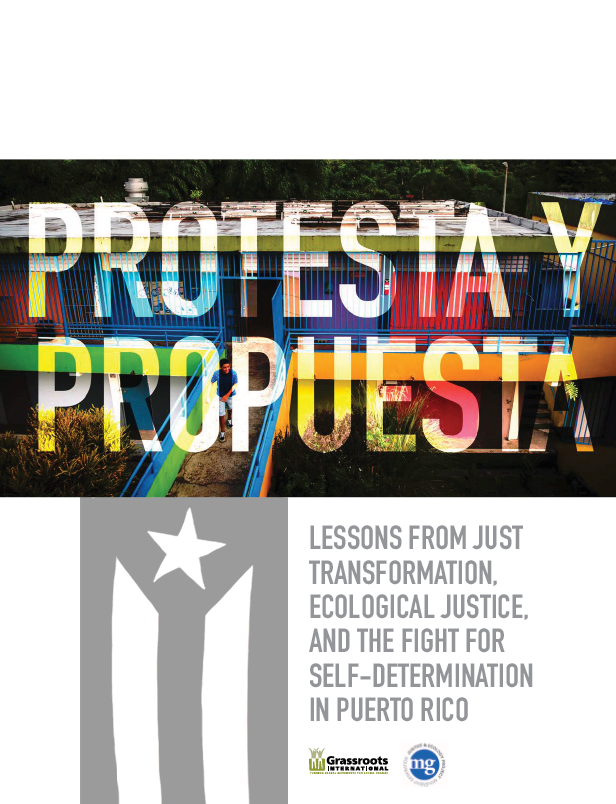
Protesta Y Propuesta: Lessons from Just Transformation, Ecological Justice, and the Fight for Self-Determination in Puerto Rico

By Brooke Anderson and Jovanna García Soto - Grassroots International and Movement Generation, February 2020

“De la Protesta a la Propuesta” (“From protest to proposal”). That’s the slogan that watershed protectors used when they successfully stopped open pit mining in the heart of Puerto Rico’s mountains then brought those same lands under community control. For those of us looking to build just transformation in place, we have much to learn from Puerto Rico’s social movements which are at once both visionary and oppositional, centering sovereignty and self-governance.

Just transformation, or just transition, is the work “to transition whole communities toward thriving economies that provide dignified, productive, and ecologically sustainable livelihoods that are governed directly by workers and communities.”

In the U.S., the term just transition was originally used by the labor movement to demand that with the phaseout of polluting industries, workers would be retrained and adequately compensated rather than bear yet another cost from working in that industry. Environmental justice communities on the fenceline of these polluting industries then built common cause with workers for a just transition that would not put the environmental or economic burden on workers or communities. In the U.S., the term has since further evolved to capture systemic transformation of the whole economy. While U.S. frontline groups often use the term just transition, some Puerto Rican social movements use the term just transformation—especially as a way to capture the necessity of achieving decolonization and sovereignty as part of any transition. As such, we’ll be using just transformation in this report, as well as other concepts such as self-determination and ecological justice.

Read the report (Link).

Scotland's Just Transition Commission Interim Report

By Jim Skea, et. al. - Scottish Just Transition Commission, February 2020

1.1 The Just Transition Commission was established by Scottish Ministers to advise on how just transition principles can be applied to climate change action in Scotland. Our remit is to prepare practical recommendations within two years of our first meeting, meaning our final report is due to be shared with Ministers by January 2021. We have been asked for recommendations that will help support action to:

  • maximise the economic and social opportunities that the move to a net-zero economy by 2045 offers
  • build on Scotland’s existing strengths and assets
  • understand and mitigate risks that could arise in relation to regional cohesion, equalities, poverty (including fuel poverty), and a sustainable and inclusive labour market

1.2 This report has been prepared as a result of a request from the Cabinet Secretary for Environment, Climate Change, and Land Reform asking for interim advice to inform the updated Climate Change Plan. We hope this document can be helpful in this regard.

1.3 We held our inception meeting at the start of last year, when we agreed a work plan and an approach to collecting evidence. Since that initial meeting, we have travelled the country speaking to a range of stakeholders regarding the challenges and opportunities of transitioning to a net-zero economy. This has included a variety of activities, such as consideration of written evidence, discussions with experts, engagement events and site visits.

1.4 While we have been carrying out this programme of work, we are very aware that public concern over the impact and response to climate change has never been higher. There have also been important changes on the policy front. With this in mind, there are a number of developments that we can point to as being broadly positive in terms of delivering a just transition to a net-zero economy in Scotland.

Read the report (Link).

Weaponizing the Numbers: The Hidden Agenda behind the Fossil Fuel Subsidy Reform

By Sean Sweeney - New Labor Forum, February 2020

Among progressives concerned about climate change, few issues provoke as much anger as the knowledge that governments continue to subsidize fossil fuels. According to the International Monetary Fund (IMF), in 2017 these subsidies totaled $5.2 trillion annually.

Don’t governments realize that fossil fuels are cooking the planet? The scientific community says we are in a desperate race against time, but the coal, oil, and gas companies apparently still have their noses deeply in the public trough.

Most policy elites think fossil fuel subsidies should go. A decade ago, Group of Twenty (G20) leaders committed to “rationalize and phase out” government support for coal, oil, and gas, a decision supported by major institutions like the IMF and the World Trade Organization (WTO). At a summit in May 2019, U.N. Secretary-General António Guterres said “taxpayers’ money” was being used “to boost hurricanes, to spread droughts, to melt glaciers, to bleach corals. In one word—to destroy the world.”

…[T]here is good reason to be wary of the global elite’s call for subsidy reform

These are fighting words, but there is good reason to be wary of the global elite’s call for subsidy reform. This call is framed in ways that seek to legitimize and universalize neoliberal approaches to energy transition. Activists may think, “So what? If it gets rid of subsidies, what’s the problem?” But there is a real risk that the consolidation of neoliberal policy will produce outcomes that are considerably worse than the outcomes produced by fossil fuel subsidies.

Union Members Support Coal Phase Out at Levin Terminal in Richmond

By Steve Morse, Martha Hawthorne, Jonathan Kocher, Jud Peake, and Steve Ongerth - Open Letter, January 2020

We are rank-and-file union members who support Richmond’s proposed ordinance to phase out coal and pet coke export from the city.

Others supportive of the ordinance who were present at the December 3rd meeting of the Richmond City Council, include members of unions representing nurses, educators,  and city and county workers. 

The Richmond City Council has been debating an ordinance to phase out coal and pet coke transport from the Levin Terminal over three years. It will finally come to a vote on Tuesday, January 14. We support this ordinance, and Richmond residents’ demands, because we support healthy, vibrant communities with clean air that are free from coal dust.

We also support good, well-paying jobs – union jobs – and the right to bargain collectively and organize for ourselves and our communities.  And we support full employment and a just transition for all workers displaced by the rapid transition away from fossil fuels toward clean and renewable energy that can protect us from climate disaster.

As union members, we call on other union members to oppose the fossil fuel corporations’ agenda -- which callously divides workers, community members and environmentalists -- so that we can’t effectively fight for our common interests and protect the health and safety of our families.

We ask all people to be fully part of the fight for protecting and expanding green union jobs. We all must work for a commitment to a just transition that goes beyond vague support.

We can have good jobs, healthy communities and environmental justice. With real unity, we can halt the power of the oil and coal industries to pollute our neighborhoods, and to pollute our planet.

The Green New Deal offers us a way forward. At the local, state and national level, it is our best strategy for jobs, community health and climate justice. A poll by Data for Progress shows that 62% of working union members favor a Green New Deal, while only 22% are in opposition. We want the collective voice of union workers to reflect this sentiment.

While just transition is a strategy to fully compensate and retrain workers displaced from the fossil fuel economy, the task at Levin Terminal is simpler. The workers can retain their jobs, their wages and benefits. They can retain their representation by the Operating Engineers and the other unions. By shifting terminal operations to handling materials that are compatible with community health and a sustainable world, their jobs can be sustained as well.

We commit ourselves to joining with community health and climate justice activists to create one or more viable fleshed-out plans to change the materials that are stored and shipped at the terminal.  At UC Berkeley alone, there are many resources, including the Labor Center, that could help hone this plan.

We ask Levin and the unions to commit to ongoing meetings with the Richmond community and to work in good faith to make this transition happen.  We also ask Levin to withdraw the threat that they made at the Dec. 3 City Council meeting that they would litigate if the ordinance passed. After all, this ordinance doesn't call for an immediate ban, and it includes an option to return to the council if replacement commodities genuinely cannot be found.

The Richmond City Council voted to push the vote on the ordinance to this Tuesday.  The clock is ticking, and the health and safety of the people here in our community is at stake. How much longer will workers and Richmond residents have to endure the worst air quality in the Bay Area?

Regenerative & Just 100% Policy Building Blocks Released by Experts from Impacted Communities

By Aiko Schaefer - 100% Network, January 21, 2020

The 100% Network launched a new effort to bring forward and coalesce the expertise from frontline communities into the Comprehensive Building Blocks for a Regenerative and Just 100% Policy. This groundbreaking and extensive document lays out the components of an 100% policy that centers equity and justice. Read the full report here.

Last year 100% Network members who are leading experts from and accountable to black, indigenous, people of color (BIPOC) and frontline communities embarked on a collective effort to detail the components of an ideal 100% policy. The creation of this 90-page document was an opportunity to bring the expertise of their communities together.

The Building Blocks document was designed primarily for frontline organizations looking to develop and implement their own local policies with a justice framework. Secondly, is to build alignment with environmental organizations and intermediary groups that are engaged in developing and advocating for 100% policies. The overall goals of the project are to:

  • Build the capacity of BIPOC frontline public policy advocates, so that impacted community groups who are leading, working to shape or just getting started on 100% policy discussions have information on what should be included to make a policy more equitable, inclusive and just
  • Align around frontline, community-led solutions and leadership, and create a shared analysis and understanding of what it will take to meet our vision for 100% just, equitable renewable energy.
  • Create a resource to help ensure equity-based policy components are both integrated and prioritized within renewable energy/energy efficiency policies. 
  • Build relationships across the movement between frontline, green, and intermediary organizations to create space for the discourse and trust-building necessary to move collaboration forward on 100% equitable, renewable energy policies. 

Climate Activists Can’t Afford to Ignore Labor. A Shuttered Refinery in Philly Shows Why

By Mindy Isser - In These Times, January 10, 2020

In the early morning hours of June 21, 2019, a catastrophic explosion tore through the Philadelphia Energy Solutions (PES) oil refinery in the southwest section of Philadelphia. The training and quick thinking of refinery workers, members of United Steelworkers Local 10-1, averted certain disaster and saved millions of lives. One month later, on July 21, PES declared bankruptcy—their second in as many years—and began to close down the refinery in the following months, laying off almost 2,000 people with no meaningful severance. According to workers who spoke with In These Times, the refinery stopped running crude oil in early August, although there are fewer than 100 workers who were kept on as caretakers for the waste water and steam generating units.

The fire on June 21 and the mass layoffs that followed impacted more than just the physical site of the refinery and the workers who made it run. It also ignited a debate throughout the city about what would become of the refinery site, which has been in operation for more than 150 years. On the one hand, the explosion underscored the dangers the refinery posed to the community immediately surrounding it, and the city as a whole. On the other, the subsequent closure of the refinery meant that workers were suddenly out of work, with no plan from PES or city officials of how to put them back to work.

This debate, while focused on Philadelphia, reflects much larger questions roiling supporters of a Green New Deal: how to ensure a just transition for fossil fuel workers who lose their jobs, and how to build bonds between unions looking out for their members, and climate organizers trying to stop fossil fuel extraction. Interviews with community organizers trying to curb the refinery’s toxic pollution, and workers laid off from the refinery, indicate that the answers are not easy, but require listening to workers, many of whom are already thinking about climate change—and forced, right now, to deal with the hardships of losing their jobs. In the words of Jim, a former worker who requested only his first name be used due to fear of retaliation, “Fossil fuels need to be phased out aggressively. That being said, I’m in the industry. You can’t just allow the people in that industry to become like the coal miners, just floundering.”

Taking the High Road: Strategies for a Fair EV Future

By staff - UAW Research Department, January 2020

The American automotive industry is constantly evolving and, throughout the union’s history, the United Auto Workers (UAW) has fought to ensure industry changes result in quality jobs that benefit workers and the economy.

The auto industry is facing a new shift in technology with the proliferation of electric vehicles (EVs). This shift is an opportunity to re-invest in U.S. manufacturing. But this opportunity will be lost if EVs or their components are imported or made by low-road suppliers who underpay workers. In order to preserve American jobs and work standards, what is needed is a proactive industrial policy that creates high-quality manufacturing jobs making EVs and their components.

Read the text (PDF).

The Industrial Workers’ Climate Plan: A Great Green Charter

By various - Bristol IWW, 2019

An ecology movement that once seemed jaded is budding and blossoming beautifully. The fantastic efforts of the school strikes’ movement and groups like Extinction Rebellion, Earth Strike and the Green Anti-Capitalist Front have forced green issues back into mainstream public debate. This achievement has been marked by declarations that there is a ‘climate emergency’, first by the Welsh and Scottish governments and then, fittingly on 1st May, by the UK Parliament. A fortnight earlier, the University of Bristol had become the first UK university to declare a climate emergency. So successful have these campaigns been that there is now a broad consensus that something must be done. It is essential to build on this achievement and keep up the momentum. We urgently need to continue the conversation about what do to now.

Alongside the general strikes for climate action in September 2019, Earth Strike is therefore proposing that a Great Green Charter would be a powerful rallying document for the environmental crisis of the Twenty-First Century. The nineteenth-century movement called Chartism inspired the idea of a Great Green Charter. The Chartists drew up clear and agreed points which they pursued with a mix of political, economic and cultural approaches. Chartism became the largest reform movement of its time, taken up by thousands of ordinary people across the United Kingdom. The Chartists were successful, in as much as most of the points listed on ‘The People’s Charter’ were eventually attained, and even exceeded. While this was not within the years of Chartism, and achieved only after great struggle, the Chartists defined the terms of political reform for the decades to come.

Read the report (PDF).

Rights in a Changing Climate: Human Rights Under the UN Framework Convention on Climate Change

By staff - Center for International Environmental Law, December 5, 2019

Climate change and human rights are not separate concepts, but rather go hand-in-hand. In line with the increased recognition in human rights bodies, countries around the world, and public discourse, Rights in a Changing Climate demonstrates the fundamental links between human rights and climate change and documents the growing momentum within the UN climate regime to articulate the legally binding duties of States to protect, respect, and promote human rights in the context of the climate crisis.

Rights in a Changing Climate showcases the increasing number of explicit and implicit references to different human rights in climate agreements and policies. It reveals that rights-based action is being discussed with greater frequency and with ever more explicit instructions for how States must incorporate a rights-based approach to climate action.

“The climate crisis is a human rights crisis. This doesn’t change when you step into the halls of the UNFCCC. Over the past decade, we’ve seen increasing momentum behind the integration of human rights and climate change under the UNFCCC,” says Erika Lennon, Senior Attorney at CIEL. “Going forward, human rights must be foundational to all climate action. Incorporating the voices and knowledge of women, youth, Indigenous Peoples, and local communities is vital to ensuring a rights-based approach to climate action and most effectively limiting global temperature rise to below 1.5°C.”

“CIEL’s report provides a vital guidebook for States as they consider their climate action plans and submit revised Nationally Determined Contributions early next year,” says André Weidenhaupt, Director General at the Ministry of the Environment, Climate and Sustainable Development of Luxembourg. “Solving the climate crisis requires the protection of human rights.”

The report concludes with an urgent call to action. “The greatest threat to human rights is climate change itself. As the climate crisis worsens, so do the threats to the realization of human rights. Parties must therefore urgently increase ambition to fulfill their legal obligations under human rights law. To ensure that Parties do not undermine human rights in doing so or act on climate at the expense of the rights of local communities, they should build on this momentum and place human rights at the center of climate action.”

Read the report (PDF).

Pages

The Fine Print I:

Disclaimer: The views expressed on this site are not the official position of the IWW (or even the IWW’s EUC) unless otherwise indicated and do not necessarily represent the views of anyone but the author’s, nor should it be assumed that any of these authors automatically support the IWW or endorse any of its positions.

Further: the inclusion of a link on our site (other than the link to the main IWW site) does not imply endorsement by or an alliance with the IWW. These sites have been chosen by our members due to their perceived relevance to the IWW EUC and are included here for informational purposes only. If you have any suggestions or comments on any of the links included (or not included) above, please contact us.

The Fine Print II:

Fair Use Notice: The material on this site is provided for educational and informational purposes. It may contain copyrighted material the use of which has not always been specifically authorized by the copyright owner. It is being made available in an effort to advance the understanding of scientific, environmental, economic, social justice and human rights issues etc.

It is believed that this constitutes a 'fair use' of any such copyrighted material as provided for in section 107 of the US Copyright Law. In accordance with Title 17 U.S.C. Section 107, the material on this site is distributed without profit to those who have an interest in using the included information for research and educational purposes. If you wish to use copyrighted material from this site for purposes of your own that go beyond 'fair use', you must obtain permission from the copyright owner. The information on this site does not constitute legal or technical advice.