

You are here

just transition

Talking Climate: Labor

Just Transition and the Energy Crisis

By Ada Colau, et, al. - C40 Cities, November 4, 2021

This joint statement puts forward a united front of mayors, unions and businesses, calling for government leadership on two crises urban residents and workers are facing in this current moment: the climate crisis and spiralling energy prices.

The next months could bring a long, cold, unjust and expensive winter to millions of people globally, suffering from unprecedented levels of energy poverty. 

Energy poverty is a key challenge facing people living in cities in all regions, and one which risks exacerbating poverty and inequality by limiting access of the most vulnerable to lighting, cooling and refrigeration, clean cooking and heating. Cities often experience energy poverty due to issues such as size of populations, unstable and informal labour with low wages coupled with higher urban costs of living, varied types of building stock, lack of formal connection to viable energy networks and/or informal settlements being disconnected from basic service provision. This has been starkly worsened by the COVID-19 pandemic which has worsened inequalities and created insecurity for many people.

Being affected by energy poverty can have severe implications for vulnerable, low-income and marginalised groups on service access, health, wellbeing, social inclusion, economic opportunity and quality of life. Families should not need to choose between food and paying their energy bills. 

Refuse workers take strike action during COP26 climate talks

(TUED Working Paper #14) Beyond Disruption: How Reclaimed Utilities Can Help Cities Meet Their Climate Goals

By Sean Sweeney and John Treat - Rosa Luxemburg Stiftung, November 3, 2021

In TUED Working Paper 14, Beyond Disruption: How Reclaimed Utilities Can Help Cities Meet Their Climate Goals, Sean Sweeney and John Treat showcase how the energy transition that was promised has yet to come to fruition. They argue specifically the arguments around cities leading the transition have not been fully accurate and provide a sober analysis of where we stand.

As Sweeney and Treat argue, “the incumbent energy companies will not be dis­rupted out of existence; rather, they will remain dominant as market players and, under the current neoliberal framework, they will help perpetuate an energy for profit regime. If this is not changed, then cities will not be able to reach their energy and decarbonization targets. There is a need, therefore, to develop an alternative approach, one that goes beyond disruption (in a politi­cal sense).”

Through the piece they outline an “alternative approach that is offered shifts attention away from disruption of the incumbent companies toward the need to focus efforts on reclaiming these companies to public ownership.”

This Working Paper, released during COP 26 in Glasgow provides a clear-eyed analysis of the challenges ahead but also highlights an alternative public-goods approach to overcoming the worst of the crisis. Download the PDF here.

Read the text (PDF).

A Green New Eskom: Transforming Power, Transforming South Africa

By staff - Climate Justice Coalition, November 2021

The campaign for a Green New Eskom is being led by the Climate Justice Coalition, a coalition of South African civil society, grassroots, trade union, and community-based organisations. We are calling for a rapid and just transition to a more socially owned, renewable energy powered economy, providing clean, safe, and affordable energy for all, with no worker and community left behind in the transition.

The Problem: Eskom’s old, unreliable and polluting coal power stations plunge us into rolling blackouts i.e. load-shedding or load reductions. Eskom has been mired in corruption, which has driven it deep into debt, sent electricity prices soaring, and robbed the public purse of trillions of rands.

Looking at Eskom now, it can be hard to think that it can be part of the solution to our problems rather than the cause of them. It can be hard to think of Eskom as anything but a headache, a drain on the taxpayer, and one of the gravest threats to our economy and environment.

The Solution: A better Eskom is possible. One that provides affordable, reliable and clean energy. An Eskom that drives a just transition to a more socially-owned renewable energy future that empowers and benefits communities, workers, businesses and all South Africans.

Not only is a transformed Eskom possible, it is absolutely vital. We simply cannot ensure a prosperous and sustainable future for South Africa without fixing Eskom. This may be one of the biggest and most important tasks in creating a better South Africa for all.

Read the entire statement (PDF).

Perspectives on a Global Green New Deal

By Harpreet Kaur Paul, et. al - Global Green New Deal, November 2021

Promises of a ‘Green New Deal’ have captured the imagination of climate activists, scholars and policymakers across Europe and North America. Unless grounded in principles of global justice, the promise of green jobs and infrastructure in the Global North could simply mean a continuation of colonial patterns of inequality and exploitation around the world. What would it mean for the Green New Deal to be globally fair? Published by the London Office of the Rosa Luxemburg Stiftung and The Leap, Perspectives on a Global Green New Deal tackles this question head on.
Harpreet Kaur Paul and Dalia Gebrial bring together climate justice insights experts from around the world, to explore the key themes that will define the future of any equitable and just global green new deal.

Read the text (link).

Spurred by unions, states make strides on climate action

By Vincent Alvarez, President of the New York City Central Labor Council, AFL-CIO and Pat Devaney, Secretary-Treasurer of the Illinois AFL-CIO - Climate Jobs National Resources Center, November 4, 2021

With Washington still negotiating critical climate provisions in the reconciliation bill, you’d be forgiven for feeling impatient. The dual crises of climate change and extreme inequality are a threat to our society, and every one of us has a stake in pushing our elected leaders to build a climate-safe and equitable future.

Fortunately, workers and their unions are making tremendous progress in advancing bold legislation at the state level to address these two existential crises. Just last week, labor unions united under the Climate Jobs Illinois coalition scored a massive victory for workers and the planet when Illinois enacted a landmark climate bill that sets the state on a path to a carbon-free power sector by 2045 with the strongest-in-the-nation labor and equity standards.

Thanks to the labor movement’s leadership on climate change, the Illinois bill will slash emissions, create thousands of new clean energy union jobs, expand union apprenticeships for Black and Latinx communities, increase energy efficiency for public schools, and safeguard thousands of union workers at the state’s nuclear plants that currently generate the bulk of Illinois’ zero-emissions energy. It also contains a transition program for families and communities currently reliant on jobs in the fossil fuel industry. This win shows what’s possible when workers and their unions lead on pursuing bold climate action at the scale that science demands.

Illinois isn’t alone. This summer, unions and environmental groups in Connecticut organized to pass strong labor and equity standards for renewable energy projects through the state legislature. The legislation they won includes prevailing wage and project labor agreement provisions and requires energy developers to partner with in-state apprenticeship and pre-apprenticeship programs, which will expand access to good union jobs, specifically in communities of color that have seen generations of underinvestment and underemployment.

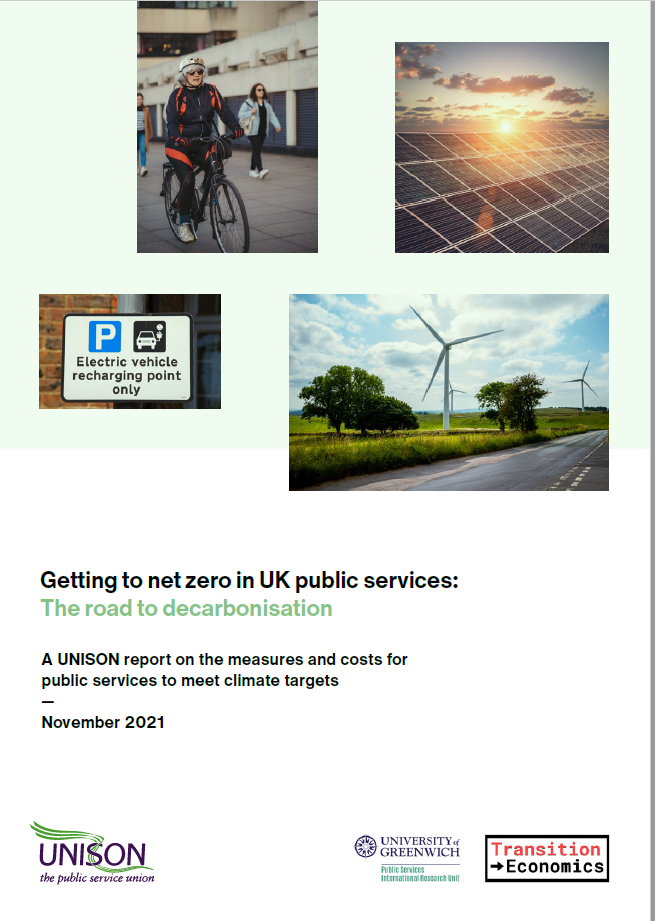
Getting to Net Zero in UK Public Services: The Road to Decarbonisation

By Dr. Vera Weghmann, et. al. - Unison, November 2021

Public services as a whole (excluding transport) represent about 8% of the UK’s direct greenhouse gas emissions. The NHS alone represents about 4% of the UK’s emissions. When procurement, construction, and social housing are taken into account, public services’ impacts are much greater.

Different sectors within the overall framework of public services have declared their decarbonisation plans. Some are ahead of the national targets. The NHS has declared that it will reach net zero by 2040, with an ambition to reach an 80% reduction by 2028 to 2032. More than one-third of local authorities (single- and upper-tier) committed themselves to decarbonise their local area by or before 2030.

The government aims to reduce direct emissions from public sector buildings by 75% against a 2017 baseline by the end of the Sixth Carbon Budget.

This report identified 21 different measures that should be taken across buildings, transport, electricity generation, waste, procurement and land use along with costed measures for each of nine different public services.

In our analysis, the UK’s public services need a capital investment injection of over £140 billion to 2035 to meet their Net Zero obligations. This will set the public sector on track to meet their climate targets and contribute to the UK’s overall carbon reduction aims. The analysis also identified measures that required annual operational expenditures of £1 billion to hit net zero targets. UNISON fully advocates that quality public services are best delivered by public ownership of public services and utilities rather than privatisation, outsourcing or PFI contracting of public services.

As well as improving the quality of life for service users, workers and the wider community, a number of the measures will also result in significant savings to public services’ budgets, through lower energy bills, cheaper to run fleets, and procurement savings. UNISON fully advocates that quality public services are best delivered by public ownership of public services and utilities rather than privatisation, outsourcing or PFI contracting of public services.

Read the text (PDF).

Report on Canada’s low carbon future makes recommendations for community and worker transitions

By Elizabeth Perry - Work and Climate Change Report, November 1, 2021

 A new report from the Canadian Institute for Climate Choices analyzes the trends in the global transition to a low carbon economy, and warns that 800,000 Canadian jobs could be at risk if we fail to support strategic industries. The report states that Canada is particularly vulnerable to market disruptions because over 70 per cent of our goods exports and over 60 per cent of foreign direct investment in Canada are in vulnerable sectors – not only fossil fuels, but also such as auto parts and vehicles, minerals, and energy intensive industries such as steel and aluminum.

The report, Sink or Swim: : Transforming Canada’s economy for a global low-carbon future is a business analysis with the overall message that transition offers opportunity, and Canada needs to act more quickly to “catch the wave”. Besides examining the benefits and sectors of opportunity in the low carbon transition, the the report includes a recommendation to: “Develop local and people-focused transition plans that drive new areas of job creation, improve the resilience of the workforce and empower Indigenous economic leadership.” More specifically, the report concludes with : “ Federal, provincial, territorial, municipal, and Indigenous governments should work together to develop detailed transition plans to support workers and communities and improve overall well-being. Transition plans should aim to attract new sources of growth and jobs, support worker transition and skill development, improve youth education outcomes and readiness, ensure alignment with Sustainable Development Goals, and empower Indigenous economic leadership.”

The Sink or Swim discussion starts from a fundamental statement that “achieving success is also about more than supporting affected workers in transition-vulnerable companies or sectors. Success will come from generating strong and inclusive economic growth that improves the wellbeing of all Canadians.” The ensuing discussion recognizes that multinational companies have weak connections and relationships to local communities, making them more likely to relocate than to re-invest. Using census data, it identifies 55 communities of 10,000 people or more that have more than 3% of their workforce employed in transition-vulnerable sectors, highlighting the Wood Buffalo area in the oil sands of Alberta, and Thompson Manitoba, a nickel-mining community. The report offers recommendations for communities, focusing on the critical areas of infrastructure investment, financing, and the need for local capacity to analyze labour markets and financial opportunities– using the examples of the InvestEU advisory hub and the Colorado Office of Just Transition.

Regarding workers, the report documents the increased vulnerability of youth, minorities, and especially Indigenous workers. It sees the solution for all as improved education and training opportunities – describing programs in B.C. , the North, and for Indigenous workers. The report also states: “all post-secondary education programs—including trades, engineering, science, economics, and business—can support transition success by incorporating future skills and knowledge needs into their curricula and programming.” 

New Nova Scotia legislation enshrines climate goals, with principles of equity and Mi’kmaq concept of Netukulimk

By Elizabeth Perry - Work and Climate Change Report, November 1, 2021

Nova Scotia’s Minister of Environment introduced the Environmental Goals and Climate Change Reduction Act to the Legislature on October 27 – the press release is here. It builds on a previous Bill which was never enacted, with the important distinction that the EGCCRAct enshrines climate action goals and timelines into law. The new legislation follows a public consultation in 2021, and is built on four principles: equity, sustainable development, a circular economy, and “Netukulimk” (a Mi’kmaq word defined as “the use of the natural bounty provided by the Creator for the self-support and well-being of the individual and the community by achieving adequate standards of community nutrition and economic well-being without jeopardizing the integrity, diversity or productivity of the environment”).

The specific goals include: reducing total GHG emissions to at least 53% below 2005 levels by 2030; ensuring at least 30% of new passenger vehicles are zero-emissions by 2030;a requirement that any new build or major retrofit in government buildings, including schools and hospitals, that enters the planning stage after 2022, be net-zero energy performance and climate resilient; decrease greenhouse gas emissions across Government-owned buildings by 75% by the year 2035; phase out of coal-fired electricity generation by 2030, with 80% of electricity supplied by renewable energy by 2030. The problematic issue of forestry policy is finally addressed with a deadline of 2023 to implement the ecological forestry approach for Crown lands, as recommended in the 2018 Lahey report, “An Independent Review of Forest Practices in Nova Scotia”.

Regarding equity, the government will “ initiate in 2022 ongoing work with racialized and marginalized communities to create a sustained funding opportunity for climate change action and support for community-based solutions and policy engagement.” The legislation mandates a Sustainable Communities Challenge Fund to be established.

The Act mandates a a Strategic Plan titled “Climate Change Plan for Clean Growth” to be tabled by December 31, 2022, with annual progress reports and a complete review in 5 years.

Reaction to the legislation, with a goal-by-goal analysis is available from Nova Scotia’s Ecology Action Centre, is here . One of the sector- specific pieces is a call for an end to oil and gas production and a Just Transition for workers . Despite the fact that there is currently no oil and gas production in Nova Scotia, the EAC highlights the danger that the Canada-Nova Scotia Offshore Petroleum Board (CNSOPB) issued a call for bids in May 2021.

Pages

The Fine Print I:

Disclaimer: The views expressed on this site are not the official position of the IWW (or even the IWW’s EUC) unless otherwise indicated and do not necessarily represent the views of anyone but the author’s, nor should it be assumed that any of these authors automatically support the IWW or endorse any of its positions.

Further: the inclusion of a link on our site (other than the link to the main IWW site) does not imply endorsement by or an alliance with the IWW. These sites have been chosen by our members due to their perceived relevance to the IWW EUC and are included here for informational purposes only. If you have any suggestions or comments on any of the links included (or not included) above, please contact us.

The Fine Print II:

Fair Use Notice: The material on this site is provided for educational and informational purposes. It may contain copyrighted material the use of which has not always been specifically authorized by the copyright owner. It is being made available in an effort to advance the understanding of scientific, environmental, economic, social justice and human rights issues etc.

It is believed that this constitutes a 'fair use' of any such copyrighted material as provided for in section 107 of the US Copyright Law. In accordance with Title 17 U.S.C. Section 107, the material on this site is distributed without profit to those who have an interest in using the included information for research and educational purposes. If you wish to use copyrighted material from this site for purposes of your own that go beyond 'fair use', you must obtain permission from the copyright owner. The information on this site does not constitute legal or technical advice.
